\[ I \da \int_\RR {\cos(x) \over x+i}\dx .\]
Solution
Since \(x+i\) is not real, \({\cos(x) \over x+i}\neq \Re\qty{e^{ix}\over x+i}\). Use \(\cos(z) = {1\over 2}(e^{iz} + e^{-iz})\) to decompose into two integrals: \[ I \da \int_\RR {\cos(x) \over x+i}\dx = \int_\RR f_1 + \int_\RR f_2, \qquad f_1(z)\da{e^{iz} \over 2(z+i)},\quad f_2(z)\da{e^{-iz} \over 2(z+i)} .\] Both are \(e^{\pm iz}g(z)\) with \(g(z)={1\over 2(z+i)}\to0\) as \(\abs z\to\infty\), so Jordan’s lemma applies on semicircles: for \(e^{i\alpha z}\) with \(\alpha>0\) on the upper half-plane (for \(f_1\)), and with \(\alpha<0\) on the lower half-plane (for \(f_2\)). For \(f_1\), use the upper contour:
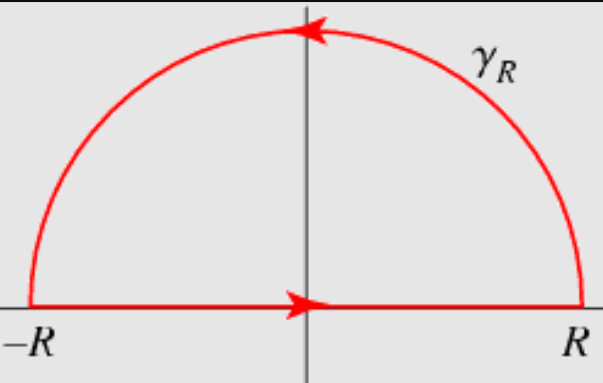
By Jordan’s lemma the arc integral tends to \(0\), so \(\int_\RR f_1\) is \(2\pi i\) times the sum of the residues of \(f_1\) in \(\HH\). The only pole of \(f_1\) is \(z=-i\notin\HH\), so \(\int_\RR f_1=0\) and \(I=\int_\RR f_2\). For \(f_2\), use the lower contour:
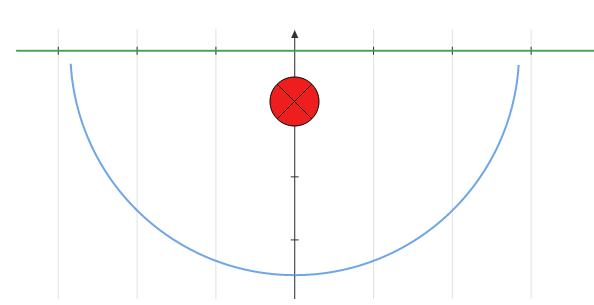
With counterclockwise orientation, the real axis is traversed from \(R\) to \(-R\), so the piece along \(\RR\) converges to \(-\int_\RR f_2=-I\). By Jordan’s lemma the arc integral tends to \(0\), so \[ -I &= 2\pi i \Res_{z=-i} {e^{-iz}\over 2(z+i)} \\ &= 2\pi i \cdot{e^{-i(-i)}\over 2} \\ &= \pi i \inverseof{e} ,\] so \[ I = -{i\pi \over e} .\]