\[ I \da \int_0^1 {1\over \sqrt{x^2-1}}\dx = {i\pi \over 2} .\]
Solution
On \((0,1)\) the radicand is negative, so \(\sqrt{x^2-1}=\pm i\sqrt{1-x^2}\) and the value of \(I\) depends on the branch. The stated value holds for \(\sqrt{x^2-1}=-i\sqrt{1-x^2}\); the other branch gives \(-i\pi/2\). Put \(J\da\int_{-1}^1{dx\over\sqrt{1-x^2}}\).
1. Let \(g(z)\da\sqrt{z-1}\,\sqrt{z+1}\) with principal square roots. Then \(g\) is holomorphic on \(\CC\setminus[-1,1]\), and for \(-1<x<1\) its boundary values are \(g(x+i0)=i\sqrt{1-x^2}\) from above and \(g(x-i0)=-i\sqrt{1-x^2}\) from below.
Each factor is holomorphic off its cut, \((-\infty,1]\) and \((-\infty,-1]\) respectively. On \((-\infty,-1)\) both factors change sign across the real axis, so their product is continuous there and extends holomorphically across it. For \(-1<x<1\), \(\sqrt{x+1}\) is continuous and positive, while \(\sqrt{x-1\pm i0}=\pm i\sqrt{1-x}\).
2. \(\oint_{\abs z=2}{dz\over g(z)}=2\pi i\).
For \(\abs z>1\), \(g(z)=z\sqrt{1-z^{-2}}\) with the principal branch, since both sides are holomorphic there, square to \(z^2-1\), and are asymptotic to \(z\) as \(z\to+\infty\) along the real axis. So \(1/g(z)=z^{-1}\qty{1+\tfrac12z^{-2}+\cdots}\) on \(\abs z>1\), and only the term \(z^{-1}\) contributes to the integral.
3. \(\oint_{\abs z=2}{dz\over g(z)}=2iJ\).
Let \(\Gamma_\eps\) be the dogbone contour around the slit, oriented counterclockwise: the upper edge from \(1\) to \(-1\), the lower edge from \(-1\) to \(1\), and circles of radius \(\eps\) about \(\pm1\).
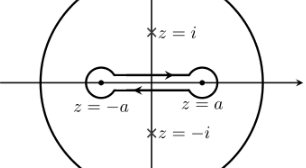
By Cauchy’s theorem on the region between them, \(\Gamma_\eps\) and \(\abs z=2\) give the same integral. On the circle about \(\pm1\), \(\abs{z^2-1}=\eps\abs{z\pm1}\ge\eps(2-\eps)\ge\eps\) for \(\eps<1\), so that circle contributes at most \(2\pi\eps\cdot\eps^{-1/2}\to0\). By step 1 the edges contribute, as \(\eps\to0\), \[ \int_1^{-1}{dx\over i\sqrt{1-x^2}}+\int_{-1}^1{dx\over -i\sqrt{1-x^2}} =\qty{-{1\over i}-{1\over i}}J=2iJ .\]
4. Q.E.D.
Steps 2 and 3 give \(J=\pi\). The integrand \(1/\sqrt{1-x^2}\) is even, so with \(\sqrt{x^2-1}=-i\sqrt{1-x^2}\), \[ I=\int_0^1{dx\over -i\sqrt{1-x^2}}=i\cdot{J\over2}={i\pi\over2} .\]