\[ I \da \int_0^\infty {\log(x) \over 1+x^2}\dx = 0 .\]
Solution
The integrand \(1/(1+x^2)\) is even, so the negative real axis contributes \(I\) plus a multiple of \(\int_0^\infty dx/(1+x^2)\). Take a branch cut for \(\log\) along \(\theta = -\pi/2\) and the upper semicircle of radius \(R\) indented at \(0\) by a semicircle of radius \(\eps\):
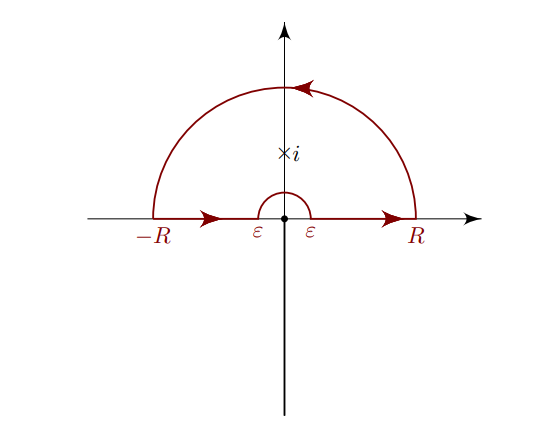
For \(f(z) \da {\log(z) \over z^2 + 1}\), the large arc contributes \(O\qty{(\log R)/R}\) and the small arc \(O\qty{\eps\abs{\log\eps}}\), so only the horizontal contours contribute as \(R\to \infty\) and \(\eps\to 0\). Parameterize, oriented counterclockwise:
- \(\gamma_1 \da \ts{t+0i \st t\in [\eps, R]}\)
- \(\gamma_2 \da \ts{t+0i \st t\in [-\eps, -R]}\)
Then \(\int_{\gamma_1} f(z)\dz \to I\). Computing the contribution from \(\gamma_2\): \[ \int_{\gamma_2} f(z) \dz &= \int_{-R}^{-\eps} f(t) \dt \qquad z=t+0i, \dz=\dt \\ &= \int_{-R}^{-\eps} {\log(t) \over t^2 + 1}\dt \\ &= -\int_{R}^{\eps} {\log(-x) \over (-x)^2 + 1 }\dx \qquad t=-x, \dt = -\dx \\ &= \int_{\eps}^{R} {\log(x) + i\pi \over x^2 + 1 }\dx \\ &= I + i\pi \cdot {\pi \over 2} \\ &= I + {i\pi^2\over 2} ,\] using the known antiderivative \(\arctan\).
Note that there are two simple poles at \(\pm i\), so only the residue at \(z_0=i\) contributes: \[ \Res_{z=i} = \lim_{z\to i} {\log(z) \over (z+i)} = {\log(i) \over 2i} = {i\pi/2 \over 2i} = {\pi \over 4} ,\] so by the residue theorem, \[ 2\pi i \Res_{z=i}f(z) = \lim\int_{\Gamma}f(z) \dz = \lim\qty{ \int_{\gamma_1} + \int_{\gamma_2}}f = 2I + {i\pi^2 \over 2} \\ \implies 2\pi i \cdot {\pi \over 4} = 2I + {i\pi^2\over 2} \\ \implies {i\pi^2\over 2} = 2I + {i\pi^2\over 2} \\ \implies I = 0 .\]