Let \(\lambda = {1\over 2}\qty{1 + i \sqrt{3}}\) and find a map \[ R \da \ts{\abs{z - \lambda} < 1} \intersect \ts{\abs{z-\bar{\lambda}} < 1 } \too \DD .\]
Solution
Let \(C_1=\theset{\abs{z-\lambda}=1}\) and \(C_2=\theset{\abs{z-\bar\lambda}=1}\). Since \(\abs\lambda=\abs{1-\lambda}=1\), both circles pass through \(0\) and \(1\), and \(R\) is the lens between them:
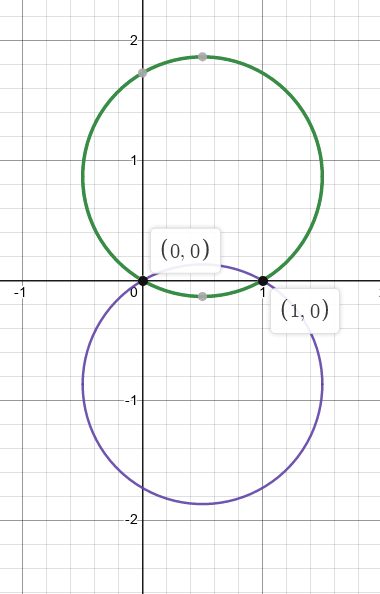
Send the vertices \(0\) and \(1\) of the lens to \(0\) and \(\infty\) with \[ f(z) \da {z\over 1-z} .\]
\[ f(R) = \ts{z\st -\theta_0 < \Arg(z) < \theta_0 },\qquad \theta_0 \da {\pi \over 6} .\]
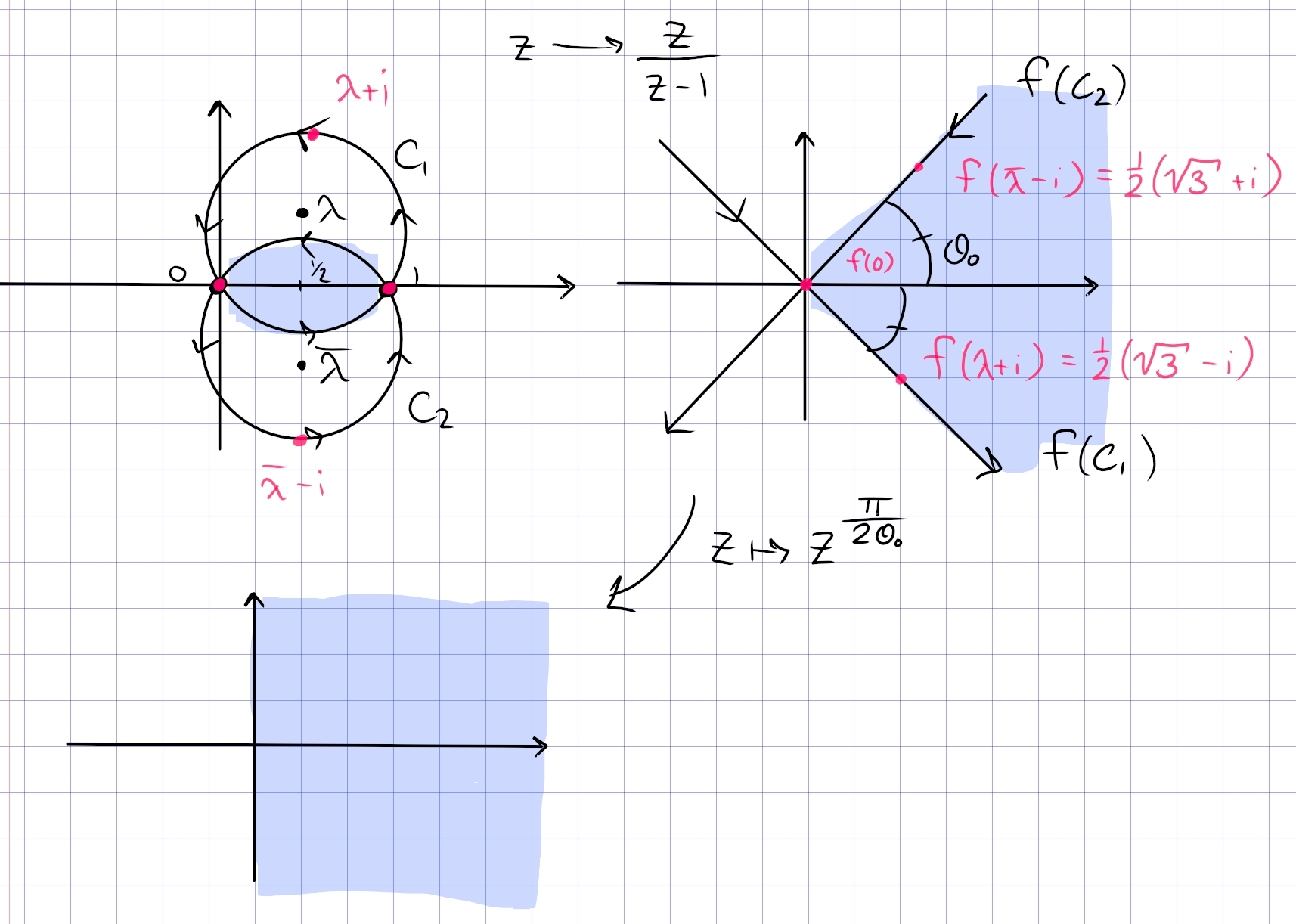
The figure is labelled \(z\mapsto{z\over z-1}\); the sector it shows is the image under \(f(z)={z\over1-z}=-{z\over z-1}\).
(of claim)
Since \(C_1\) and \(C_2\) pass through \(0\) and \(1\), their images pass through \(f(0)=0\) and \(f(1)=\infty\), so they are lines through the origin.
The point \(z_0=i\sqrt3\) lies on \(C_1\), since \(\abs{i\sqrt3-\lambda}^2={1\over4}+{3\over4}=1\), and \[ f(z_0) = {i\sqrt 3 \over 1-i\sqrt 3} = {i\sqrt3(1+i\sqrt3)\over4} = {1\over 4}\qty{-3+i\sqrt 3} ,\] which has argument \(5\pi/6\). So \(f(C_1)\) is the line through \(0\) in the directions \(5\pi/6\) and \(-\pi/6\). Similarly \(z_1=-i\sqrt3\in C_2\) and \(f(z_1)={1\over4}\qty{-3-i\sqrt3}\), so \(f(C_2)\) is the line through \(0\) in the directions \(-5\pi/6\) and \(\pi/6\).
The two lines divide \(\CC\setminus\theset{0}\) into four open sectors, and \(f(R)\) is one of them, being connected with boundary in the two lines. Since \({1\over2}\in R\) and \(f\qty{1\over2}=1\), \(f(R)\) is the sector containing \(1\), which is \(\abs{\Arg z}<\pi/6\).
From here we map to the disc in the following steps:
- \(z\mapsto {z\over 1-z}\) sends \(R\) to \(\abs{\Arg(z)} < \theta_0\).
- \(z\mapsto z^{\pi \over 2\theta_0}=z^3\) maps \(\abs{\Arg(z)}<\theta_0\) onto \(\abs{\Arg(z)} < {\pi \over 2}\), the right half-plane.
- \(z\mapsto iz\) rotates the right half-plane onto \(\HH\).
- \(z\mapsto {z-i\over z+i}\) maps \(\HH\) onto \(\DD\).
The composite is \[ F(z)={i\qty{z\over1-z}^3-i\over i\qty{z\over1-z}^3+i}={z^3-(1-z)^3\over z^3+(1-z)^3} .\]