Find a conformal map
from \(\{ z: |z - 1/2| > 1/2, \text{Re}(z)>0 \}\) to \(\mathbb H\)
from \(\{ z: |z - 1/2| > 1/2, |z| <1 \}\) to \(\mathbb D\)
from the intersection of the disk \(|z + i| < \sqrt{2}\) with \({\mathbb H}\) to \({\mathbb D}\).
from \({\mathbb D} \backslash [a, 1)\) to \({\mathbb D} \backslash [0, 1)\) (\(0<a<1)\).
Short solution possible using Blaschke factors.
from \(\{ z: |z| < 1, \text{Re}(z) > 0 \} \backslash (0, 1/2]\) to \(\mathbb H\).
Solution
Part 1. The region is bounded by \(i\RR\) and the circle \(S=\theset{\abs{z-1/2}=1/2}\), which meet at \(0\) and \(\infty\). Let \(f(z)=1/z\) and write \(z=x+iy\). Then \(\Re f(z)=x/\abs z^2\), so \(\Re z>0\) if and only if \(\Re f(z)>0\), and \[ \abs{z-1/2}>1/2 \iff x^2+y^2>x \iff \Re f(z)<1 .\] So \(f\) maps the region onto the strip \(0<\Re(w)<1\):
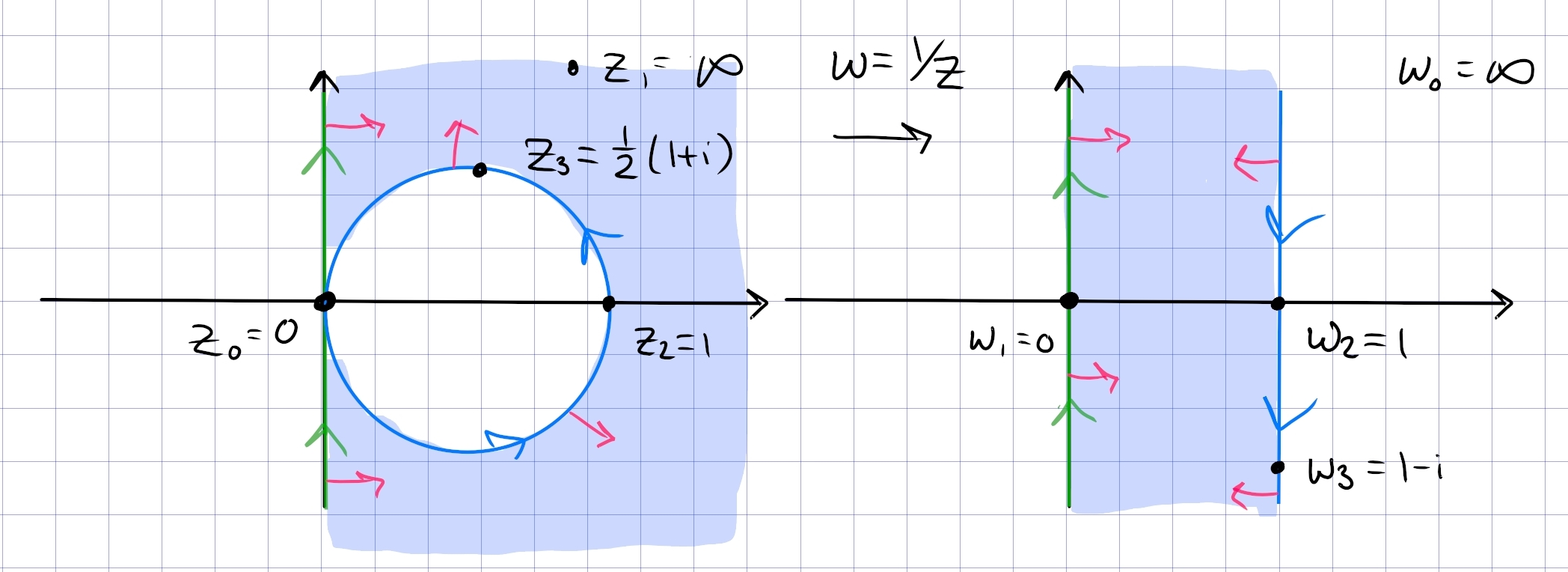
The remaining steps are:
Dilate and rotate to \(0<\Im(w) < \pi\) using \(w\mapsto i\pi w\).
Exponentiate using \(w\mapsto e^w\) to get \(\HH\).
The composite is \(z\mapsto e^{i\pi/z}\).
Part 2. The region is a lune with vertex \(1\), where the circles \(\abs z=1\) and \(\abs{z-1/2}=1/2\) are tangent. Send \(1\to \infty\) with \(f(z) \da {1\over z-1}\). For \(z=x+iy\), \[ \Re f(z)={x-1\over\abs{z-1}^2}, \qquad \Re f(z)>-1\iff x^2+y^2>x, \qquad \Re f(z)<-{1\over2}\iff x^2+y^2<1 ,\] so \(f\) maps the region onto the strip \(-1<\Re(w) < -{1\over 2}\). For instance
\({1\over 2}(1+i) \mapsto -(1+i)\)
\(0\mapsto -1\)
\(i\mapsto -{1\over 2}(1+i)\)
\(-1\mapsto -{1\over 2}\)
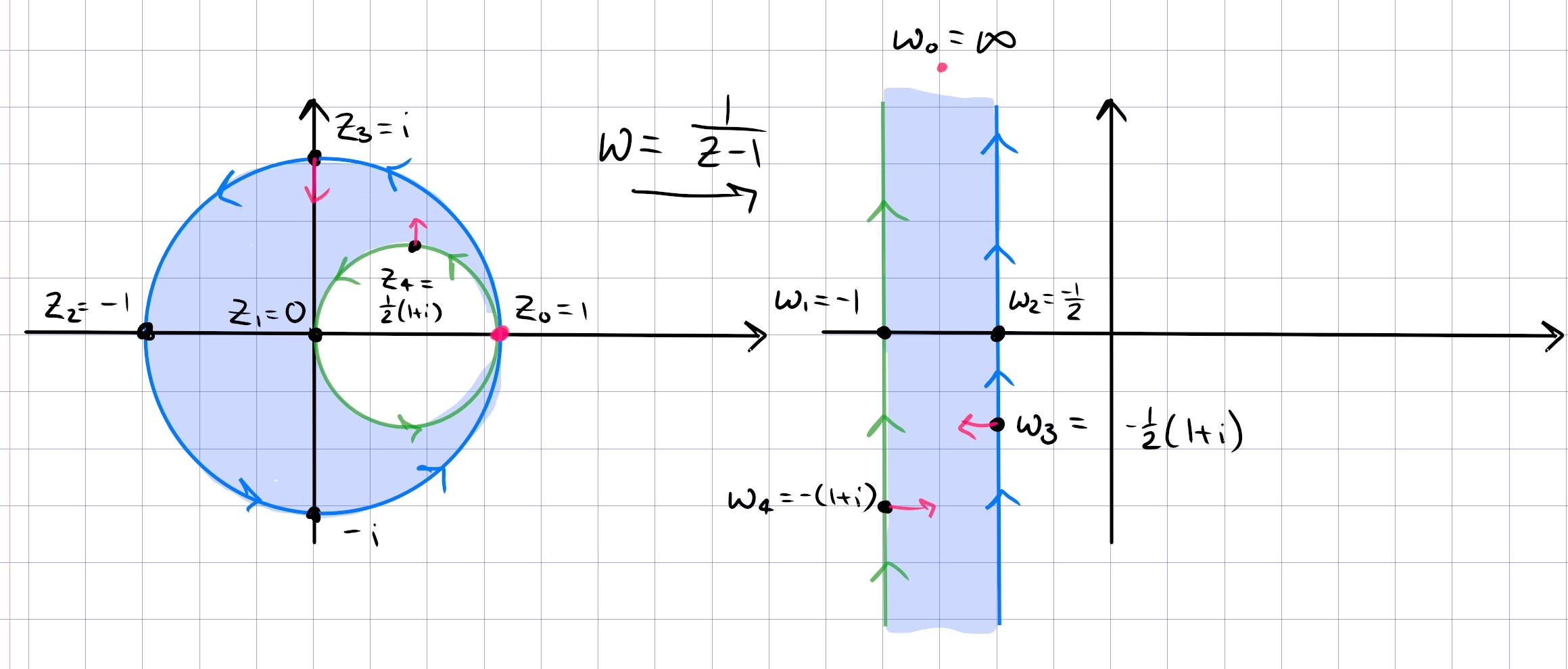
The remaining steps are:
Translate by \(w\mapsto w+{1\over 2}\) to get \(-{1\over 2}<\Re(w) < 0\).
Rotate and dilate by \(w\mapsto -2i\pi w\) to get \(0<\Im(w) < \pi\).
Exponentiate by \(w\mapsto e^w\) to get \(\HH\).
Apply the Cayley map \(w\mapsto {w-i\over w+i}\) to get \(\DD\).
Part 3. The circle \(\abs{z+i}=\sqrt2\) passes through \(\pm1\) and meets \(i\RR\) in \(\HH\) at \(z_3 \da i(\sqrt{2} - 1)\), so the region is a lune with vertices \(\pm 1\) bounded by \((-1,1)\) and the arc through \(z_3\). Take \(f(z)={z+1\over z-1}\), so that
\(-1\mapsto 0\)
\(1\mapsto \infty\)
\(0\mapsto -1\)
\(z_3\mapsto w_0\) where \(\arg(w_0) = -3\pi/4\)
Let \(z_3 = ic\) where \(c\da \sqrt{2} -1\), then \[ f(z_3) &= -{1+z_3\over 1-z_3} \\ &= -{1+ic \over 1-ic} \\ &= -{(1+ic)^2 \over 1+c^2} \\ &= -\qty{ {1-c^2 \over 1+c^2} + i{2c\over 1+c^2} } .\] Now \(c^2 = 3-2\sqrt 2\) and \(1-c^2 = -2+2\sqrt{2}\), so \[ { 2c\over 1-c^2} = {2(\sqrt 2 - 1) \over -2 + 2\sqrt 2 } = 1 ,\] so the argument is \(\arctan(1) = { \pi \over 4}\) or \(-{3\pi \over 4}\). Since \(1-c^2>0\) and \(2c>0\), the negative sign places \(f(z_3)\) in the third quadrant, so the argument is \(-{3\pi \over 4}\).
The segment \((-1,1)\) maps onto the negative real axis, and the arc through \(z_3\) maps onto the ray from \(0\) through \(w_0\). The image of the region is the sector between these rays containing \(f(0.2i)=(-0.96-0.4i)/1.04\), namely \(-\pi<\Arg(w)<-3\pi/4\):
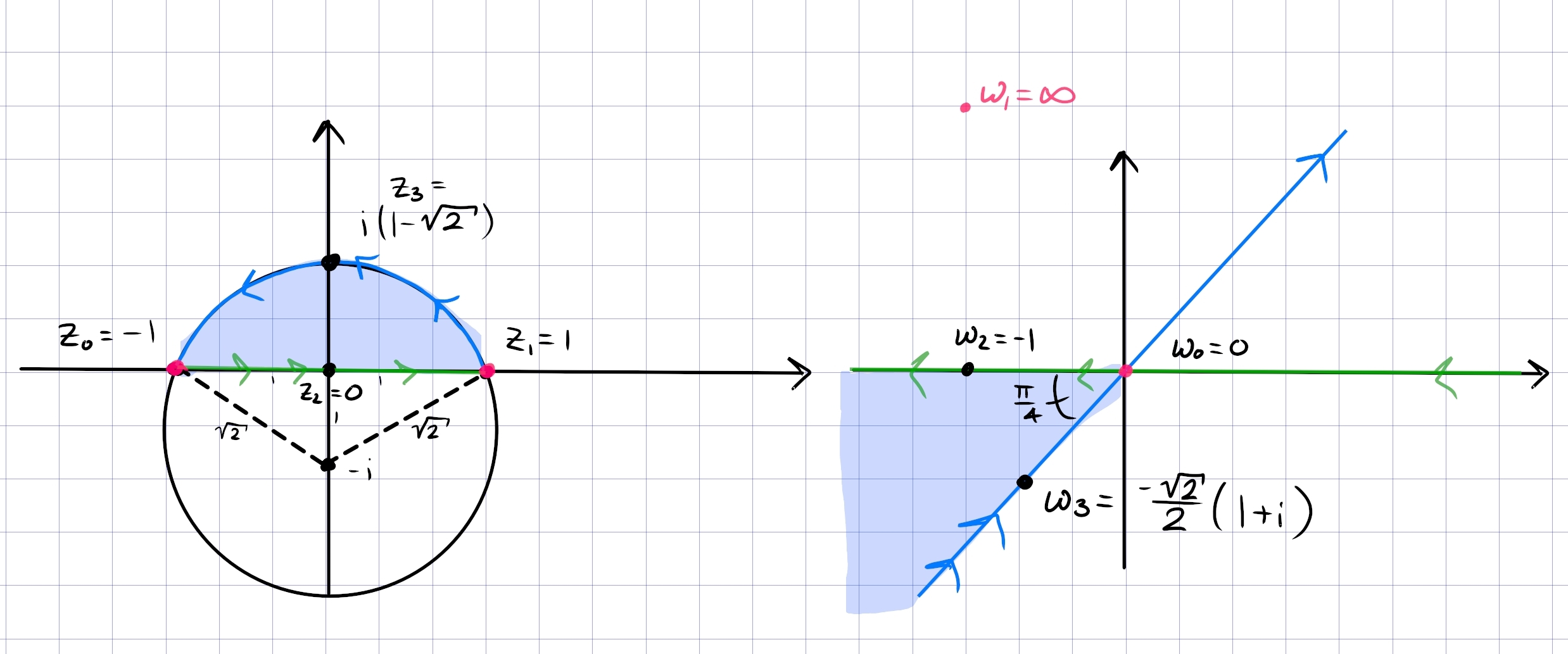
Now
Flip this with \(w\mapsto -w\) to get \(0<\Arg(w) < \pi/4\).
Rotate clockwise with \(w\mapsto e^{-i\pi/8}w\) to get \(-\pi/8<\Arg(w) < \pi/8\).
Dilate the argument to a half-plane with \(w\mapsto w^{\pi/(2\theta_0)}=w^4\), where \(\theta_0 = \pi/8\), to get \(-\pi/2<\Arg(w) < \pi/2\).
Rotate with \(w\mapsto iw\) to get \(\HH\).
Apply the Cayley map \(w\mapsto {w-i\over w+i}\).
Part 4. The Blaschke-type map \[ \varphi(z)={z-a\over1-az} \] is an automorphism of \(\DD\) since \(a\in(0,1)\) is real. It maps \(\RR\) to \(\RR\), is increasing on \((-1,1)\) since \(\varphi'(x)=(1-a^2)/(1-ax)^2>0\), and satisfies \(\varphi(a)=0\) and \(\varphi(1)=1\). So \(\varphi([a,1))=[0,1)\) and \(\varphi\) maps \(\DD\setminus[a,1)\) onto \(\DD\setminus[0,1)\).
Part 5. Let \(U\) be the region.
The squaring map \(z\mapsto z^2\) sends the right half-disk \(\theset{\abs z<1,\ \Re z>0}\) bijectively onto \(\DD\setminus(-1,0]\), and sends the slit \((0,1/2]\) onto \((0,1/4]\). So it maps \(U\) onto \(\DD\setminus(-1,1/4]\).
As in Part 4, \(z\mapsto {z-1/4\over1-z/4}\) is an automorphism of \(\DD\), increasing on \((-1,1)\), with \(-1\mapsto-1\) and \(1/4\mapsto0\). It maps \(\DD\setminus(-1,1/4]\) onto \(\DD\setminus(-1,0]\).
The map \(z\mapsto -z\) gives \(\DD\setminus[0,1)\).
The branch of \(z\mapsto z^{1/2}\) with argument in \((0,\pi)\) maps \(\DD\setminus[0,1)\) onto the upper half-disk \(\DD\intersect\HH\).
The map \(z\mapsto -{1\over2}\qty{z+\inverseof{z}}\) sends \(\DD\intersect\HH\) onto \(\HH\), as in E-FCTXH.