\[ I\da \int_\RR {x\over (x^2 + 4x+13)^2}\dx .\]
Solution
Write the integrand as \(f\).
\(f\in \bigo\qty{1\over z^{3}} \subseteq \bigo\qty{1\over z^{1+\eps}}\) means that a semicircular contour will work:
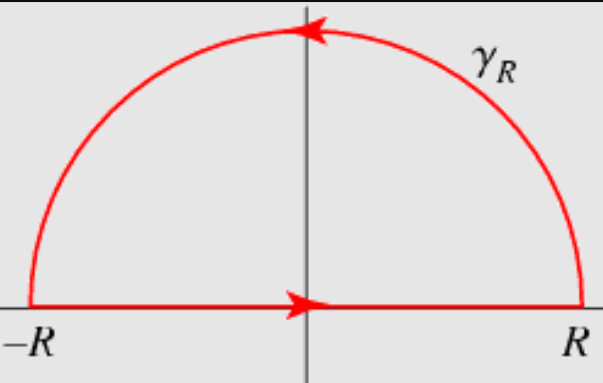
(Of integrand decay)
A quick justification: for \(R>1\), if \(n>k\) then \(\abs{z}^n > \abs{z}^k\), so using the reverse triangle inequality, \[ \abs{z\over (z^2 + 4z + 13)^2} &= \abs{z\over z^4 + 8z^3 + 42z^2 + 104z + 169}\\ &\leq \abs{z\over \abs{z}^4 - 8\abs{z}^3 - 42\abs{z}^2 - 104\abs{z} - 169}\\ &\leq \abs{z\over \abs{z}^4 - 8\abs{z}^4 - 42\abs{z}^4 - 104\abs{z}^4 - 169\abs{z}^4}\\ &= \abs{z\over \abs{z}^4( 1 - 8 - 42 - 104 - 169)}\\ &= 322 {\abs{z} \over \abs{z}^4} \\ &= 322 \abs{z}^{-3} \\ &= 322 R^{-3} \to 0 \text{ as } R\to\infty .\]
Factor the denominator: \[ x^2 + 4x + 13 = 0 &\implies x^2 + 4x + \qty{4\over 2}^2 = -13 + \qty{4\over 2}^2 \\ &\implies (x+2)^2 = -9 \\ &\implies x = -2 \pm 3i ,\] one of which is in \(\HH\). Write these as \[ z_1 \da -2+3i && z_2 \da -2 - 3i .\]
So let \(\Gamma\) be comprised of
- \(C_1 = [-R,R]\),
- \(C_2 = \ts{Re^{it} \st t\in [0, \pi]}\),
- \(\Gamma = C_1 + C_2\), then \[ 2\pi i \sum_{z_k\in \HH} \Res_{z=z_k}f(z) = \int_\Gamma f = \qty{\int_{C_1} + \int_{C_2}}f ,\] where \(\int_{C_2} f\to 0\) and \(\int_{C_1} f\to I\). So in the limit, \(I = 2\pi i \Res_{z=z_1} f(z)\). Computing this residue: note \(z_1\) is a pole of order 2, so \[ \Res_{z=z_1} &= \lim_{z\to z_1} \dd{}{z} (z-z_1)^2f(z) &= \lim_{z\to z_1} \dd{}{z} {z \over (z-z_2)^2} \\ &= \lim_{z\to z_1} { (z-z_2)^2 - 2z(z-z_2 ) \over (z-z_2)^4} \\ &= \lim_{z\to z_1} { (z-z_2) - 2z \over (z-z_2)^3} \\ &= \lim_{z\to z_1} -{ z+z_2 \over (z-z_2)^3} \\ &= - {z_1 + z_2 \over (z_1 - z_2)^2}\\ &= - {z_1 + \bar{z_1} \over (z_1 - \bar{z_1} )^2}\\ &= - {2\Re(z_1) \over (2i\Im(z_1))^3} \\ &= - {2\cdot (-2) \over (2i\cdot 3) ^3} \\ &= {4\over 2^3 \cdot 3^3 \cdot i^3} \\ &= {-i \over 2 \cdot 3^3 i^2} \\ &= {i\over 54} ,\] so \[ I = 2\pi i \cdot {i\over 54} = -{\pi \over 27} .\]