\[ I\da \int_\RR {1\over x^2 + 3x+ 2 }\dx .\]
Solution
Note that \(f(x) = (x+2)(x+1)\), so the singularities on on \(\RR_{< 0}\).Phantom log trick. The function isn’t even, so a semicircular contour won’t work. Attempting to find a ray-like symmetry only yields one option: \[ f(z) = f(e^{i\theta } z) \implies \theta = 2k\pi ,\] which suggests a keyhole. But since there’s no \(\log\) in \(f\), there’s no monodromy, and the contributions cancel out. So introduce a log with a branch cut along \(\theta = 0\), and consider \[ \int f(z) \log(z) .\]
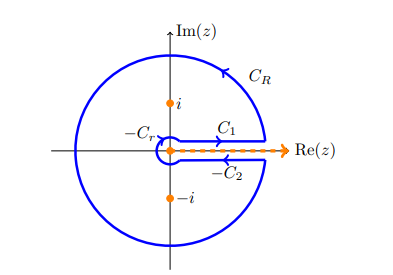
Let \(\gamma_+ = \ts{t + i\eps \st t\geq 0}\) (right-to left) and \(\gamma_0 = \ts{t-i\eps \st t\geq 0}\) (left-to-right). Now use the general fact \[ \int_{\gamma_+}f(z)\log(z) \dz &= \int_\eps^R f(t+i\eps)\log(t+i\eps) \dt \too \int_\RR f(t)\log(t)\dt \\ \int_{\gamma_-}f(z)\log(z) \dz &= \int_R^\eps f(t-i\eps)\log(t-i\eps) \dt \too -\int_\RR f(t)\qty{ \log(t) + 2\pi i} \dt \\ ,\] thus \[ \int_{\gamma_+}f(z)\log(z)\dz + \int_{\gamma_-}f(z)\log(z) &\too \int_0^\infty f(t)\log(t)\dt - \int_0^\infty f(t)(\log(t) + 2\pi i) \dt \\ &= -2\pi i \int_0^\infty f(t) \dt .\]
By the ML estimate, the semicircular piece vanishes. Since \(\lim_{x\to 0}{ x\log(x) \over x^n+c} = 0\) for any \(c>0\) and \(n\geq 1\), the inner indented pieces goes to zero. Parameterize by \(z= \eps e^{it}\) \[ \int_{C_\eps} f(z)\log(z)\dz &\approx \int_{\eps}^{2\pi - \eps} {\log(\eps e^{it}) \over \eps^2 + 3\eps + 2} \eps e^{it}\dt \\ &= \int_{\eps}^{2\pi - \eps} {\log(\eps) + it \over \eps^2 + 3\eps + 2} \eps e^{it}\dt \\ &\approx \int_\eps^{2\pi - \eps} {\eps \log(\eps) + c_1 \over \eps^2 + c_2}\dt \\ &\convergesto{\eps\to 0} 0 ,\] where the displayed approximations omit factors \(e^{it}\) of modulus one. By the residue theorem, \[ 2\pi i \sum_{z_k\in \CC} \Res_{z=z_k} f(z)\log(z) = \int_\Gamma f(z)\log(z)\dz = -2\pi i\int_\RR f(z)\dz .\] There are just two simple poles at \(z_1 = -1, z_2 = -2\), so For \(z_1\): \[ \Res_{z=-1}{\log(z) \over (z+1)(z+2)} = \lim_{z\to -1} {\log(z) \over z+2} = \log(-1) ,\] and for \(z_2\), \[ \Res_{z=-2}{\log(z) \over (z+1)(z+2)} = \lim_{z\to -2} {\log(z) \over z+1} = -\log(-2) .\]
Thus \[ I &= -(\log(-1) - \log(-2)) \\ &= - (\ln(1) + i\pi) + (\ln(2) + i\pi) \\ &= \ln(2) ,\] noting that we’ve chosen a branch of \(\log(z) \da \ln\qty{\abs{z}} + i\Arg(z)\) where \(\Arg(z) \in (0, 2\pi)\).