- Consider the Fibonacci numbers \(\{ F _ { n } \} _ { n = 0 } ^ { \infty }\) , defined by the two initial values \(F _ { 0 } = 0 , F _ { 1 } = 1\) and the recursion relation
\[ F _ {n} = F _ {n - 1} + F _ {n - 2} \quad \mathrm{for} n \geq 2. \]
- Consider the generating function \(\textstyle F ( x ) = \sum _ { n = 0 } ^ { \infty } F _ { n } x ^ { n }\) associated to \(\{ F _ { n } \}\) , and prove that
\[ F (x) = x ^ {2} F (x) + x F (x) + x \]
for all x in a neighborhood of 0.
- Show that the polynomial \(q ( x ) = 1 - x - x ^ { 2 }\) can be factored as
\[ q (x) = (1 - \alpha x) (1 - \beta x), \]
where α and \(\beta\) are the roots of the polynomial \(p ( x ) = x ^ { 2 } - x - 1\)
- Expand the expression for F in partial fractions and obtain
\[ F (x) = \frac {x}{1 - x - x ^ {2}} = \frac {x}{(1 - \alpha x) (1 - \beta x)} = \frac {A}{1 - \alpha x} + \frac {B}{1 - \beta x}, \]
where \(A = 1 / ( \alpha - \beta )\) and \(B = 1 / ( \beta - \alpha )\)
- Conclude that \(F _ { n } = A \alpha ^ { n } + B \beta ^ { n }\) for \(n \geq 0\) . The two roots of \(p\) are actually
\[ \alpha = \frac {1 + \sqrt {5}}{2} \quad \mathrm{and} \quad \beta = \frac {1 - \sqrt {5}}{2}, \]
so that \(A = 1 / \sqrt { 5 }\) and \(B = - 1 / \sqrt { 5 } .\)
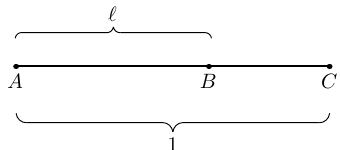
The number \(1 / \alpha = ( \sqrt { 5 } - 1 ) / 2\) , which is known as the golden mean, satisfies the following property: given a line segment \(\left[ A C \right]\) of unit length (Figure 2), there exists a unique point B on this segment so that the following proportion holds
\[ {\frac {A C}{A B}} = {\frac {A B}{B C}}. \]
If \(\ell = A B\) , this reduces to the equation \(\ell ^ { 2 } + \ell - 1 = 0\) , whose only positive solution is the golden mean. This ratio arises also in the construction of the regular pentagon. It has played a role in architecture and art, going back to the time of ancient Greece.
Solution
Let \[ F(x)=\sum_{n=0}^\infty F_nx^n. \] By induction \(0\le F_n\le 2^n\), so the series converges absolutely for \(|x|<1/2\). Using \(F_0=0\), \(F_1=1\), and \(F_n=F_{n-1}+F_{n-2}\) for \(n\ge2\), \[ \begin{aligned} F(x) &=x+\sum_{n=2}^\infty(F_{n-1}+F_{n-2})x^n\\ &=x+xF(x)+x^2F(x). \end{aligned} \] Therefore \[ F(x)=\frac{x}{1-x-x^2}. \]
Let \(\alpha,\beta\) be the roots of \(t^2-t-1\). Then \[ \alpha+\beta=1,\qquad \alpha\beta=-1, \] so \[ (1-\alpha x)(1-\beta x) =1-(\alpha+\beta)x+\alpha\beta x^2 =1-x-x^2. \]
Write \[ \frac{x}{(1-\alpha x)(1-\beta x)} =\frac{A}{1-\alpha x}+\frac{B}{1-\beta x}. \] Comparing numerators gives \[ A+B=0, \qquad -A\beta-B\alpha=1, \] so \[ A=\frac1{\alpha-\beta}, \qquad B=\frac1{\beta-\alpha}. \] Expanding both geometric series near \(0\), \[ F(x)=\sum_{n=0}^\infty(A\alpha^n+B\beta^n)x^n, \] and coefficient comparison yields \[ F_n=A\alpha^n+B\beta^n. \] Since \[ \alpha=\frac{1+\sqrt5}{2}, \qquad \beta=\frac{1-\sqrt5}{2}, \] we obtain Binet’s formula \[ \boxed{F_n=\frac{\alpha^n-\beta^n}{\sqrt5}}. \]