\[ I \da \int_0^\infty {1\over x^4 + 1 }\dx = {\pi \over 2\sqrt 2} .\]
Solution: Integrand symmetry
Note that the function is even, so \[ \int_{0^\infty} f(x) \dx = {1\over 2} \int_\RR f(x)\dx = {1\over 2} {\pi \over \sqrt 2} = {\pi \over 2 \sqrt 2} ,\] using the solution from a previous problem.
Solution: Sector
A sector will work, since there is a symmetry under \(z\to \zeta_4 z\) and \(f(z) \sim z^{-4}\), so the semicircular piece will vanish. Take the contour \(\Gamma\) comprised of
\(\gamma_1: \ts{t + 0i \st t\in [0, R]}\),
\(C_R: \ts{Re^{it}\st t\in [0, \pi/2]}\),
\(\gamma_2: \ts{0 + it \st t\in [0, R]}\),
oriented counter-clockwise. Note that \(z^4+1 = \prod_{k=0}^3 (z-\omega \zeta_4)\) where \(\omega = e^{i\pi \over 4}\) and \(\zeta_4 = e^{2\pi i\over 4} = i\), so there is only one pole at \(z_0 \da e^{i\pi\over 4}\) within this contour.
Computing the symmetry: \[ \int_{\gamma_2} f(z) \dz &= \int_R^0 {i \over (ti)^4 + 1}\dt \qquad z=ti,\, \dz = i\dt \\ &= -i \int_0^R {1\over t^4 + 1}\dt \\ &= -i \int_{\gamma_1} f(z) \dz ,\] so applying the residue theorem and noting that \(\int_{C_R}f\to 0\), \[ 2\pi \Res_{z=z_0} f(z) = \int_\Gamma f(z) \dz = \qty{\int_{\gamma_1} + \int_{C_R} + \int_{\gamma_2}}f \too (1-i) I .\] Computing the residue: \[ \Res_{z=z_0}f(z) &= {1\over 4z^3}\evalfrom_{z= e^{i\pi \over 4}} \\ &= {1\over 4}e^{-3i\pi \over 4} \\ &= {1\over 4}e^{5i\pi \over 4} .\]
Thus \[ I &= \inverseof{(1-i)} 2\pi i \Res_{z=z_0} f(z) \\ &= \qty{\bar{1-i} \over \abs{1-i}^2} 2\pi i \cdot {1\over 4}e^{5i\pi \over 4} \\ &= {1+i \over 2} {\pi i \over 2}e^{5i\pi \over 4} \\ &= {e^{i\pi \over 4} \over \sqrt{2} } {\pi i \over 2}e^{5i\pi \over 4} \\ &= {\pi i \over 2\sqrt{2}}e^{6i\pi \over 4} \\ &= {\pi i \over 2\sqrt{2}}(-i) \\ &= {\pi \over 2\sqrt{2}} .\]
Solution: The log trick
Consider the auxiliary function \(g(z) \da \log(z) f(z)\), and take a keyhole contour:
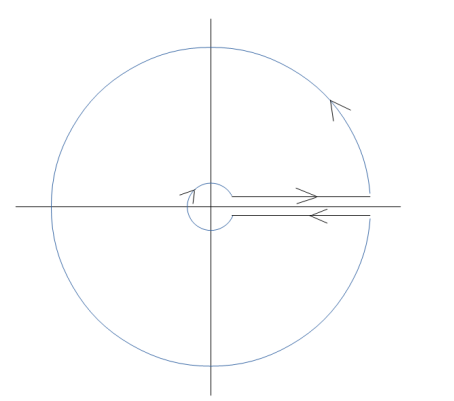
Let \(\Gamma\) be the counterclockwise contour consisting of
\(C_\eps = \ts{\eps e^{it}\st t\in [0+\eps, 2\pi - \eps]}\)
\(\gamma_+ = \ts{x+i\eps \st x\in [\eps, R]}\)
\(C_R= \ts{R e^{it}\st t\in [0+\eps, 2\pi - \eps]}\)
\(\gamma_- = \ts{x-i\eps \st x\in [\eps, R]}\)
Computing the symmetry: \[ \int_{\gamma_-}{\log(z) \over z^{4} + 1} \dz &= \int_{R}^\eps {\log(x-i\eps) \over (x-i\eps)^4 + 1} \dx \qquad z=x-i\eps, \dz = \dx \\ &\to - \int_{\eps}^R {\log(x) + 2\pi i\over x^4 + 1}\dz \\ &= -\int_{\gamma_+} {\log(z) \over z^4+1}\dz - 2\pi i\int_{\gamma_+} {1\over z^4+1} \dz ,\] so \[ \int_{\gamma_+} f + \int_{\gamma_-}f \too -2\pi i I .\] By the ML estimate, since \(\log(z)/z^4\to 0\) as \(\abs{z}\to \infty\), \(\int_{C_R}g(z) \to 0\). Similarly, since \(\log(z) / (z^4+1)\to 0\) as \(\abs{z}\to 0\), \(\int_{C_\eps}\to 0\). We’re then left with the sum of residues at \(e^{k i \pi \over 4}\) for \(k = 1,3,5,7\). We have \[ \Res_{z=z_k} f(z) &= {1\over 4z^3}\evalfrom_{z=z_k} \\ &= {z\over 4z^4}\evalfrom_{z=z_k} \\ &= - {z\over 4}\evalfrom_{z=z_k} \qquad \text{ since } z_k^4 = -1 \\ &= -{z_k \over 4} ,\] so \[ \Res_{z=z_k}g(z) = -{z_k \over 4}\log(z_k) .\]
Now use that in the limit, \[ 2\pi i \sum_k \Res_{z=z_k}g(z) &= \int_\Gamma g(z) \dz \\ &= \qty{\int_{\gamma_+} + \int_{\gamma_i}} f \\ &= -2\pi i I ,\] so \(I = -\sum_k \Res_{z=z_k} g(z)\).
Being very careful to note that we’ve chosen a branch of \(\log\) where \(\Arg(z) \in (0, 2\pi)\) in order to get the signs right, \[ -\sum_k \Res(z=z_k) g(z) &= {1\over 4}\qty{ z_1\log(z_1) + z_2\log(z_2)+z_3\log(z_3)+z_4\log(z_4) } \\ &= {1\over 4}\qty{ z_1 {i\pi \over 4} + z_2 {3i\pi \over 4} + z_3 {5i\pi \over 4}+ z_4 {7i\pi \over 4} } \\ &= {i\pi \over 16}\qty{ z_1 + 3z_2 + 5z_3+ 7z_4 } \\ &= {i\pi \over 16}\qty{ \omega \zeta_4^0 + 3\omega\zeta_4^1 + 5\omega\zeta_4^2+ 7\omega \zeta_4^3 } \\ &= {i\pi \omega \over 16}\qty{ 1 + 3i + -5 + -7i } \\ &= {i\pi \omega \over 16}(-4-4i) \\ &= -{i\pi \omega \over 4}(1+i) \\ &= -{i\pi \omega \over 2}{ \omega \over \sqrt{2} } \\ &= -i\omega^2 {\pi \over 2 \sqrt 2} \\ &= {\pi \over 2\sqrt{2} } ,\] using that \({\sqrt 2\over 2}(1+i) = e^{i\pi \over 4} = \omega\) and \(\omega^2 = i\).