\[ \int_{1}^{\infty} \frac{d x}{x \sqrt{x^{2}-1}} = {\pi \over 2} .\]
Solution
Write \(f(z) \da (z^2-1)^{-{1\over 2}}/z\). In order for \((z^2-1)^{-{1\over 2}}\) to be well-defined, one needs to introduce a branch cut. Note that \(f\) has a simple pole at \(z=0\) and is holomorphic away from \(z=0\) if \(z^2-1\) is not on the positive real axis, where we’ve chosen the branch cut \(\theta = 0\) for \(\Log(z)\) and define \(z^{1\over 2} = e^{{1\over 2}\Log(z)}\). But \(z^2-1 \in \RR_{\geq 0} \iff z\in [-1, 1]^c\), which is what we’ve cut.
So take the branch cut \((-\infty, 1] \union [1, \infty)\) and use the following indented double-keyhole contour:
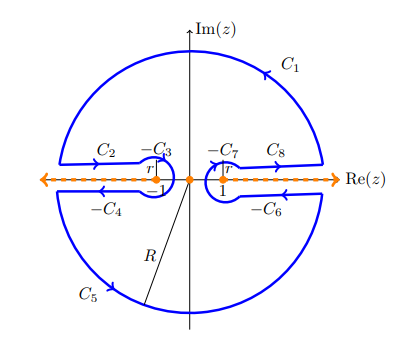
Contributions along \(C_8\) and \(C_6\): note that \(\int_{C_8}f \to I\), the desired integral. For reference, note that \(z^2-1 = (z+1)(z-1)\), and we can parameterize \[ C_8 = \ts{t+1+ i\eps \st t\in [\eps, R] } \implies \\ \int_{C_8}f(z)\dz \to \int_0^\infty \inverseof{t} (t+2)^{-{1\over 2}} t^{-{1\over 2}} \dt ,\] where on \(C_8\) we choose a branch of the square root so that \(\arg(z+1) \in [-\pi, \pi)\) and \(\arg(z-1)\in [-\pi, \pi)\). Now consider \(C_6\). Write \(\zeta_0 \da e^{2\pi i}\), then \[ C_6 = \ts{\zeta_0 t + 1 - i\eps \st t\in [\eps, R]} \implies \\ \int_{C_6} f(z)\dz &\to \int_R^{\eps} \inverseof{(\zeta_0 t)}(\zeta_0 t + 2)^{-{1\over 2}}(\zeta_0 t)^{-{1\over 2}}\dt \\ &\to -\zeta_0^{-{3 \over 2}} \int_0^\infty \inverseof{t} (t+2)^{-{1\over 2}} t^{-{1\over 2}}\dt \\ &= I ,\] since \(-\zeta_0^{-{3\over 2}} \da -e^{-3\pi i} = 1\). So in the limit \(\eps\to 0, R\to\infty\), \[ \qty{ \int_{C_8} + \int_{C_6}}f \too 2I .\]
The contribution from \(C_2\): parameterize \[ C_2 = \ts{s + i\eps \st x\in [-R, -1-\eps]} ,\] which implies \[ \int_{C_2}f(z)\dz &= \int_{-\infty}^{-1} {1\over s\sqrt{s^2-1}}\,ds \\ &= - \int_{\infty}^{1} {1\over (-x) \sqrt{(-x)^2-1}}\dx,\qquad x=-s,\, \dx = -\,ds \\ &= \int_\infty^1 {1\over (-x) \sqrt{ (-x)^2 - 1} }\dx \\ &= - \int_\infty^1 {1\over x \sqrt{ x^2 - 1} }\dx \\ &= \int_1^\infty {1\over x \sqrt{ x^2 - 1} }\dx \\ &= I ,\] so the same argument as above shows \[ \qty{ \int_{C_2} + \int_{C_4}}f \too 2I .\]
Computing the residues: the full contour encloses a simple pole at \(z=0\), so \[ 2\pi i \Res_{z=0} f(z) = 2\pi i \lim_{z\to 0} {1\over \sqrt{z^2-1}} = 2\pi \cdot (-i) = 2\pi .\]
So by the residue theorem, \[ 2\pi = 2I + 2I \implies I = {\pi \over 2} .\]