\[ I \da \int_0^\infty {x^\alpha \over (1+x)^2}\dx, \qquad 0<\alpha<1. \]
Solution
Set \[ f(z)=\frac{z^\alpha}{(1+z)^2}, \] using the branch \(z^\alpha=e^{\alpha\Log z}\) with \(0<\Arg z<2\pi\). Take a positively oriented keyhole contour around the positive real axis.
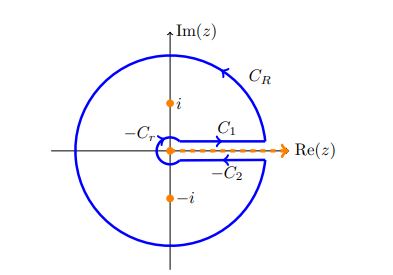
On the upper bank, \(z^\alpha=x^\alpha\); on the lower bank, \(z^\alpha=e^{2\pi i\alpha}x^\alpha\), and the lower bank is traversed from \(R\) to \(\varepsilon\). Hence the two straight segments contribute \[ \qty{1-e^{2\pi i\alpha}} \int_\varepsilon^R\frac{x^\alpha}{(1+x)^2}\,dx. \]
The small circular contribution is \(O(\varepsilon^{\alpha+1})\), while the large circular contribution is \(O(R^{\alpha-1})\). Both tend to zero because \(0<\alpha<1\).
The only pole inside the contour is the double pole at \(z=-1\). Since \(\Arg(-1)=\pi\) on this branch, \[ \Res_{z=-1}f(z) =\left.\dd{}{z}z^\alpha\right|_{z=-1} =\alpha e^{i\pi(\alpha-1)} =-\alpha e^{i\pi\alpha}. \] Letting \(\varepsilon\to0\) and \(R\to\infty\) and applying the residue theorem gives \[ \qty{1-e^{2\pi i\alpha}}I=-2\pi i\alpha e^{i\pi\alpha}. \] Since \[ 1-e^{2\pi i\alpha}=-2i e^{i\pi\alpha}\sin(\pi\alpha), \] we obtain \[ I=\pi\alpha\csc(\pi\alpha). \]