Find a conformal map that maps the region \[ R = \ts{z \st \Re(z) > 0,\, \abs{z - {1\over 2} }> {1\over 2} } \] to the upper half plane.
Find a conformal map from \[ \ts{ z\st \abs{z -1 / 2} >1 / 2, \Re(z)>0 } \] to \(\mathbb{H}\).
Solution
The main step: blow up the tangency.
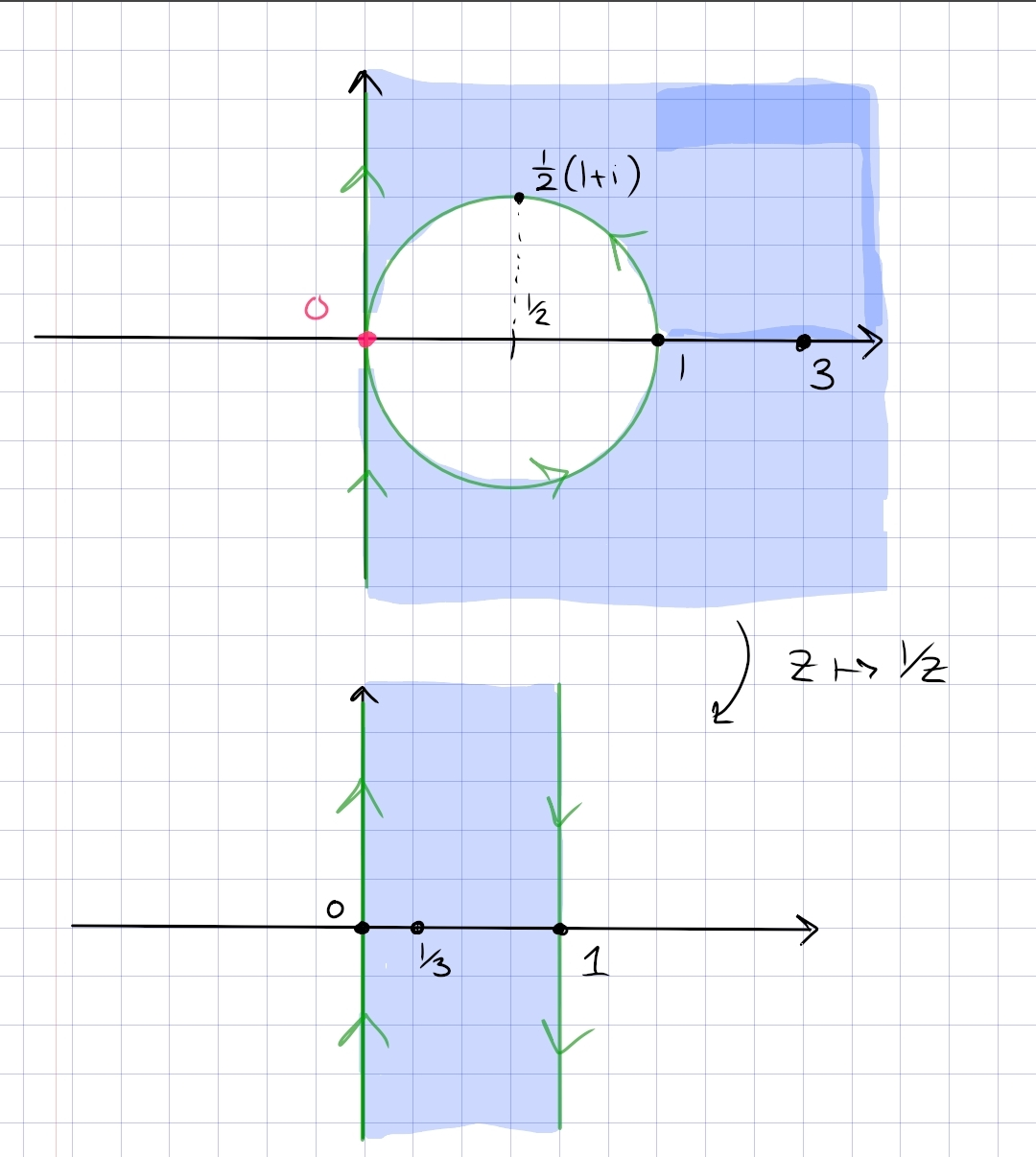
The individual maps:
- Send \(0\to \infty\) by \(z\mapsto {1\over z}\) to map \(R\) to \(0<\Re(z)<1\)
- Rotate with \(z\mapsto iz\) to map this to \(0< \Im(z) < 1\)
- Dilate by \(z\mapsto \pi z\) to get \(0 < \Im(z) < \pi\)
- Apply \(z\mapsto e^z\) to map to \(\HH\).
That steps 1 and 2 work requires a bit of analysis. Use that \(f(z) \da 1/z\) satisfies \(f(\RR) = \RR\) and \(f(i\RR) = i \RR\). To see where the circle \(C_1\) gets mapped to, parameterize it as \[ \gamma(t) \da \ts{{1\over 2}\qty{1+e^{it}} \st t\in [-\pi, \pi]} .\]
Now computing its image: \[ f(\gamma(t)) &= {2 \over 1 + e^{it}} \\ &= {2e^{-it\over 2} \over e^{-it\over 2}(1 + e^{it})} \\ &= {2e^{-it} \over e^{-it\over 2} + e^{it\over 2} } \\ &= { 2e^{-it\over 2} \over 2\cos\qty{t\over 2} } \\ &= \sec\qty{t\over 2}\qty{\cos\qty{-t\over 2} + i\sin\qty{-t\over 2}} \\ &= \sec\qty{t\over 2}\qty{\cos\qty{t\over 2} - i\sin\qty{t\over 2}} \\ &= 1 - i\tan\qty{t\over 2} ,\] and as \(t\) runs from \(-\pi\) to \(\pi\), \(-\tan\qty{t\over 2}\) runs from \(+\infty\) to \(-\infty\). So this is a line along \(z=1\), oriented top to bottom as in the image.
Similarly, computing \(f(i\RR)\): parameterize \(\gamma(t) = it\) with \(t\in (-\infty, \infty)\), then \[ f(\gamma(t)) = {1\over it} = -{i\over t} ,\] and as \(t\) runs from \(0\) to \(\infty\), \(-1/t\) runs from \(-\infty\) to \(0\), and as \(t\) runs from \(-\infty\) to \(0\), \(-1/t\) runs from \(0\) to \(\infty\). So \(f(i\RR)\) is oriented from bottom to top, as in the image.
That the region outside the disc is mapped to the strip shown: points \(x\in \RR\) with \(\abs{x} > 1\) map to \(\abs{x}<1\), which is in the strip. One can also conclude this by handedness: the original region is on the right with respect to \(C_1\) and also on the right with respect to \(i\RR\), so the new region should be on the right with respect to both \(f(i\RR)\) and \(f(C_1)\) with their induced orientations.