Find a conformal map from \[ D=\ts{ z\in \CC\st |z|<1 \text{ and } \abs{ z-{1\over 2}}>{1\over 2}} \] to the unit disk \(\Delta=\{z:|z|<1\}\).
Solution
This is a lune-type region:
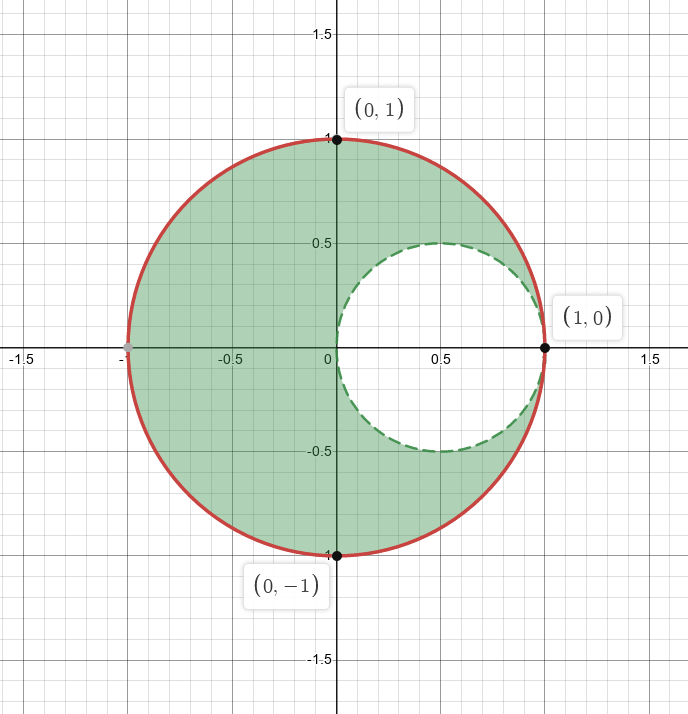
The usual strategy is to blow up the tangency, so send \(1\to\infty\) with \[ f(z) \da {1\over z-1} .\]
\(f\) has the following effect:
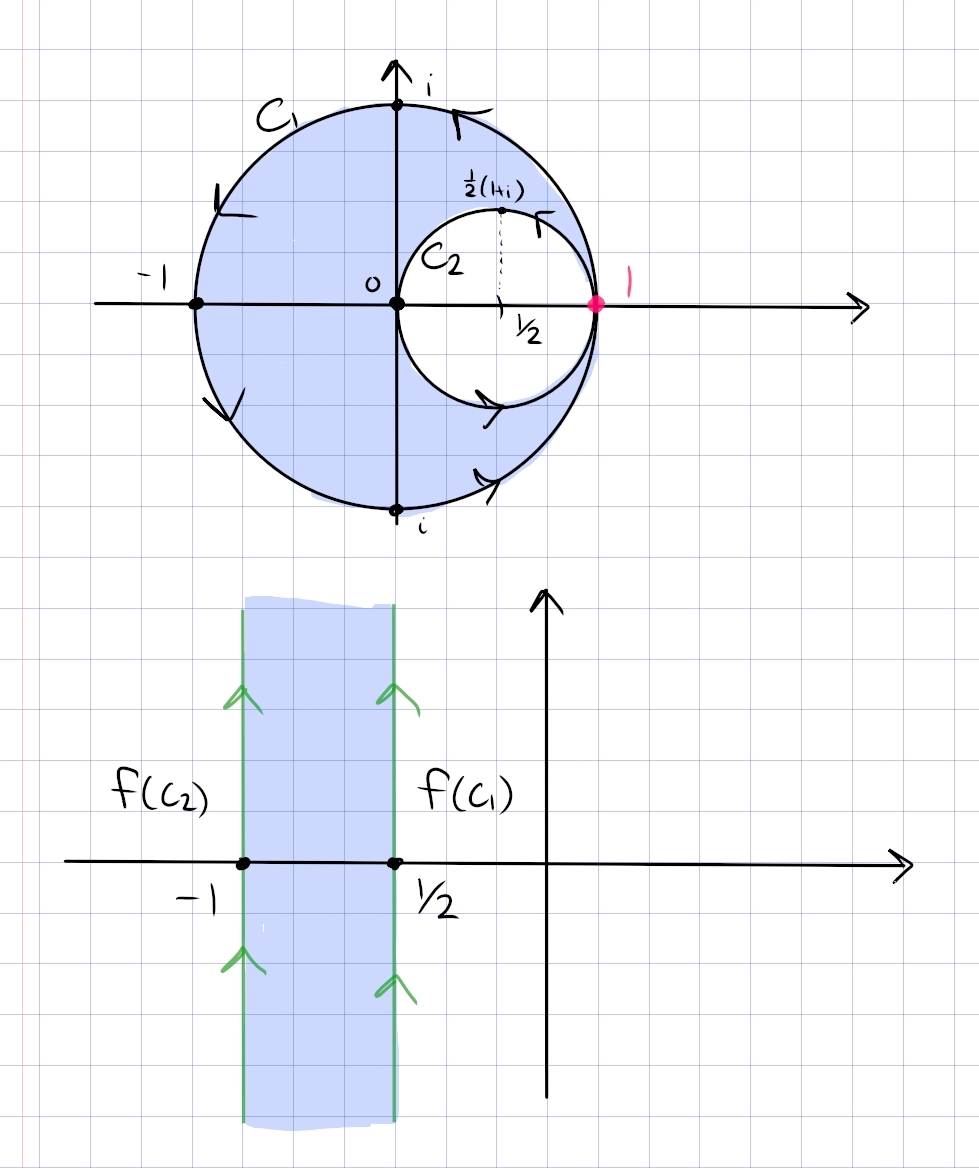
(of claim)
Write \(C_1\) for \(S^1\) and \(C_2\) for the smaller circle. Computing the image of \(C_1\): parameterize as \(\gamma_1(t) = e^{it}\) for \(t\in [-\pi, \pi]\), then \[ f(\gamma_1(t)) &= {1\over e^{it} - 1} \\ &= {e^{-it/2} \over e^{it/2} - e^{-it/2}} \\ &= {e^{-it/2} \over 2i\sin(t/2) } \\ &= -{i\over 2}\csc(t/2)\qty{\cos(t/2) - i\sin(t/2)} \\ &= -{i\over 2}\qty{\cot(t/2) - i } \\ &= {1\over 2}\qty{-1-i\cot(t/2)} \\ &= -{1\over 2} - i\cdot {1\over 2}\cot(t/2) .\]
Some analysis on \(\cot(t/2)\):
- \(-\pi\increasesto 0 \leadsto 0\decreasesto -\infty\)
- \(0\increasesto \pi \leadsto \infty\decreasesto 0\)
Thus for \(-\cot(t/2)\),
- \(-\pi\increasesto 0 \leadsto 0\increasesto \infty\)
- \(0\increasesto \pi \leadsto -\infty\increasesto 0\)
So the image is a vertical line through \(\Re(z) = -{1\over 2}\) oriented from \(-\infty\to\infty\).
For the image of \(C_2\): parameterize as \(\gamma_2(t) = {1\over 2}\qty{1 + e^{it}}\), then \[ f(\gamma_2(t)) &= {1\over {1\over 2}\qty{1+e^{it}} - 1 } \\ &= {1\over -{1\over 2} + {1\over 2}e^{it} } \\ &= {1\over {1\over 2}\qty{e^{it} - 1}} \\ &= {2e^{-it/2} \over e^{it/2} - e^{-it/2} } \\ &= {2e^{-it/2} \over 2i\sin(t/2) } \\ &= -i\csc(t/2) \qty{\cos(-t/2) + i\sin(-t/2) } \\ &= -i\csc(t/2) \qty{\cos(t/2) - i\sin(t/2) } \\ &= -i \qty{\cot(t/2) - i } \\ &= -1 - i\cot(t/2) .\] By the same argument as above, this traces out a vertical line at \(\Re(z) = -1\).
By handedness, since the original region is on the left with respect to \(C_1\) and the right with respect to \(C_2\), the new region is to the left of \(\Re(z) = -{1\over 2}\) and the right of \(\Re(z) = -1\) (since both are oriented from \(-\infty\) to \(\infty\)).
From here, it’s a standard exercise. In steps:
- Map \(R\) to the vertical strip \(-1< \Re(z) < -{1\over 2}\) using \(z\mapsto {1\over z-1}\).
- Shift using \(z\mapsto z+{1\over 2}\) to send this to \(-{1\over 2}< \Re(z) < 0\).
- Rotate using \(z\mapsto -iz\) to get \(0<\Im(z) < {i\over 2}\), a horizontal strip.
- Dilate using \(z\mapsto 2\pi z\), which sends \({i\over 2}\to \pi i\), so the resulting region is \(0 < \Im(z) < \pi\).
- Apply \(z\mapsto e^z\) to map the horizontal strip to \(\HH\).
- Apply the Cayley map \(z\mapsto {z-i\over z+i}\) to map \(\HH\to\DD\).