Let \(\tau\) be the map that in cylindrical coordinates takes \((r,\theta,z)\) to \((r,\theta+\pi,z)\), thus \(\tau\) maps the torus \(T\) to itself as shown below.
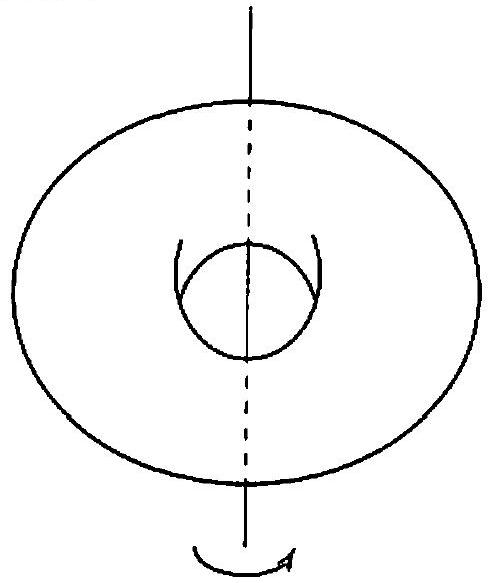
Find a cell structure on \(T\) such that \(\tau\) maps cells to cells.
Let \(Q\) be the quotient of \(T\) given by identifying \(x\) and \(\tau(x)\) for all \(x\in T\). What is \(\chi(Q)\)?
Is \(Q\) a surface?
Solution
Identify the torus with \[ T=S^1\times S^1, \] where the first factor records the cylindrical angle \(\theta\) and the second records the meridional angle. Then \[ \tau(z,w)=(-z,w). \]
1. Give the first factor \(S^1\) a CW structure with two \(0\)-cells\[ p=1, \qquad q=-1, \]and two open \(1\)-cells \(e_+\) and \(e_-\), the two components of \(S^1\setminus\{p,q\}\).Give the second factor a CW structure with one \(0\)-cell \(v\) and one open \(1\)-cell \(f\).The product CW structure on \(T\) is preserved by \(\tau\).
Multiplication by \(-1\) on the first circle satisfies \[ p\longleftrightarrow q, \qquad e_+\longleftrightarrow e_-. \] The second coordinate is fixed by \(\tau\). Thus the product cells are \[ p\times v,\ q\times v \] in dimension \(0\), \[ e_+\times v,\ e_-\times v,\ p\times f,\ q\times f \] in dimension \(1\), and \[ e_+\times f,\ e_-\times f \] in dimension \(2\). The map \(\tau\) exchanges the members of each displayed pair, so it maps cells to cells.
2. The quotient \(Q=T/(x\sim\tau(x))\) inherits a CW structure with one \(0\)-cell, two \(1\)-cells, and one \(2\)-cell.
No cell in 1 is fixed by \(\tau\); the cells occur in the four two-element orbits \[ \{p\times v,q\times v\}, \quad \{e_+\times v,e_-\times v\}, \quad \{p\times f,q\times f\}, \quad \{e_+\times f,e_-\times f\}. \] Passing to the quotient therefore gives one cell from the first orbit, two from the middle two orbits, and one from the last orbit.
3. The Euler characteristic of the quotient is\[ \boxed{\chi(Q)=0}. \]
By 2, \[ \chi(Q)=1-2+1=0. \]
4. The quotient \(Q\) is a surface; in fact, it is homeomorphic to the torus.
Define \[ F:T\longrightarrow S^1\times S^1, \qquad F(z,w)=(z^2,w). \] Since \[ F(-z,w)=F(z,w), \] the map is constant on the \(\tau\)-orbits and hence factors through a continuous map \[ \overline F:Q\longrightarrow S^1\times S^1, \qquad \overline F([z,w])=(z^2,w). \]
The map \(\overline F\) is surjective because every point of \(S^1\) has a square root. It is injective because \[ z_1^2=z_2^2 \] for \(z_1,z_2\in S^1\) implies \(z_2=z_1\) or \(z_2=-z_1\), exactly the two points identified by the quotient; equality of the second coordinates is also forced.
The torus \(T\) is compact, so its quotient \(Q\) is compact. The target \(S^1\times S^1\) is Hausdorff. Therefore the continuous bijection \(\overline F\) is a homeomorphism. Hence \[ Q\cong S^1\times S^1, \] so \(Q\) is a surface.