The nerve of a collection of sets is an abstract simplicial complex that has a \(0\)-cell for each set, a \(1\)-cell joining each pair of sets that intersect each other, a \(2\)-cell for every triple of sets with a common intersection, and so forth. Consider the collection of sets below:
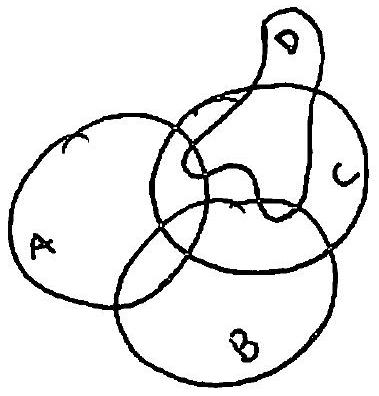
Draw the nerve of the collection.
Compute the homology of the nerve.
Solution
1. The nonempty intersections visible in the diagram are all six pairwise intersections and exactly the three triple intersections\[ A\cap B\cap C, \qquad A\cap C\cap D, \qquad B\cap C\cap D. \]The intersection \(A\cap B\cap D\) is empty, and hence so is \(A\cap B\cap C\cap D\).
The three large regions \(A\), \(B\), and \(C\) overlap pairwise and have a common central region, so \[ A\cap B, \quad A\cap C, \quad B\cap C, \quad A\cap B\cap C \] are nonempty.
The region \(D\) meets each of \(A\), \(B\), and \(C\). Its small overlap with \(A\) is the lens immediately to the left of the lower part of \(D\); that lens lies inside \(C\) and above \(B\). Thus \[ A\cap C\cap D\ne\varnothing \qquad\text{but}\qquad A\cap B\cap D=\varnothing. \] Its small overlap with \(B\) is the lens immediately below the lower boundary of \(D\); that lens lies inside \(C\) and to the right of \(A\). Thus \[ B\cap C\cap D\ne\varnothing. \] Since \(A\cap B\cap D\) is empty, no point lies in all four sets.
2. Therefore the nerve \(N\) has vertices\[ A,B,C,D, \]all six edges\[ AB,AC,AD,BC,BD,CD, \]and precisely the three \(2\)-simplices\[ ABC, \qquad ACD, \qquad BCD. \]There is no \(2\)-simplex \(ABD\) and no \(3\)-simplex \(ABCD\).
1. Equivalently,\[ N=C*\partial\Delta^2_{ABD}, \]the cone with apex \(C\) on the \(3\)-cycle with vertices \(A,B,D\).Thus one may draw the complete graph on the four vertices, fill the three triangular faces incident to \(C\), and leave the face \(ABD\) unfilled.
3. With integral coefficients,\[ \boxed{ H_0(N;\ZZ)\cong\ZZ, \qquad H_n(N;\ZZ)=0\quad(n\ge 1). } \]
By 2, \(N\) is a simplicial cone with apex \(C\). Its geometric realization contracts to \(C\): if \(x\in |N|\) has barycentric coordinates in a simplex of \(N\), define \[ H(x,t)=(1-t)x+tC, \qquad 0\le t\le 1. \] Every simplex of the base \(\partial\Delta^2_{ABD}\) together with \(C\) is a simplex of the cone, so the whole line segment from \(x\) to \(C\) remains in \(|N|\). Hence \(|N|\) is contractible. Therefore its reduced integral homology vanishes in every degree, which gives the displayed groups.