A continuous vector field \(V\) on the plane is a continuous map from \(\RR^2\) to \(\RR^2\). The portion of \(V\) along the boundary of a disk \(D\) is shown below:
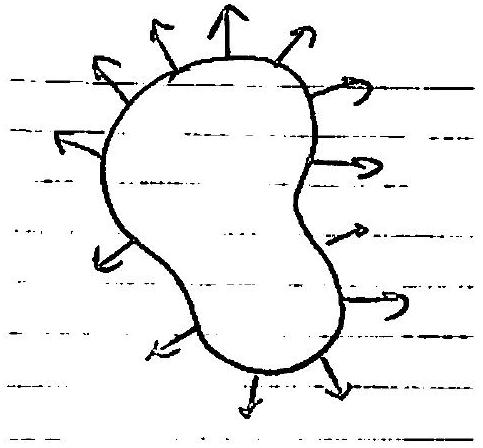
Show that the vector field has a zero inside \(D\).
Solution
Let \(c\) be the center of \(D\). The boundary condition shown in the figure says that \(V(x)\) points strictly outward for every \(x\in\partial D\); equivalently, \[ \langle V(x),x-c\rangle>0 \qquad(x\in\partial D). \]
1. If \(V\) had no zero in \(D\), then the normalized field\[ u:D\longrightarrow S^1, \qquad u(x)=\frac{V(x)}{\|V(x)\|}, \]would be continuous, and its restriction to \(\partial D\) would have degree \(0\).
Under the assumption that \(V(x)\ne0\) on \(D\), the displayed normalization is well defined and continuous. Since \(u|_{\partial D}\) extends continuously over the disk, it is null-homotopic: contract \(D\) to its center and compose that contraction with \(u\). A null-homotopic map \(S^1\to S^1\) has degree \(0\).
2. The same boundary map \(u|_{\partial D}\) has degree \(1\).
Let \[ n(x)=\frac{x-c}{\|x-c\|}, \qquad x\in\partial D, \] be the outward radial unit field. For \(0\le t\le1\), set \[ W_t(x)=(1-t)V(x)+t(x-c). \] Then \[ \langle W_t(x),x-c\rangle =(1-t)\langle V(x),x-c\rangle+t\|x-c\|^2>0, \] so \(W_t(x)\ne0\) for every \(x\in\partial D\) and every \(t\). Therefore \[ H_t(x)=\frac{W_t(x)}{\|W_t(x)\|} \] is a homotopy through maps \(\partial D\to S^1\) from \(u|_{\partial D}\) to \(n\).
After the standard orientation-preserving identification \(\partial D\cong S^1\), the map \(n\) is the identity map of \(S^1\). Hence \[ \deg(u|_{\partial D})=\deg(n)=1. \]
3. Thus \(V\) has a zero in the interior of \(D\).
If \(V\) had no zero in \(D\), 1 and 2 would give simultaneously \[ \deg(u|_{\partial D})=0 \qquad\text{and}\qquad \deg(u|_{\partial D})=1, \] a contradiction. Therefore \(V\) vanishes somewhere in \(D\). The pictured boundary condition implies \(V(x)\ne0\) for every \(x\in\partial D\), so every zero lies in the interior.