Prove that the distinct complex numbers \(z_1, z_2, z_3\) are the vertices of an equilateral triangle if and only if \[ z_{1}^{2}+z_{2}^{2}+z_{3}^{2}=z_{1} z_{2}+z_{2} z_{3}+z_{3} z_{1} .\]
Solution
\(\implies\): Write the vertices as \(z_1, z_2, z_3\) and the sides as
- \(s_1 \da z_2-z_1\)
- \(s_2 \da z_3 - z_2\)
- \(s_1 \da z_1 -z_3\)
Note that \(s_i = \pm \zeta_3 s_{i-1}\), dividing yields \[ {s_2 \over s_3} &= {s_1\over s_2} \\ &\iff s_2^2 - s_1 s_3 = 0 \\ &\iff \left(z_{2}-z_{3}\right)^{2}-\left(z_{2}-z_{1}\right)\left(z_{1}-z_{3}\right)=0 \\ &\iff \left(z_{2}^{2}+z_{3}^{2}-2 z_{2} z_{3}\right)-\left(z_{2} z_{1}-z_{2} z_{3}-z_{1}^{2}+z_{1} z_{3}\right)=0 \\ &\iff z_{1}^{2}+z_{2}^{2}+z_{3}^{2}-\left(z_{1} z_{2}+z_{2} z_{3}+z_{3} z_{1}\right)=0 .\]
\(\impliedby\): We still have \(s_i = \theta_i s_{i-1}\) for some angles \(\theta_i\) We have
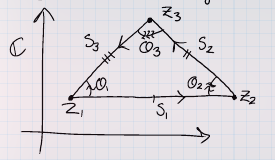
and \[ {s_1\over s_2} &= {\theta_1 \over \theta_2} \cdot {s_3\over s_1} \\ {s_2\over s_3} &= {\theta_2 \over \theta_3} \cdot {s_1\over s_2} \\ {s_3\over s_1} &= {\theta_3 \over \theta_1} \cdot {s_2\over s_3} .\]
Running the above calculation backward yields \(s_2/s_3 = s_1/s_2\), and by the 2nd equality above, this forces \(\theta_2 = \theta_3\). Similar arguments show \(\theta_1=\theta_2 = \theta_3\) which forces \(s_1=s_2 = s_3\).