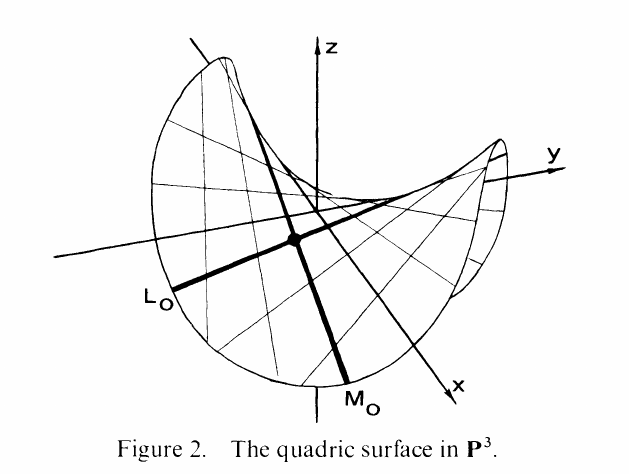
Let \(k\) be algebraically closed. Consider the surface \(Q\) in \(\PP^3\) defined by \(xy - zw = 0\); a surface is a variety of dimension \(2\).
Show that \(Q\) is the Segre embedding of \(\PP^1 \times \PP^1\) in \(\PP^3\), for a suitable choice of coordinates.
Show that \(Q\) contains two families of lines \(\ts{L_t}\) and \(\ts{M_t}\), each parametrized by \(t \in \PP^1\), with these properties: if \(L_t \neq L_u\) then \(L_t \intersect L_u = \emptyset\); if \(M_t \neq M_u\) then \(M_t \intersect M_u = \emptyset\); and \(L_t \intersect M_u\) is a single point for all \(t, u\). A line is a linear variety of dimension \(1\).
Show that \(Q\) contains curves other than these lines, and deduce that the Zariski topology on \(Q\) is not carried by \(\psi\) to the product topology on \(\PP^1 \times \PP^1\), where each factor has its Zariski topology.
Solution
Use the coordinate order \([x:y:z:w]\) on \(\PP^3\) and the reordered Segre map \[ \psi([a:b],[c:d])=[ac:bd:ad:bc]. \] The topology in (c) is the topology on the classical sets of projective points over \(k\).
1. The image of \(\psi\) is exactly \(Q\).
1.This proves (a).
2. The ruling lines in (b) are\[ \boxed{L_{[a:b]}=\{[ac:bd:ad:bc]:[c:d]\in\PP^1\},\qquad M_{[c:d]}=\{[ac:bd:ad:bc]:[a:b]\in\PP^1\}.} \]
For fixed \([a:b]\), the vectors in the first parametrization have the form \[ c(a,0,0,b)+d(0,b,a,0). \] The two displayed vectors are linearly independent, since \((a,b)\ne(0,0)\) and their nonzero coordinates lie in disjoint pairs of positions. Their projectivized span is consequently a line by P-AGH211LINEAR. Similarly, for fixed \([c:d]\), the second parametrization is the projectivized span of the independent vectors \((c,0,d,0)\) and \((0,d,0,c)\). All these lines lie in \(Q\) by step 1.
Under the bijection \(\psi\), the first family is the image of the subsets \(\{t\}\times\PP^1\), and the second is the image of \(\PP^1\times\{u\}\). Two distinct members of either family are therefore disjoint. For every \(t,u\), their intersection is precisely the one point \(\psi(t,u)\). This also proves that each family is parametrized without repetition by \(\PP^1\).
3. The closed curve\[ C=Q\cap Z(z-w)=\{[a^2:b^2:ab:ab]:[a:b]\in\PP^1\} \]is not a line.
In the coordinates of \(\psi\), the extra equation \(z=w\) is \(ad=bc\). For nonzero two-dimensional vectors, this determinant equation is equivalent to \([a:b]=[c:d]\). Thus \(C\) is precisely the image under \(\psi\) of the diagonal of the set \(\PP^1\times\PP^1\). Its displayed parametrization is the quadratic Veronese embedding of \(\PP^1\) in the plane \(z=w\), by P-AGH212DUPLE. It is therefore a closed irreducible curve. It contains the points \[ [1:0:0:0],\qquad[0:1:0:0],\qquad[1:1:1:1], \] whose representative vectors are linearly independent. A projective line is the projectivization of a two-dimensional vector space, so it cannot contain these three points. Hence \(C\) is a curve other than either ruling line, in every characteristic.
4. The product topology in (c) does not make \(\psi\) a homeomorphism onto \(Q\).
Every proper Zariski-closed subset of \(\PP_k^1\) is finite. Indeed, it is contained in the zero set of a nonzero homogeneous polynomial, whose zeros on either affine chart are zeros of a nonzero one-variable polynomial, apart from a possible missing endpoint. Conversely, every finite subset is closed because points are closed. The field \(k\) is infinite, so the set of projective points is infinite and this topology is the cofinite topology.
Let \(\Delta=\{(t,t):t\in\PP^1\}\). Every nonempty basic open rectangle \(A\times B\) in the product topology meets \(\Delta\): both \(A\) and \(B\) have finite complement, so \(A\cap B\ne\varnothing\). Thus \(\Delta\) is dense in the product topology. It is a proper subset, since there are distinct projective points, and hence is not closed.
But step 3 gives \(\psi^{-1}(C)=\Delta\), whereas \(C\) is Zariski-closed in \(Q\). Therefore \(\psi\) from the product-topological space to \(Q\) is not even continuous, and in particular is not a homeomorphism. This proves (c).
5. Q.E.D.
Step 1 proves (a), step 2 proves (b), and steps <1>3–<1>4 prove both assertions in (c).
Source Collections
Dependencies
P-AGH214SEGREThe Segre embedding of $\PP^r \times \PP^s$uses
Backlinks
P-AGH45QUADSURFBIRThe quadric surface $xy = zw$ is birational but not isomorphic to $\PP^2$uses