Let \(Y\) be the plane nodal cubic curve \(y^2 = x^2(x+1)\). Show that \(Y\) has a finite étale covering \(X\) of degree \(2\), where \(X\) is a union of two irreducible components, each one isomorphic to the normalization of \(Y\).
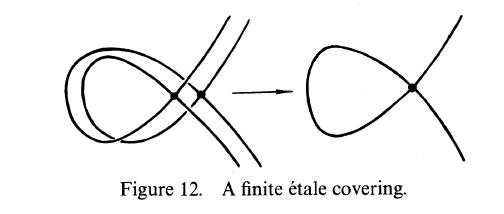
Solution
Let \(N=(0,0)\) be the singular point of the affine cubic. Because the curve is assumed nodal, we are in characteristic different from \(2\); in characteristic \(2\) the tangent cone is \((y-x)^2\) and the displayed curve is not nodal P-AGH44RATCURVES.
1. The normalization of \(Y\) is \(\PP_v^1\), and the two points above \(N\) are\[ p=(v=1), \qquad q=(v=-1). \]
On the affine chart of \(Y\) containing the node, put \[ v=\frac yx. \] Then \[ v^2=x+1, \] so \[ x=v^2-1, \qquad y=v(v^2-1). \] Thus the normalization map is the parametrization \[ \nu:\PP_v^1\longrightarrow Y \] recorded in P-AGH44RATCURVES. The node \(x=y=0\) has preimages \(v=1\) and \(v=-1\), which are distinct because \(\operatorname{char}k\ne2\). Away from these two points, \(\nu\) is an isomorphism onto \(Y\setminus\{N\}\).
2. On the affine nodal chart, the coordinate ring of \(Y\) is\[ A=k+(v^2-1)k[v]\subseteq B=k[v]. \]
The parametrization of step 1 identifies \[ A=k[v^2-1,\,v(v^2-1)]. \] Every element of this subring is a polynomial whose values at \(v=1\) and \(v=-1\) agree. Conversely, if \(F\in k[v]\) satisfies \(F(1)=F(-1)\), then \(F-F(1)\) is divisible by \((v-1)(v+1)=v^2-1\), so \[ F\in k+(v^2-1)k[v]. \] Hence \[ \boxed{A=\{F\in B:F(1)=F(-1)\}}. \] This is also the branch-gluing description used in P-AGH2713NONPROJ.
3. Define an affine curve over the nodal chart by\[ C=left\{ (F,G)\in B\oplus B: F(1)=G(-1),\quad F(-1)=G(1) \right\}. \]Then \(\Spec C\) has two irreducible components, each with normalization \(\AA^1\), and those components meet transversely in two points.
The normalization of \(C\) is \(B\oplus B\), hence consists of two affine lines. The defining equalities identify the branch \(v=1\) on the first line with the branch \(v=-1\) on the second, and independently identify the branch \(v=-1\) on the first with the branch \(v=1\) on the second.
Put \[ J=(v^2-1)B. \] Modulo \(J\oplus J\), the ring \(C\) becomes \[ C/(J\oplus J)\cong k\oplus k, \] the two factors recording the two common branch values. Hence there are exactly two points where the two normalization components are glued.
At either such point, the completed local ring is the ordinary node \[ k[[s,t]]/(st), \] because it is obtained by gluing two smooth formal branches along their common residue field. Thus the two components meet transversely at both points.
4. The diagonal homomorphism\[ A\longrightarrow C, \qquad H\longmapsto(H,H), \]defines a finite morphism of degree two over the nodal chart.
If \(H\in A\), step 2 gives \(H(1)=H(-1)\), so \((H,H)\) satisfies both crossed equalities and lies in \(C\).
The normalization ring \(B\) is finite over \(A\): the element \(v\) is integral, since \[ v^2=x+1\in A. \] Therefore \(B\oplus B\) is a finite \(A\)-module. The ring \(A\) is noetherian, so its submodule \(C\subseteq B\oplus B\) is finite as well. Hence \[ \Spec C\longrightarrow\Spec A \] is finite.
After inverting \(v^2-1\), the normalization is already an isomorphism with the smooth locus of \(Y\), and the crossed conditions disappear. Thus away from the node the map is simply \[ (Y\setminus\{N\})\sqcup(Y\setminus\{N\}) \longrightarrow Y\setminus\{N\}. \] It therefore has degree two.
5. Gluing with two copies of the smooth locus produces a curve \(X\) whose two irreducible components are each isomorphic to \(\PP^1\), together with a finite morphism\[ f:X\longrightarrow Y. \]
Let \[ V=Y\setminus\{N\}. \] Over the overlap of the affine nodal chart with \(V\), step 4 identifies \(\Spec C\) with two disjoint copies of that overlap. Glue \(\Spec C\) to \[ V\sqcup V \] by these two identifications. The resulting curve \(X\) carries a morphism to \(Y\) which is the map of step 4 near the node and the identity on each copy of \(V\) away from the node. Finiteness is local on the target, so \(f\) is finite. Since \(Y\) is projective and a finite morphism is projective, \(X\) is projective as well.
3.Each \(X_i\) is therefore isomorphic to the normalization of \(Y\).
6. The morphism \(f\) is étale at the two points lying above \(N\).
Let \(r\) be one of the two nodes of \(X\) over \(N\). The completed local ring of the ordinary node \(N\in Y\) is \[ \widehat\OO_{Y,N}\cong k[[s,t]]/(st). \] By step 3 the completed local ring at \(r\) is the same: \[ \widehat\OO_{X,r}\cong k[[s,t]]/(st). \] Under the map induced by \(f\), the two formal branches of \(Y\) are carried to the two branches meeting at \(r\); the crossed construction merely chooses which normalization component supplies each branch. Hence \[ \widehat\OO_{Y,N}\xrightarrow{\sim}\widehat\OO_{X,r}. \] The residue-field map is the identity on \(k\).
Therefore the completed-local-ring criterion of Exercise III.10.4 shows that \(f\) is étale at \(r\). The identical argument applies to the other point above \(N\).
7. The morphism \(f\) is a finite étale cover of degree two.
Away from \(N\), step 4 identifies \(f\) with the disjoint union of two identity maps, so it is étale there. Step 6 proves étaleness at the two remaining points of \(X\). Hence \(f\) is étale everywhere.
5. A finite étale morphism is finite locally free, andits rank is locally constant on the base. The curve \(Y\) is irreducible, henceconnected. Over the nonempty open subset \(Y\setminus\{N\}\), step 4 showsthat the rank is two. Therefore the rank is two everywhere:\[ \boxed{2}. \]So \(f:X\to Y\) is the required finite étale covering of degree two.
8. Q.E.D.
Steps <1>1–<1>5 construct the crossed two-component cover, and steps <1>6–<1>7 prove that it is finite étale of degree two with each irreducible component isomorphic to the normalization of \(Y\).