Assume \(\operatorname{char} k \neq 2\). Locate the singular points of the following curves in \(\AA^2\) and sketch each curve.
\(x^2 = x^4 + y^4\)
\(xy = x^6 + y^6\)
\(x^3 = y^2 + x^4 + y^4\)
\(x^2 y + x y^2 = x^4 + y^4\)
Which is which in the figure?
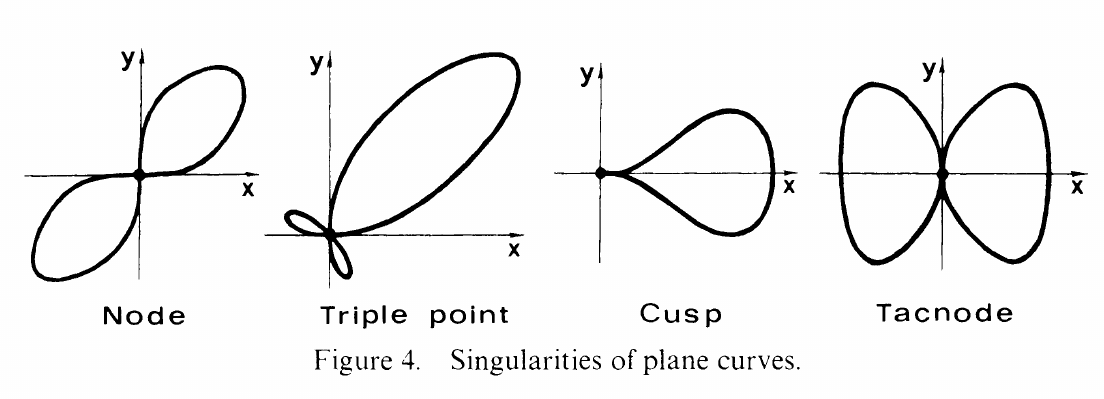
(Characteristic exceptions in part (3))
The source assumes only \(\operatorname{char}k\ne2\). That hypothesis is sufficient for parts (1), (2), and (4), but part (3) acquires the two additional singular points displayed in step <1>3 when \(\operatorname{char}k=7\) or \(13\). Thus the four-singularity picture is literally correct, without further points, for characteristic zero and for \(\operatorname{char}k\notin\{2,7,13\}\).
Solution
For a plane curve \(f(x,y)=0\), a point is singular exactly when \[ f=f_x=f_y=0 \] at that point [@Har10a, Chapter I, §5]. The lowest-degree nonzero homogeneous part of the translated equation is the tangent cone; its linear factors give the tangent directions.
1. For\[ f_1=x^2-x^4-y^4, \]the only singular point is \((0,0)\).
The partial derivatives are \[ (f_1)_x=2x-4x^3=2x(1-2x^2),\qquad (f_1)_y=-4y^3. \] Since \(\operatorname{char}k\ne2\), the second equation forces \(y=0\). Then \(f_1=0\) gives \(x^2(1-x^2)=0\). If \(x^2=1\), then \((f_1)_x=-2x\ne0\); hence a singular point must have \(x=0\). Thus the origin is the unique singular point.
The tangent cone there is \(x^2\), a double tangent line \(x=0\). Moreover the equation has two formal branches \[ x=\pm y^2+\text{terms of higher order}, \] because \(x^2(1-x^2)=y^4\) and \(1-x^2\) has a square root with constant term \(1\) in the completed local ring. The two smooth branches have the same tangent. Thus the origin is a tacnode.
2. For\[ f_2=xy-x^6-y^6, \]the only singular point is \((0,0)\), and it is a node.
One has \[ (f_2)_x=y-6x^5,\qquad (f_2)_y=x-6y^5. \] At a singular point, \[ x(f_2)_x+y(f_2)_y =2xy-6(x^6+y^6). \] Using \(f_2=0\), so that \(xy=x^6+y^6\), this becomes \[ -4(x^6+y^6)=0. \] Because \(\operatorname{char}k\ne2\), it follows that \(x^6+y^6=0\), hence \(xy=0\). If \(x=0\), the equation \(x^6+y^6=0\) gives \(y=0\), and similarly if \(y=0\). Thus the origin is the only singular point.
The tangent cone is \(xy\), the union of the two distinct lines \(x=0\) and \(y=0\). Hence the singularity is an ordinary double point, or node.
3. For\[ f_3=x^3-y^2-x^4-y^4, \]the origin is always singular; if \(\operatorname{char}k\notin\{7,13\}\) it is the only singular point, while in characteristics \(7\) and \(13\) there are exactly two further singular points\[ \boxed{\left(\frac34,\ \pm\sqrt{-\frac12}\right).} \]
The derivatives are \[ (f_3)_x=x^2(3-4x),\qquad (f_3)_y=-2y(1+2y^2). \] Thus a singular point must satisfy \[ x=0\ \text{or}\ x=\frac34, \qquad y=0\ \text{or}\ y^2=-\frac12. \] If \(x=0\), substitution in \(f_3\) shows that the second alternative for \(y\) gives \[ -y^2-y^4=\frac14\ne0, \] so \(y=0\). If \(y=0\), the alternative \(x=3/4\) gives \[ x^3-x^4=\frac{27}{256}, \] which is nonzero unless \(\operatorname{char}k=3\); in characteristic \(3\), however, \(3/4=0\), so this is again the origin.
For the remaining possibility, \[ x=\frac34,\qquad y^2=-\frac12, \] direct substitution gives \[ f_3=\frac{27}{256}+\frac14=\frac{91}{256}. \] Since the characteristic is not \(2\), this vanishes exactly in characteristics \(7\) and \(13\). In either of those characteristics \(-1/2\ne0\), so algebraic closedness gives two distinct square roots and hence exactly two additional singular points.
At the origin the tangent cone is \(-y^2\), a double tangent \(y=0\), while the first term involving \(x\) is \(x^3\). This is the standard cusp type \(y^2=x^3\) up to higher-order terms. Thus the origin is the cusp shown in the source figure.
4. For\[ f_4=x^2y+xy^2-x^4-y^4, \]the only singular point is \((0,0)\), and it is an ordinary triple point.
The derivatives are \[ (f_4)_x=2xy+y^2-4x^3,\qquad (f_4)_y=x^2+2xy-4y^3. \] At a singular point, \[ x(f_4)_x+y(f_4)_y =3xy(x+y)-4(x^4+y^4). \] The equation \(f_4=0\) gives \(xy(x+y)=x^4+y^4\), so the preceding equality becomes \[ -(x^4+y^4)=0. \] Hence \(x^4+y^4=0\) and also \(xy(x+y)=0\). If \(x=0\) or \(y=0\), the first equality forces the other coordinate to be zero. If \(x+y=0\), then \(x^4+y^4=2x^4=0\), and \(\operatorname{char}k\ne2\) again gives \(x=y=0\). Thus the origin is the only singular point.
Its tangent cone is \[ x^2y+xy^2=xy(x+y), \] the union of three distinct lines. Therefore the origin is an ordinary triple point.
5. The four origin singularities in the figure are, respectively,\[ \boxed{\text{(1) tacnode,\quad (2) node,\quad (3) cusp,\quad (4) ordinary triple point}.} \]
This is exactly the tangent-cone and branch analysis in steps <1>1–<1>4. The displayed source figure represents the characteristic-zero, equivalently the generic-characteristic, picture. In characteristics \(7\) and \(13\), part (3) has the two additional singular points found in step 3, so that figure does not depict the entire singular locus under only the source’s stated assumption \(\operatorname{char}k\ne2\).
6. Q.E.D.
Steps <1>1–<1>4 locate every singular point and identify the local shapes at the origin; step 5 matches them with the four sketches.