Prove Pascal’s theorem: if \(A, B, C, A^{\prime}, B^{\prime}, C^{\prime}\) are any six points on a conic, then the points \(P=A B^{\prime} \cdot A^{\prime} B\), \(Q=A C^{\prime} \cdot A^{\prime} C\), and \(R=B C^{\prime} \cdot B^{\prime} C\) are collinear.
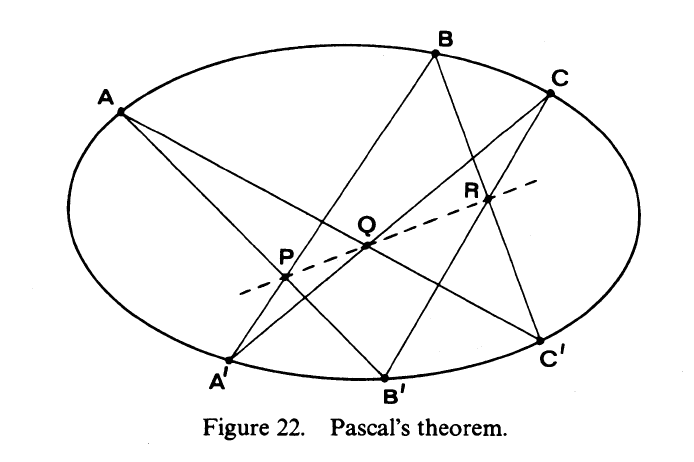
Solution
Let \[ K\subseteq\PP^2 \] be the conic containing \[ A,B,C,A',B',C'. \] We first treat the open configuration in which the six points are distinct and all the side intersections in the statement are distinct and well-defined.
1. Form the two reducible cubics\[ X=AB'\cup BC'\cup CA' \]and\[ Y=A'B\cup B'C\cup C'A. \]Their nine pairwise line intersections are exactly\[ A,B,C,A',B',C',P,Q,R. \]
Write the three components of \(X\) as rows and those of \(Y\) as columns. Their pairwise intersections are \[ \begin{array}{c|ccc} & A'B & B'C & C'A\\ \hline AB' & P & B' & A\\ BC' & B & R & C'\\ CA' & A' & C & Q. \end{array} \] Indeed, for example, \[ AB'\cap A'B=P, \qquad BC'\cap B'C=R, \qquad CA'\cap C'A=Q, \] by the definitions in the problem; the remaining six intersections are the six named points on \(K\).
For a general such configuration the two cubics have no common line component. Hence Bezout gives \[ \deg(X\cap Y)=3\cdot3=9, \] and the table lists all nine points of their complete intersection.
2. The reducible cubic\[ Z=K\cup PQ \]contains eight of the nine points of \(X\cap Y\):\[ A,B,C,A',B',C',P,Q. \]
The first six points lie on the conic \(K\) by hypothesis, while \(P\) and \(Q\) lie on the line \(PQ\) by definition. Thus all eight lie on the cubic \(K\cup PQ\).
3. The ninth point \(R\) lies on \(Z\).
Apply the Cayley–Bacharach theorem to the complete intersection of the two cubics \(X\) and \(Y\). Any cubic through eight of the nine intersection points passes through the ninth. By step 2, \(Z\) passes through eight of them. Therefore \[ R\in Z=K\cup PQ. \]
4. In the nondegenerate configuration,\[ R\notin K. \]
By definition, \[ R\in BC'. \] The line \(BC'\) already meets the conic \(K\) at the two distinct points \[ B \qquad\text{and}\qquad C'. \] If \(R\) were a third distinct point of \(BC'\cap K\), then a line and a conic would have at least three distinct intersection points, contradicting Bezout. In the present open configuration \(R\) is distinct from \(B,C'\), so indeed \(R\notin K\).
5. Therefore\[ \boxed{P,Q,R\text{ are collinear}.} \]
Step 3 gives \[ R\in K\cup PQ, \] while step 4 excludes the conic component. Hence \[ R\in PQ. \] This is precisely Pascal’s collinearity assertion for the nondegenerate configuration.
6. The same collinearity holds for every specialization for which thethree points \(P,Q,R\) in the statement are defined.
The construction is algebraic in the six points. On any affine coordinate chart, the intersection point of two distinct lines is given by their cross product, so homogeneous coordinates of \(P,Q,R\) are polynomial expressions in homogeneous coordinates of \[ A,B,C,A',B',C'. \] Collinearity is the vanishing of the determinant \[ \det(P,Q,R). \] After substituting those cross-product expressions, this determinant is a multihomogeneous polynomial in the coordinates of the six points. For a fixed nonsingular conic \(K\), the parameter space \[ K^6 \] is irreducible, and the nondegenerate configurations used in steps <1>1–<1>5 form a nonempty dense open subset. The determinant vanishes on that dense open subset, hence on all of \(K^6\). Therefore every specialization on \(K\) for which the three line intersections remain defined also satisfies \[ \det(P,Q,R)=0. \]
The same closed-condition argument in the universal family of plane conics extends the identity to a degenerate conic whenever the three intersections in the statement remain defined. If adjacent marked points coalesce, the usual limiting formulation replaces their secant by the tangent to the conic, and the same specialization gives the degenerate Pascal identity.
7. Q.E.D.
Steps <1>1–<1>5 prove Pascal’s theorem by Cayley–Bacharach on the dense nondegenerate locus, and step 6 extends the identity to all well-defined specializations.