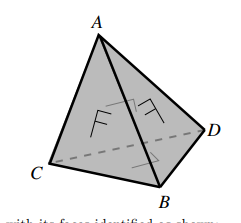
Use cellular chain complexes to compute the homology of the space obtained by gluing the faces of a solid tetrahedron as shown, with \(ABC\) glued to \(ABD\) and \(ACD\) glued to \(BCD\).
Solution
1. The source gluing is the same tetrahedron quotient as the Summer 2007 UCSD problem: \(ABC\) is glued to \(ABD\) by \(A\mapsto A\), \(B\mapsto B\), \(C\mapsto D\), and \(BCD\) is glued to \(ACD\) preserving the listed vertex order.
These are exactly the affine face maps encoded by the repeated source glyphs; the same quotient is stated explicitly in the retained Summer 2007 source.
2. There are two vertex classes, \(A\sim B\) and \(C\sim D\). The six edges form three classes: a loop \(a=[AB]\) at the first vertex, a loop \(c=[CD]\) at the second, and one edge \(e=[AC]=[AD]=[BC]=[BD]\) joining them.
The first face map identifies \(AC\sim AD\) and \(BC\sim BD\). The second identifies \(BC\sim AC\) and \(BD\sim AD\), while also identifying \(B\sim A\) and preserving \(C\sim C\), \(D\sim D\). Thus all four cross-edges form one class.
3. The two face-pairs give two \(2\)-cells \(f_1,f_2\), with cellular boundaries\[\partial_2(f_1)=a,\qquad \partial_2(f_2)=c\](up to signs and the choice of orientations).
Traversing \(ABC\) gives \(AB\cdot BC\cdot CA=aee^{-1}=a\). Traversing \(BCD\) gives \(BC\cdot CD\cdot DB=ece^{-1}\), whose cellular boundary is \(c\) because the two occurrences of \(e\) cancel.
4. With bases \((a,c,e)\) for \(C_1\) and the two vertex classes for \(C_0\), one has\[\operatorname{rank}\partial_1=1,\qquad \ker\partial_1=\langle a,c\rangle=\operatorname{im}\partial_2.\]
The loops \(a,c\) have zero boundary, while \(e\) joins the two distinct vertex classes. By 3, the image of \(\partial_2\) is exactly the span of \(a,c\).
5. The map \(\partial_2:C_2\cong\mathbb Z^2\to C_1\) is injective, and therefore the top boundary \(\partial_3:C_3\cong\mathbb Z\to C_2\) is zero.
The two images \(a,c\) are independent, so \(\partial_2\) is injective. Since \(\partial_2\partial_3=0\), injectivity forces \(\partial_3=0\).
6. Hence\[\boxed{H_i(X;\mathbb Z)\cong\begin{cases} \mathbb Z,&i=0,3,\\ 0,&i=1,2\text{ or }i>3. \end{cases}}\]
The quotient is connected, so \(H_0\cong\mathbb Z\). The equality in 4 gives \(H_1=0\); injectivity in 5 gives \(H_2=0\); and \(\partial_3=0\) gives \(H_3\cong\mathbb Z\).