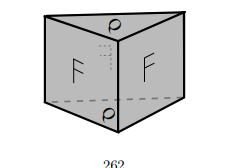
Use cellular chain complexes to compute the homology of the solid triangular prism whose faces are identified as shown.
Solution
1. The top and bottom triangular faces are identified by the common \(Q\) marking, and the three rectangular side faces are identified by the common \(F\) marking. Thus the quotient is\[X\cong D\times S^1,\]where \(D\) is the dunce cap obtained by identifying the three sides of a triangle in the source orientation pattern.
The \(Q\) pairing first turns \(\Delta^2\times I\) into \(\Delta^2\times S^1\). The side-face identifications preserve the circle coordinate and identify the three boundary edges of \(\Delta^2\) by the standard dunce-cap pattern shown on the same source sheet.
2. The dunce cap \(D\) is contractible.
Its CW structure has one \(0\)-cell, one \(1\)-cell \(a\), and one \(2\)-cell attached by a word freely reducing to \(a^{\pm1}\). Thus the \(1\)-cell is killed; the standard elementary collapse/homotopy of the dunce cap then contracts the resulting complex to its vertex.
3. Projection \(D\times S^1\to S^1\) is a homotopy equivalence.
Choose a contraction of \(D\) to a point and take its product with \(S^1\).
4. Therefore\[\boxed{H_i(X;\mathbb Z)\cong\begin{cases} \mathbb Z,&i=0,1,\\ 0,&i\ge2. \end{cases}}\]
Use 3 and the integral homology of the circle.