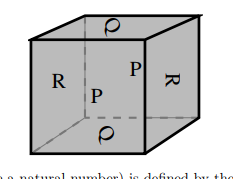
Use cellular chain complexes to compute the homology of the cube whose faces are identified in pairs according to the scheme shown.
Solution
1. The source diagram shows that the \(P\)- and \(Q\)-face pairs are identified by translations, while the \(R\)-face pair is identified by a \(180^\circ\) rotation.
The repeated \(P\) and \(Q\) glyphs have the same orientation on their paired parallel faces. The \(R\) glyph on the opposite face is rotated by \(180^\circ\). These glyph orientations are the pairing data in the original Fall 2022 exam diagram.
2. First quotient by the two translation pairings. A cross-section perpendicular to the \(R\)-direction becomes a torus \(T^2\), and the remaining \(R\)-pairing makes \(X\) the mapping torus of the half-turn\[ f:T^2\to T^2,\qquad f_*|_{H_1(T^2)}=-I. \]
The \(P\)- and \(Q\)-translations identify opposite sides in the two transverse coordinate directions, producing \(T^2\times I\). The half-turn of the remaining square face descends to the torus automorphism represented on \(H_1(T^2)\cong\mathbb Z^2\) by \(-I\).
3. The induced maps are\[ f_*=\operatorname{id}\text{ on }H_0(T^2),\qquad f_*=-I\text{ on }H_1(T^2),\qquad f_*=\operatorname{id}\text{ on }H_2(T^2). \]
The half-turn is orientation-preserving on the torus, hence acts by \(+1\) on \(H_2\), and it negates each standard \(H_1\) generator.
4. The Wang sequence for the mapping torus gives\[ 0\to\operatorname{coker}(1-f_*:H_k(T^2)\to H_k(T^2)) \to H_k(X) \to\ker(1-f_*:H_{k-1}(T^2)\to H_{k-1}(T^2))\to0. \]
This is the standard homology exact sequence of a mapping torus.
5. Therefore\[ \boxed{H_k(X;\mathbb Z)\cong \begin{cases} \mathbb Z,&k=0,3,\\ \mathbb Z\oplus(\mathbb Z/2)^2,&k=1,\\ \mathbb Z,&k=2,\\ 0,&k>3. \end{cases}} \]
On \(H_1(T^2)\), \(1-f_*=2I\), so its cokernel is \((\mathbb Z/2)^2\) and its kernel is \(0\). On \(H_0\) and \(H_2\), \(1-f_*=0\). Thus \(H_1\) is an extension of \(\mathbb Z\) by \((\mathbb Z/2)^2\), which splits because \(\mathbb Z\) is free; \(H_2\cong\mathbb Z\); and \(H_3\cong\mathbb Z\).