- \(S^2\)
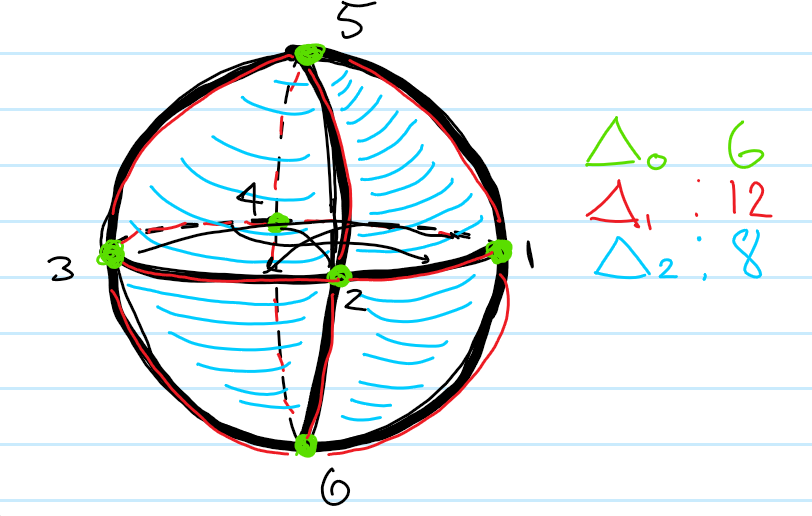 So we have \(C_0 =
1,2,3,4,5,6\) \(C_1 =
12,14,15,16,23,25,26,34,35,36,45,46\) \(C_2 = 126, 236, 346, 146, 125, 235, 345,
145\)
\(C_3 = \emptyset\)
And \(0 \xrightarrow{\del_3} C_2 \xrightarrow{\del_2} C_1 \xrightarrow{\del_1} C_0 \xrightarrow{\del_0} 0 \cong 0 \xrightarrow{\del_3} \ZZ^{8} \xrightarrow{\del_2} \ZZ^{12} \xrightarrow{\del_1} \ZZ^{6} \xrightarrow{\del_0} 0\) We have \(\del_1([ij]) = j-i\) and \(\del_2([ijk]) = jk -ik +ij\).
We know in advance we should have \(\prod H_n = (\cdots,0, \ZZ, 0, \ZZ)\).
For \(H_0 = \frac{\ker \del_0}{\im \del_1} = \frac{C_0}{\left<\theset{j-i \mid i < j}\right>}\). In the quotient, we see \(1=6=3=2=5=4\) by just taking the indicated walk on the graph, so there is one generator in the quotient and \(H_0 \cong \ZZ\).
For \(H_1 = \frac{\ker \del_1}{\im \del_2}\), we just note that there are 6 2-cycles, so each are in the kernel of \(\del_1\), but each of them comes from a 2-cell, so is in the image of \(\del_2\). So both groups in question are \(\ZZ^8\), and the quotient is zero. For \(H_3 = \frac{\ker\del_2}{\im\del_3}\), since \(\im\del_3 = 0\), we can just look at \(\del_3([123456]) = 23456 - 13456 + 12456 - 12356 +12346 - 12345\). This is an element (and the only one) that goes to zero under \(\del_2\), it generates \(\ker\del_2\). So there is one generator, and \(H_3 =\ZZ\).
Solution
1. The listed triangulation has \(V=6\), \(E=12\), and \(F=8\), and its underlying space is \(S^2\).
The eight listed triangles form the indicated triangulated sphere; each edge lies in exactly two triangles.
2. Since the complex is connected, \(H_0\cong\mathbb Z\).
Zeroth simplicial homology of a connected complex is \(\mathbb Z\).
3. The oriented sum of all eight triangular faces, with coherent orientations, is a \(2\)-cycle generating \(H_2\cong\mathbb Z\).
Every edge occurs twice with opposite induced orientations, so the boundary cancels. For a connected triangulated closed orientable surface this fundamental cycle generates top homology.
4. Euler characteristic gives\[2=V-E+F=\operatorname{rank}H_0-\operatorname{rank}H_1+\operatorname{rank}H_2,\]so \(H_1=0\).
The chain groups are free, and \(H_0,H_2\) each have rank \(1\). Since the underlying sphere has no torsion in \(H_1\) (equivalently, compute the boundary matrix), its rank-zero first homology vanishes.
5. Thus\[\boxed{H_k(S^2;\mathbb Z)\cong\begin{cases}\mathbb Z,&k=0,2,\\0,&\text{otherwise.}\end{cases}}\]
There are no simplices above dimension \(2\).