Show that if \(a>0\), then \[ \int_{0}^{\infty} \frac{\log x}{x^{2}+a^{2}} d x=\frac{\pi}{2 a} \log a .\]
Hint: use the following contour.
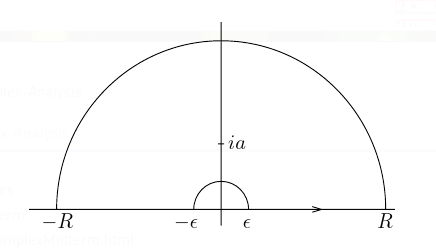
Solution
Let \(\Log\) be the branch of the logarithm on \(\CC\setminus[0,\infty)\) with argument in \((0, 2\pi)\). For \(0<\varepsilon<a<R\), let \(\Gamma\) be the keyhole contour consisting of the segment \([\varepsilon, R]\) on the upper edge of the cut, the circle \(\abs z = R\) counterclockwise, the segment from \(R\) to \(\varepsilon\) on the lower edge, and the circle \(\abs z = \varepsilon\) clockwise. Put \[f(z) \coloneqq \frac{\Log z}{z^2 + a^2}, \qquad g(z) \coloneqq \frac{(\Log z)^2}{z^2 + a^2}, \qquad I \coloneqq \int_0^{\infty} \frac{\log x}{x^2 + a^2}\, dx.\]
1. On the upper edge \(\Log z = \log x\), and on the lower edge \(\Log z = \log x + 2\pi i\).
Approaching the positive real axis from above, \(\arg z\to0\); from below, \(\arg z\to2\pi\).
2. For \(h\in\{f,g\}\), the integrals of \(h\) over \(\abs z = R\) and \(\abs z = \varepsilon\) tend to \(0\) as \(R\to\infty\) and \(\varepsilon\to0\).
On \(\abs z = r\), \(\abs{\Log z} \le \abs{\log r} + 2\pi\) and \(\abs{z^2 + a^2} \ge \abs{r^2 - a^2}\). The circle has length \(2\pi r\), so the integral of \(h\) over it is at most \(2\pi r\,(\abs{\log r} + 2\pi)^2/\abs{r^2 - a^2}\) (with exponent \(1\) in place of \(2\) for \(f\)). This tends to \(0\) as \(r\to\infty\) and as \(r\to0\).
3. \(\displaystyle\int_0^{\infty} \frac{dx}{x^2 + a^2} = \frac{\pi}{2a}\).
3.1. The two edges contribute \(-2\pi i \int_\varepsilon^R \frac{dx}{x^2 + a^2}\) to \(\int_\Gamma f\).
By step 1, and since the lower edge runs from \(R\) to \(\varepsilon\), the two edges give \[\int_\varepsilon^R \frac{\log x}{x^2 + a^2}\, dx - \int_\varepsilon^R \frac{\log x + 2\pi i}{x^2 + a^2}\, dx.\]
3.2. \(\Res_{z=ia} f + \Res_{z=-ia} f = -\dfrac{\pi}{2a}\).
The poles \(\pm ia\) are simple, \(z^2 + a^2 = (z-ia)(z+ia)\), \(\Log(ia) = \log a + i\pi/2\), and \(\Log(-ia) = \log a + 3i\pi/2\). Hence \[\Res_{z=ia} f + \Res_{z=-ia} f = \frac{\log a + i\pi/2}{2ia} + \frac{\log a + 3i\pi/2}{-2ia} = \frac{-i\pi}{2ia}.\]
3.3. Q.E.D.
Both poles lie inside \(\Gamma\), so the residue theorem and step 2 give \(\int_\Gamma f = 2\pi i\cdot(-\pi/(2a)) = -i\pi^2/a\). Letting \(\varepsilon \to 0\) and \(R \to \infty\), steps 2 and 1 give \(-2\pi i \int_0^{\infty} \frac{dx}{x^2 + a^2} = -\frac{i\pi^2}{a}\).
4. The two edges contribute \(\displaystyle\int_\varepsilon^R \frac{-4\pi i \log x + 4\pi^2}{x^2 + a^2}\, dx\) to \(\int_\Gamma g\).
By step 1, and since the lower edge runs from \(R\) to \(\varepsilon\), the edges give \(\int_\varepsilon^R \frac{(\log x)^2 - (\log x + 2\pi i)^2}{x^2 + a^2}\, dx\). Expand \((\log x + 2\pi i)^2 = (\log x)^2 + 4\pi i \log x - 4\pi^2\).
5. \(\displaystyle\int_\Gamma g = -\frac{2\pi^2 i}{a}\log a + \frac{2\pi^3}{a}\).
The residues are \(\Res_{z=ia} g = \frac{(\log a + i\pi/2)^2}{2ia}\) and \(\Res_{z=-ia} g = \frac{(\log a + 3i\pi/2)^2}{-2ia}\). By the difference of squares, their sum is \[\frac{1}{2ia}(-i\pi)(2\log a + 2i\pi) = -\frac{\pi}{a}(\log a + i\pi).\] Multiply by \(2\pi i\).
6. \(I = \boxed{\dfrac{\pi}{2a}\log a}\).
Let \(\varepsilon \to 0\) and \(R \to \infty\) in \(\int_\Gamma g\). By steps 2, 3, 4, and 5, \[-4\pi i I + 4\pi^2 \cdot \frac{\pi}{2a} = -\frac{2\pi^2 i}{a}\log a + \frac{2\pi^3}{a}.\] The real terms \(4\pi^2 \cdot \frac{\pi}{2a}\) and \(\frac{2\pi^3}{a}\) are equal, leaving \(-4\pi i I = -\frac{2\pi^2 i}{a} \log a\).
7. Q.E.D.
Step 6 is the claimed identity.