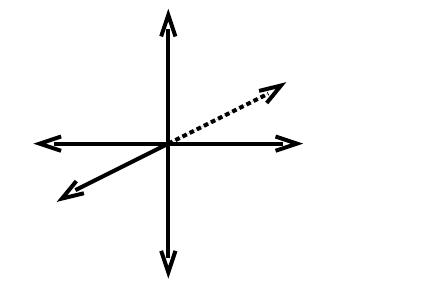
Find the fundamental group of the space \(X\) consisting of \(\RR^3\) with the three coordinate axes removed; see figure.
Solution
Let \(L\subset\RR^3\) be the union of the three coordinate axes, so that \(X=\RR^3\setminus L\), and let \(e_1,e_2,e_3\) be the standard basis of \(\RR^3\).
1. The space \(X\) strongly deformation retracts onto \(S^2\setminus\{\pm e_1,\pm e_2,\pm e_3\}\).
Every point of \(X\) is nonzero. Define \(H\colon X\times[0,1]\to\RR^3\) by \[H(v,t)=\left((1-t)+\frac{t}{\norm{v}}\right)v.\] The scalar multiplying \(v\) is strictly positive, so \(H(v,t)\) lies on the open ray from the origin through \(v\). Each coordinate axis is a union of rays from the origin, so if \(v\notin L\) then \(H(v,t)\notin L\); thus \(H\) takes values in \(X\).
At \(t=0\) it is the identity, and \(H(v,1)=v/\norm{v}\in S^2\). If \(v\in S^2\cap X\), then \(H(v,t)=v\) for every \(t\). Finally, \(S^2\cap L=\{\pm e_1,\pm e_2,\pm e_3\}\). Hence \(H\) is a strong deformation retraction of \(X\) onto \(S^2\setminus\{\pm e_1,\pm e_2,\pm e_3\}\).
2. \(S^2\setminus\{\pm e_1,\pm e_2,\pm e_3\}\) is homeomorphic to \(\RR^2\setminus\{p_1,\ldots,p_5\}\) for five distinct points \(p_1,\ldots,p_5\in\RR^2\).
Stereographic projection from \(-e_3\) is a homeomorphism \(S^2\setminus\{-e_3\}\cong\RR^2\). It sends the other five deleted points to five distinct points \(p_1,\ldots,p_5\in\RR^2\), and its restriction is the required homeomorphism.
3. \(\RR^2\setminus\{p_1,\ldots,p_5\}\) is homotopy equivalent to \(\bigvee_{i=1}^5 S^1\).
Choose a closed disk \(D\subset\RR^2\) containing all five punctures in its interior. Radially collapsing the complement of \(D\) onto \(\partial D\) gives a strong deformation retraction of \(\RR^2\setminus\{p_1,\ldots,p_5\}\) onto \(D\setminus\{p_1,\ldots,p_5\}\).
Choose pairwise disjoint closed disks \(D_i\) centered at \(p_i\) and contained in \(\operatorname{int}D\). Inside each punctured disk \(D_i\setminus\{p_i\}\), push points radially outward to \(\partial D_i\), fixing the complement of the interiors of the \(D_i\). This gives a deformation retraction onto the disk with five holes \(M=D\setminus\bigcup_{i=1}^5\operatorname{int}(D_i)\).
Choose five pairwise disjoint arcs joining the five inner boundary circles to the outer boundary. Cutting \(M\) along these arcs produces a disk, so \(M\) has a handle decomposition with one \(0\)-handle and five \(1\)-handles. Collapsing the \(0\)-handle to a point and each \(1\)-handle across its transverse interval gives a deformation retraction onto the core graph \(\bigvee_{i=1}^5 S^1\).
4. Q.E.D.
By steps 1, 2, and 3, \(X\simeq\bigvee_{i=1}^5S^1\). By the Seifert–van Kampen theorem, \[\pi_1(X)\cong\pi_1\Bigl(\bigvee_{i=1}^5S^1\Bigr)\cong\underbrace{\ZZ*\cdots*\ZZ}_{5\text{ factors}}=\boxed{F_5},\] the free group of rank \(5\).