Define \[ f(x) \da x^4 + 4x^2 + 64 \in \QQ[x] .\]
Find the splitting field \(K\) of \(f\) over \(\QQ\).
Find the Galois group \(G\) of \(f\).
Exhibit explicitly the correspondence between subgroups of \(G\) and intermediate fields between \(\QQ\) and \(K\).
- Useful trick: given \(a + \sqrt{b}\), try to rewrite this as \((\sqrt{c} + \sqrt{d})^2\) for some \(c, d\) to get a better basis for \(\SF(f)\).
Solution
First consider \(g(z) \da z^2 + 4z + 64\). Applying the quadratic formula yields \[ z = {-4 \pm \sqrt{16 - 64} \over 2} = -2 \pm {1\over 2}\sqrt{ -15 \cdot 16 } = -2 \pm 2i \sqrt{15} .\]
Substituting \(z=x^2\) yields the splitting field of \(f\) as \(L\da \QQ(\pm \sqrt{ -2 \pm 2i\sqrt{15}})\).
- Note that this factorization shows that \(f\) is irreducible over \(\QQ\), since the two quadratic factors have irrational coefficients and none of the roots are real.
- Irreducible implies separable over a perfect field, so \(L/\QQ\) is a separable extension.
- \(L\) is the splitting field of a separable polynomial and thus normal, making \(L\) Galois.
In this form, it’s not clear what the degree \([L:\QQ]\) is, so we can find a better basis by rewriting the roots of \(g\): \[ z = -2 \pm 2i\sqrt{15} = \qty{\sqrt{5}}^2 - \qty{\sqrt 3}^2 \pm 2i\sqrt{5}\sqrt{3} = (\sqrt 5 \pm i\sqrt{3})^2 ,\] and so the roots of \(f\) are \(x = \pm \sqrt{5} \pm i\sqrt{3}\) and \(L = \QQ(\sqrt 5, i\sqrt 3)\).
Counting in towers, \[ [L:\QQ] = [\QQ(\sqrt 5, i \sqrt{3} ) : \QQ \sqrt{5} ][\QQ \sqrt{5} : \QQ] = (2)(2) = 4 ,\] where we’ve used that \(\min_{\sqrt 5, \QQ}(x) = x^2-5\) and \(\min_{i\sqrt 3, \QQ}(x) = x^2 + 3\), which remains the minimal polynomial over \(\QQ(\sqrt 5) \subseteq \RR\) since both roots are not real.
So \(G\da \Gal(L/\QQ) \leq S_4\) is a transitive subgroup of size 4, making it either \(C_4\) or \(C_2^2\).
Label the roots: \[ r_1 &= \sqrt 5 + i\sqrt 3 \\ r_2 &= \sqrt{5} - i \sqrt{3} \\ r_3 &= - \sqrt 5 + i\sqrt 3 = -r_2 \\ r_4 &= -\sqrt{5} - i\sqrt{3} = -r_1 .\]
We can start writing down automorphisms: \[ \sigma_1: \begin{cases} \sqrt 5 &\mapsto -\sqrt 5 \\ i\sqrt 3 &\mapsto i\sqrt 3 . \end{cases} && \sigma_1 \sim (1,3)(2,4) \\ \sigma_2 \begin{cases} \sqrt 5 &\mapsto \sqrt 5 \\ i\sqrt 3 &\mapsto -i\sqrt 3 . \end{cases} && \sigma_2 \sim (1, 2)(3, 4) .\] Note that these define automorphisms because we’ve specified what happens to a basis and they send roots to other roots.
Checking that \(\sigma_1^2 = \sigma_2^2 = \id\), this produces two distinct order 2 elements, forcing \(G \cong C_2^2\) since \(C_4\) only has one order 2 element. Explicitly, we have \[ C_2^2 \cong G = \gens{\tau_1, \tau_2} = \ts{\id, \tau_1, \tau_2, \tau_1 \tau_2} = \ts{\id, (1,3)(2,4), (1,2)(3,4), (1,4)(2,3) } ,\] and the generic subgroup lattice looks like:
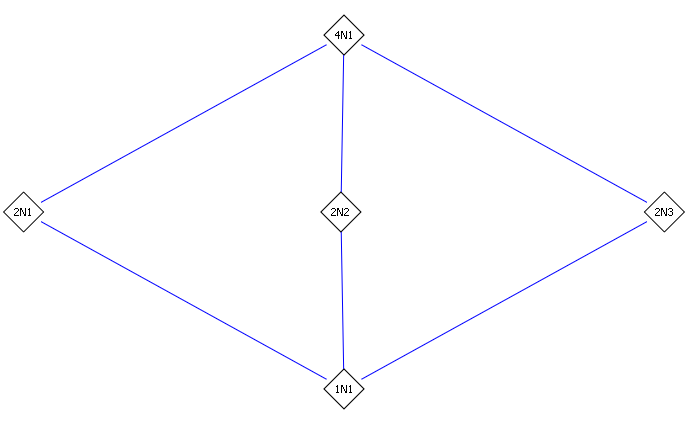
Computing some fixed fields. Write \(i \sqrt{3} = x, \sqrt{5} = y\), then elements in the splitting field are of the form \(\alpha = 1 + ax + by + cxy\).
For \(\sigma_1\), we have \(x\mapsto -x\), so \[ \sigma_1(\alpha) = 1 - ax + by - cxy = \alpha \implies a=-a=0, c=-c=0 ,\] so this preserves \(1+by\), making the fixed field \(\QQ(1, y) = \QQ(i \sqrt{3})\).
For \(\sigma_2\), we have \(y\mapsto -y\), so \[ \sigma_2(\alpha) = 1 +ax -by -cxy = \alpha \implies b=-b=0,c=-c=0 ,\] preserving \(1 + ax\) and making the fixed field \(\QQ(1, x) = \QQ(\sqrt 5)\).
For \(\sigma_1 \sigma_2\), we have \(x\mapsto -x\) and \(y\mapsto -y\), so \[ \sigma_1\sigma_2(\alpha) = 1 -ax -by +cxy = \alpha \implies a=-a=-, b=-b=0 ,\] preserving \(1 + cxy\) and yielding \(\QQ(xy) = \QQ(i\sqrt 3 \sqrt 5)\).
So the lattice correspondence we get here is