Let \(\xi\in \RR\), evaluate \[ \int_\RR {e^{i\xi x} \over \cosh(x)} \dx .\]
Solution
Note \(\cosh(z) \da {1\over 2}(e^z + e^{-z})\), and \[ \cosh(z) &= 0 \\ \iff e^z + e^{-z} &= 0 \\ \iff e^{-z}(e^{2z} + 1) &= 0 \\ \iff e^{2z} &= -1 \quad \text{since }\abs{e^{-z}} = e^{\Re(z)} > 0 \\ \iff 2z &= (2k+1)i\pi \\ \iff z &\in \ts{\cdots, {-3i\pi \over 2}, {-i\pi \over 2}, {i\pi \over 2}, {3i\pi \over 2}, \cdots} .\] So take the following rectangular contour enclosing the singularity \(z= i\pi/2\):
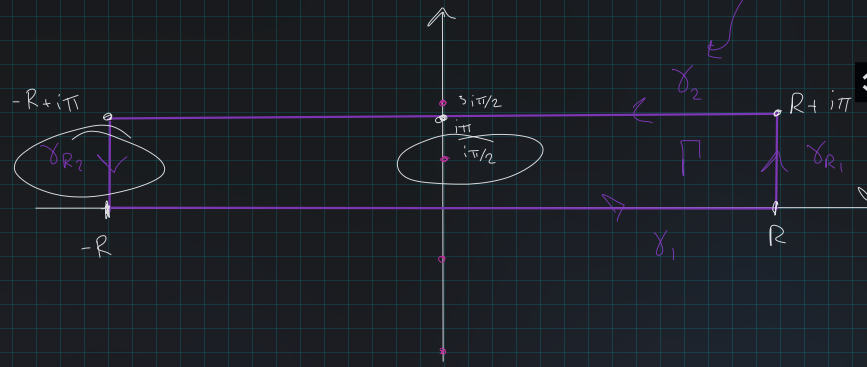
Then letting \(\Gamma\) be the entire contour and \(I\) be the desired integral, we can solve for \(I\): \[ \int_\Gamma f &= \int_{-R}^R f + \int_{\gamma_{R_1}} f + \int_{\gamma_2}f + \int_{\gamma_{R_2}} f \\ \int_\Gamma f &= I + \int_{\gamma_{R_1}} f + \int_{\gamma_2}f + \int_{\gamma_{R_2}} f \\ \\ I &= \int_{\gamma_{R_1}} f + \int_{\gamma_2}f + \int_{\gamma_{R_2}} f - \int_\Gamma f ,\] being very sloppy about the fact that we’re going to take \(R\to \infty\).
Computing the residue term \(\int_\Gamma f = 2\pi i \Res_{z=i\pi/2} f(z)\): \[ {1\over 2\ pi i } \int_\Gamma f &= \Res_{z = i\pi/2} f(z)\\ &= \Res_{z = i\pi/2} {e^{i\xi z} \over \cosh(z) } \\ &= {e^{i\xi z} \over \dd{}{t} \cosh(z) } \evalfrom_{i\pi/2}\\ &= {e^{i\xi \cdot i\pi/2} \over \sinh(i\pi/2)} \\ &= {e^{-\xi \pi/ 2} \over i} \\ \implies 2\pi i \Res_{z=i\pi/2} f(z) &= 2\pi e^{-\xi \pi/ 2} .\] using that \(2\sinh(i\pi/2) = e^{i\pi/2} - e^{-i\pi/2} = i-(-i) = 2i\).
The \(\gamma_2\) term: parameterize \(\gamma_2 = \ts{t + i\pi \st t\in [-R, R]}\), then \[ \int_{\gamma_2} f &= -\int_{-\gamma_2} f \\ &= -\int_{-R}^{R} { e^{iz} \over \cosh(t + i\pi) } \dz, \quad z = t+i\pi, \dz = \dt \\ &= -\int_{-R}^{R} { e^{i\xi(t+i\pi)} \over \cosh(t + i\pi) }\dt \\ &= -e^{-\xi \pi} \int_{-R}^R {e^{i\xi t} \over \cosh(t+i\pi)} \dt \\ &= e^{-\xi \pi} \int_{-R}^R {e^{i\xi t} \over \cosh(t)} \dt \\ &\da e^{-\xi \pi} I ,\] using that \(\cosh(z + i\pi) = -\cosh(z)\).
The two \(\gamma_{R_i}\) terms: the claim is that these vanish in the limit \(R\to \infty\). Parameterize \(\gamma_{R_2} = \ts{R = i \pi t \st t\in [0, 1]}\), then \[ \abs{\int_{\gamma_{R_2}} f} &= \abs{ \int_0^1 {e^{i\xi(R+i\pi t)} \over \cosh(R + i\pi t)} \dt } \\ &= \abs{ 2e^{i\xi R} \int_0^1 {e^{-\xi \pi t } \over {e^{R+ i\pi t} + e^{-R - i\pi t}} } \dt } \\ &\leq 2 \int_0^1 \abs{ {e^{-\xi \pi t } \over {e^{R+ i\pi t} + e^{-R - i\pi t}} } } \dt \\ &\leq 2 \int_0^1 {e^{-\xi \pi t } \over { \abs{ e^{R+ i\pi t} } - \abs{ e^{-R - i\pi t} } } }\dt \\ &= 2 \int_0^1 {e^{-\xi\pi t} \over e^R - e^{-R} } \\ &= { 2\over e^R - e^{-R}} \int_0^1 e^{-\xi \pi t} \dt \\ &= {2\over e^R - e^{-R}} \qty{-1\over \xi \pi} e^{\xi \pi t}\evalfrom_{t=0}^{t=1} \\ &= {2\over e^R - e^{-R}} \qty{1 - e^{-\pi \xi } \over \xi \pi} \\ &\convergesto{R\to\infty} 0 .\]
Putting it all together: \[ (1 + e^{-\xi \pi}) I &= 2\pi e^{-\xi \pi / 2} \\ \implies I &= {2\pi e^{-\xi \pi / 2} \over 1 + e^{-\xi \pi }} \\ &= {2\pi \over e^{\xi\pi/2} (1 + e^{-\xi \pi })} \\ &= {2\pi \over e^{\xi\pi/2} + e^{-\xi\pi/2} } \\ &= {2\pi \over 2\cosh(\xi\pi/2)} \\ &= {\pi \over \cosh\qty{\xi\pi\over 2}} \\ \\ &= \pi \sech\qty{\xi\pi\over 2 } .\]