Consider the function \(f(z)=\frac{1}{2}\left(z+\frac{1}{z}\right)\) for \(z \in \mathbb{C} \backslash\{0\}\). Let \(\mathbb{D}\) denote the open unit disc.
Show that \(f\) is one-to-one on the punctured disc \(\mathbb{D} \backslash\{0\}\). What is the image of the circle \(|z|=r\) under this map when \(0<r<1\) ?
Show that \(f\) is one-to-one on the domain \(\mathbb{C} \backslash \mathbb{D}\). What is the image of this domain under this map?
Show that there exists a map \(g: \mathbb{C} \backslash[-1,1] \rightarrow \mathbb{D} \backslash\{0\}\) such that \((g \circ f)(z)=z\) for all \(z \in \mathbb{D} \backslash\{0\}\). Describe the map \(g\) by an explicit formula.
Solution
Part a: That \(f: \CC\smz\to \DD\smz\) is injective: compute the derivative as \[ f'(z) = {1\over 2}\qty{1 - {1\over z^2}} ,\] which only vanishes at \(z=\pm 1\). Away from 0 in \(\DD\), \(f'\) is nonzero and continuous, so by the inverse function theorem \(f\) is a local homeomorphism onto its image, and in particular is injective.
The images of circles: parameterize one as \(\gamma(t) = Re^{it}\) for \(t\in [-\pi, \pi]\). Note that if \(R=1\), \(f(\gamma(t)) = {1\over 2}\qty{e^{it} + e^{-it}} = \cos(t)\), so as \(t\) increases from \(-\pi\to \pi\), the interval \([-1, 1]\) is covered twice. For \(0<R<1\), \[ f(\gamma(t)) &= {1\over 2}\qty{ Re^{it} + {1\over Re^{it}}} \\ &= {1\over 2}\qty{Re^{it} + \inverseof{R} e^{-it} } \\ &= {1\over 2}\qty{R\cos(t) + iR\sin(t) + \inverseof{R}\cos(-t) + i\inverseof{R}\sin(-t) } \\ &= {1\over 2}\qty{R\cos(t) + iR\sin(t) + \inverseof{R}\cos(t) - i\inverseof{R}\sin(-t) } \\ &= {1\over 2}\qty{R+\inverseof{R}}\cos(t) + i{1\over 2}\qty{R-\inverseof{R}}\sin(t) \\ &\da H_R \cos(t) + iV_R\sin(t) ,\] which is generally the equation of an ellipse of horizontal radius \(H_R\) and vertical radius \(V_R\). As \(R\) varies, these sweep out ellipses of vertical radii from 0 to \(\infty\). One can compute the foci: their distance from \(z=0\) is given by \(c\), where \[ c^2 = H_R^2 - V_R^2 = {1\over 4}(R+\inverseof{R})^2 - {1\over 4}(R-\inverseof{R})^2 = 1 ,\] so the foci are all at \(\pm 1\in \RR\). One can check that these are clockwise when \(0<R<1\) and counterclockwise when \(R>1\).
In general, you take the coefficient for the major axis squared minus that of the minor axis squared. The foci are along the major axis.
Part b: The claim is that \(f(\CC\sm\DD) = \CC\sm[-1, 1]\).
Note that \(f(z) = f(1/z)\), so for \(z\neq 1/z\) there are exactly two preimages. These points are exactly \(z=\pm 1\), so we need to take the domain \(\Omega \da \CC\sm(\DD\union\ts{\pm 1})\) to get injectivity. Otherwise, for every \(z\in \Omega\), exactly one of \(z\) or \(1/z\) is in \(\DD\), so \(f(z)\) takes on unique values in \(\Omega\). By part 1, the images of circles of radius \(R\) are ellipses, and these sweep out the entire plane outside of \([-1, 1]\):
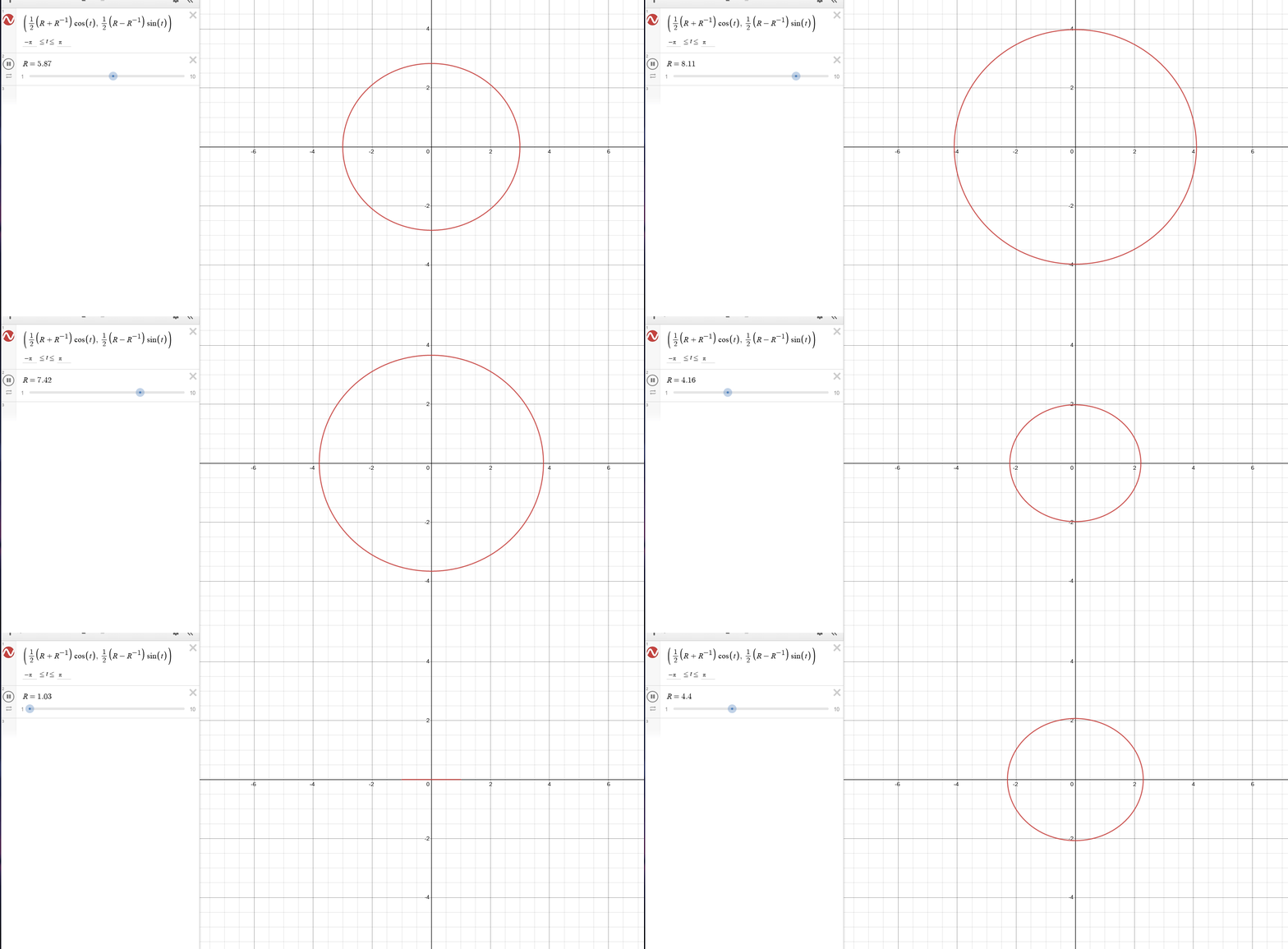
To be explicit, one can just solve for the two preimages. Setting \(w=f(z)\) and solving for \(z\) yields \[ w &= {1\over 2}\qty{z + {1\over z}} \\ \implies 2wz &= z^2 + 1 \\ \implies z^2 - 2wz + 1 &= 0 \\ \implies z &= {2w \pm \sqrt{4w^2 -4} \over 2} \\ \implies z &= w\pm \sqrt{w^2-1} ,\] where in order to define \(\sqrt{w^2-1}\), one needs a branch cut for \(\Log\) along \([-1, 1]\), which is precisely what we’re deleting from the image.
Part c: as in a usual conformal map problem, find a map to \(\CC\sm[-1,1]\to \DD\).
Send \(-1\to 0\) and \(1\to \infty\) with \(z\mapsto {z+1\over z-1}\). Checking that \(f(0) = -1\), this yields \(\CC\sm\RR_{\leq 0}\).
Unwrap with \(z\mapsto \sqrt{z}\) to obtain the right half-plane \(-\pi/2<\Arg(z) < \pi/2\).
Apply the rotated Cayley map \(z\mapsto {z-1\over z+1}\) to map this to \(\DD\).
This composes to \[ g(z) &= {\sqrt{z+1\over z-1} -1 \over \sqrt{z+1\over z-1} +1} \\ &= { \qty{ \sqrt{z+1} - \sqrt{z-1}}^2 \over (z+1)-(z-1) } \\ &= z - \sqrt{z^2-1} ,\] and checking that it has the right inverse: \[ w &= z-\sqrt{z^2-1} \\ \implies (z-w)^2 &= z^2-1 \\ \implies w^2+1 &= 2wz \\ \implies z = {1\over 2}\qty{w + {1\over w}} .\]