Let \(X\) and \(Y\) be nonempty topological spaces. Show that \(X \cross Y\) is compact if and only if both \(X\) and \(Y\) are compact.
- Proof of the tube lemma:
- Continuous image of compact is compact.
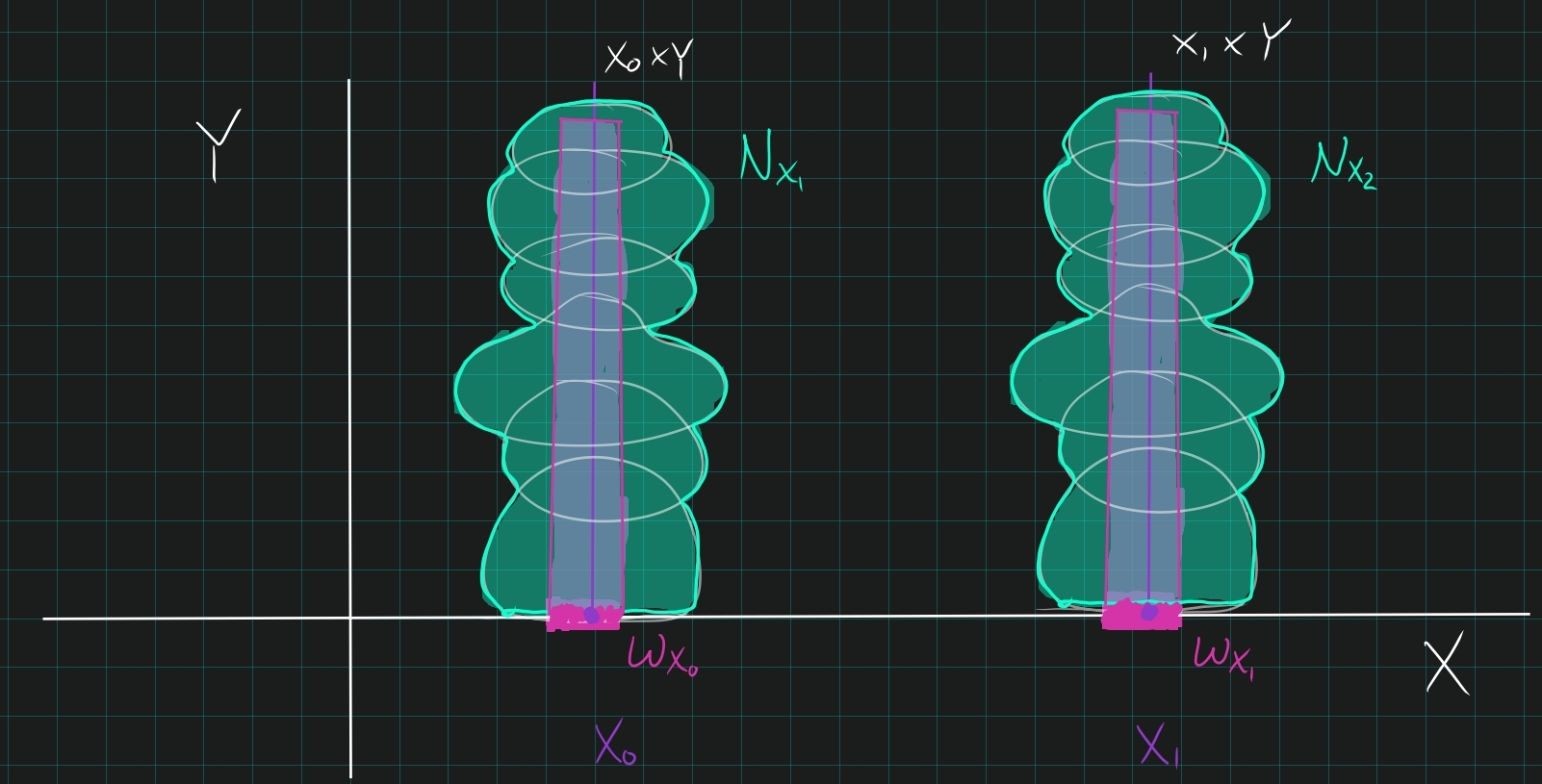
Take an open cover of the product, use that vertical fibers are compact to get a finite cover for each fiber. Use tube lemma to get opens in the base space, run over all \(x\) so the tube bases cover \(X\). Use that \(X\) is compact to get a finite subcover.
Solution
1. If \(X\times Y\) is compact, then both \(X\) and \(Y\) are compact.
The coordinate projections \[ \pi_X:X\times Y\to X, \qquad \pi_Y:X\times Y\to Y \] are continuous. Because both factors are nonempty, the projections are surjective. Continuous images of compact spaces are compact, so \[ X=\pi_X(X\times Y), \qquad Y=\pi_Y(X\times Y) \] are compact.
2. Suppose \(X\) and \(Y\) are compact, and let \(\mathcal U\) be an open cover of \(X\times Y\).For every \(x\in X\), there is an open neighborhood \(V_x\) of \(x\) such that \(V_x\times Y\) is covered by finitely many members of \(\mathcal U\).
Fix \(x\in X\). The fiber \(\{x\}\times Y\) is homeomorphic to the compact space \(Y\), so finitely many members \[ U_{x,1},\ldots,U_{x,m_x}\in\mathcal U \] cover it. Set \[ W_x=U_{x,1}\cup\cdots\cup U_{x,m_x}. \] Then \(W_x\) is open in \(X\times Y\) and contains \(\{x\}\times Y\). By the tube lemma, there is an open neighborhood \(V_x\ni x\) such that \[ V_x\times Y\subseteq W_x. \] Thus the same finitely many \(U_{x,j}\) cover \(V_x\times Y\).
3. If \(X\) and \(Y\) are compact, then \(X\times Y\) is compact.
The family \(\{V_x:x\in X\}\) from 2 is an open cover of \(X\). Compactness of \(X\) gives points \(x_1,\ldots,x_r\) such that \[ X=V_{x_1}\cup\cdots\cup V_{x_r}. \] For each \(i\), 2 supplies finitely many members of \(\mathcal U\) covering \(V_{x_i}\times Y\). The union of these finitely many finite subfamilies covers \[ X\times Y =\bigcup_{i=1}^r(V_{x_i}\times Y). \] Hence \(\mathcal U\) has a finite subcover.
4. The nonempty hypothesis is necessary for the implication in
1.
If \(Y=\emptyset\), then \(X\times Y=\emptyset\) is compact for every space \(X\), including noncompact spaces.