Find a conformal map from the intersection of \(|z-1|<2\) and \(|z+1|<2\) to the upper half plane.
DZG: I’m 90% sure this is meant to be \(\abs{z-1}, \abs{z+1} < \sqrt{2}\) or \(\abs{z-1}^2,\abs{z+1}^2 < 2\). Otherwise computing the argument of the resulting lines is tricky…
Solution
The region:
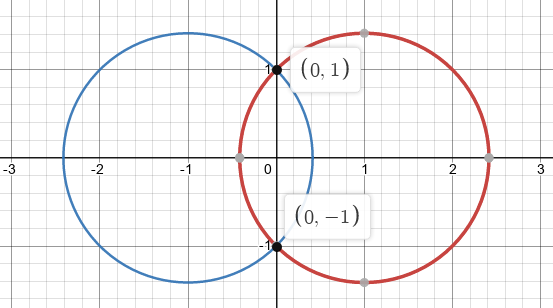
Note that you can find that \(i, -i\) are the intersection points by noting that \(i\RR\) is the perpendicular bisector through the line segment connecting the centers of the circles, then expanding \(\abs{z-1}^2 = (x-1)^2 + y^2 = 2\) and setting \(x=0\) to get \(y=\pm i\).
First rotate this by \(\pi/2\):
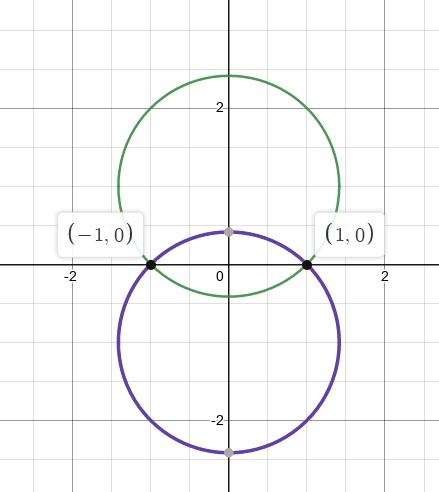
Call the upper circle \(C_1\) and the lower \(C_2\). Send \(-1\to 0, 1\to \infty\) by taking \[ f(z) \da {z+1\over z-1} .\] This sends the circles to lines through zero, and the lune now spans a triangular sector. Finding the angles of the lines: write \(c\da 1 + \sqrt{2}\). Note that \(f\) fixes \(\RR\), so the image regions are symmetric about \(\RR\), and it suffices to find the angle of the line \(f(C_1)\). Note that \(C_1 \intersect i\RR = ic\), so we compute \(\Arg(f(ic))\): \[ f(ic) &= {ic+1\over ic-1} \\ &= {(1+ic)^2 \over c^2 + 1} \\ &= {-1 + c^2 - 2ic \over c^2 + 1} \\ &= {c^2-1 \over c^2+1} -i {2c\over c^2+1} ,\] so \[ \Arg(f(ic)) &= \arctan\qty{ 2c\over -1 + c^2} \\ &= \arctan\qty{2(1+\sqrt 2) \over 1 - (3 + \sqrt 2)} \\ &= \arctan(-1) \\ &= {\pi\over 4} \text{ or } {3\pi \over 4} .\]
Thus \(f(C_1) = \ts{te^{-i\pi\over 4} \st t\in (-\infty, \infty)}\). Note that \(f(ic)\in Q_4\), since \(c^2-1, c^2+1 > 0\) and \({-2c\over c^2+1} < 0\). For the orientation of \(f(C_1)\), note that \((1, ic, -1) \mapsto (\infty, f(ic), 0)\), so the line is oriented from \(Q_4\) to \(Q_2\).
A similar computation shows \[ f(-ic) = {c^2-1\over c^2+1} + i{2\over c^2+1} \in Q_1 ,\] and \((-1, -ic, 1)\mapsto (0, f(-ic), \infty)\), so \(f(C_2)\) is oriented from \(Q_3\) to \(Q_1\).
Since the origin region was to the left of the curves, it remains to the left, so the resulting region is \(\ts{z\st 3\pi/4 < \Arg(z) < 5\pi/4}\):
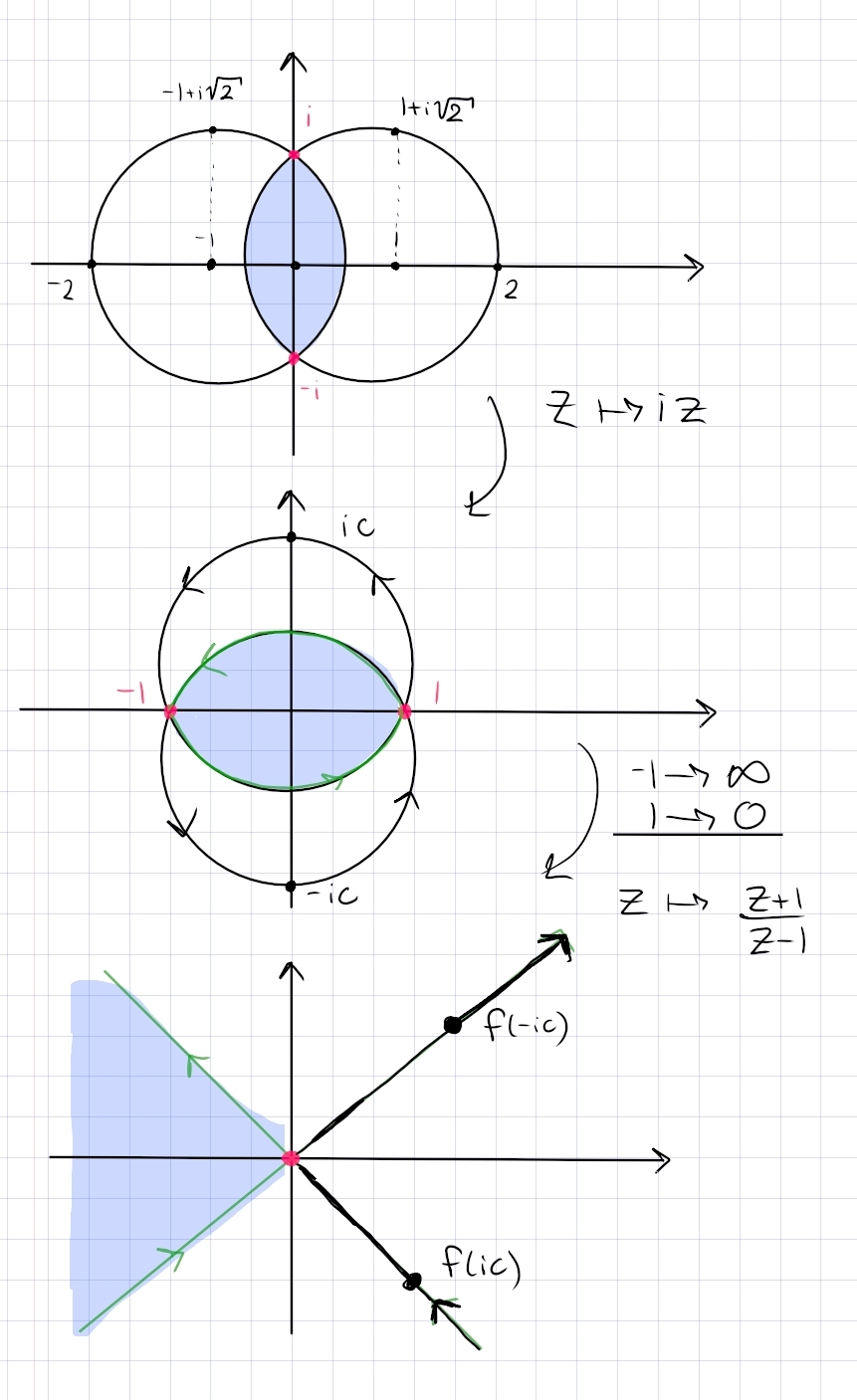
From here, it’s a standard exercise, so to sum up:
- Rotate \(R\to \tilde R\) by \(z\mapsto iz\) to get a horizontal lune with intersection points \(\pm 1\).
- Send \(-1\to \infty, 1\to 0\) by \(z\mapsto {z+1\over z-1}\) to send \(\tilde R \to 3\pi/4 < \Arg(z) < 5\pi/4\).
- Reflect by \(z\mapsto -z\) to get \(-\pi/4 < \Arg(z) < \pi/4\).
- “Open” by \(z\mapsto z^{\pi \over 2 \theta_0}\) to map to \(-\pi/2<\Arg(z) < \pi/2\), where here \(\theta_0 \da {\pi \over 4}\).
- Rotate by \(z\mapsto iz\) to get \(0 < \Arg(z) < {\pi \over 2}\), i.e. \(\HH\).
- Use the Cayley map \(z\mapsto {z-i\over z+i}\) to send \(\HH\to \DD\).