- Figure 8
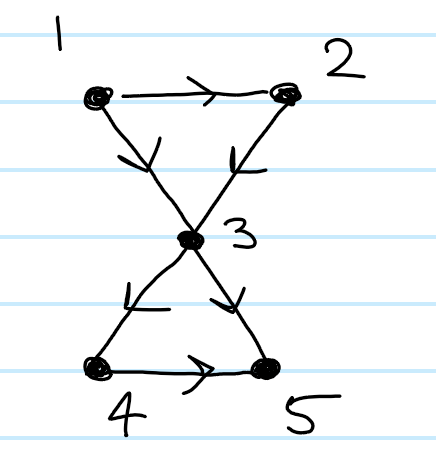 Here we have: \(C_3 =
\emptyset\) \(C_1 = [12], [23], [13],
[34], [35], [45] \cong \ZZ^6\) \(C_0 =
[1], [2], [3],[4], [5] \cong \ZZ^5\)
So we have \(C_2 \into C_1 \into C_0 \cong 0\xrightarrow{\del_2} \ZZ^6 \xrightarrow{\del_1} \ZZ^5\xrightarrow{\del_0} 0\)
Computing boundary operators, we have
\(\del_1([12]) = [2] - [1]\) \(\del_1([23]) = [3] - [2]\) \(\del_1([13]) = [3] - [1]\) \(\del_1([34]) = [4] - [3]\) \(\del_1([35]) = [5] - [3]\) \(\del_1([45]) = [5] - [4]\)
\(\del_0 = 0\)
And so \(H_0 = \ker \del_0/\im\del_1 = \frac{C_0}{<\del_1([ij])>}\), but from the above calculation we have \([5] = [4] = [3] = [2] = [1]\) in the quotient, so there is just one generator and \(H_0 \cong \ZZ\).
Note that \(\del_2\) is an injection from 0 into \(C_1\), since there are no 2-simplices. Moreover, one can generate two 1-cycles, so we have \(H_1 = \frac{\ker \del_1}{\im \del_2} =\frac{<[23]-[31] + [12],~[45] - [35] + [34]>}{0} \cong \ZZ^2\).
One way to see that these are the generators is to pretend there are two 2-simplices, \([123], [345]\) and compute \(\del_2\) of both of them. Since \(\del_1\del_2 = 0\), anything in the image of \(\del_2\) would have to go to zero anyways, and would thus be in the kernel of \(\del_1\). Since it’s not actually the boundary of any 2-chain, it doesn’t become trivial in homology.
So we have \(H_2 \into H_1 \into H_0 = 0 \into \ZZ^2 \into \ZZ\).
Solution
1. The displayed simplicial complex is a connected graph with \(V=5\) vertices and \(E=6\) edges and no simplices of dimension at least \(2\).
This is exactly the listed chain data.
2. Therefore \(H_0\cong\mathbb Z\) and \(H_k=0\) for \(k\ge2\).
Connectedness gives \(H_0\), and the simplicial chain groups vanish above degree \(1\).
3. The first homology is free of rank\[E-V+1=6-5+1=2.\]
For a connected finite graph, \(\operatorname{rank}H_1=E-V+1\), from the cellular chain complex or Euler characteristic.
4. Hence\[\boxed{H_k\cong\begin{cases}\mathbb Z,&k=0,\\\mathbb Z^2,&k=1,\\0,&k\ge2.\end{cases}}\]
Combine <1>2–<1>3.