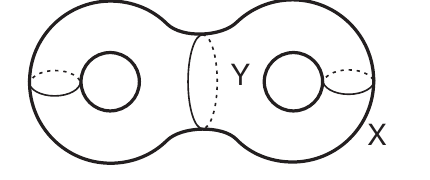
Let \(X\) be the surface of genus \(2\) shown below and let \(Y \supseteq X\) be the region of \(\mathbb{R}^3\) that it encloses. Show that there is no retraction \(r : Y \to X\) (that is, no continuous map for which \(r(x) = x\) for all \(x \in X\)).
Solution
Let \[ i:X\hookrightarrow Y \] be the inclusion.
1. If a retraction\[ r:Y\longrightarrow X \]existed, then the induced homomorphism\[ i_*:H_1(X;\mathbb Z)\longrightarrow H_1(Y;\mathbb Z) \]would be injective.
A retraction satisfies \[ r\circ i=\operatorname{id}_X. \] Functoriality of singular homology gives \[ r_*\circ i_*=(r\circ i)_*=\operatorname{id}_{H_1(X;\mathbb Z)}. \] Thus \(i_*\) has a left inverse, so \(i_*\) is injective.
2. The genus-\(2\) surface \(X\) has\[ H_1(X;\mathbb Z)\cong\mathbb Z^4. \]
A closed orientable surface of genus \(g\) has a CW structure with one \(0\)-cell, \(2g\) \(1\)-cells, and one \(2\)-cell whose attaching word is the product of the \(g\) commutators. After abelianization, the commutator attaching word gives zero boundary in degree \(1\). For \(g=2\) this yields \[ H_1(X;\mathbb Z)\cong\mathbb Z^{2g}=\mathbb Z^4. \]
3. The region \(Y\) bounded by \(X\) has\[ H_1(Y;\mathbb Z)\cong\mathbb Z^2. \]
The supplied figure shows \(Y\) as the standard genus-\(2\) handlebody. Collapse each solid handle to its core circle and the remaining central \(3\)-ball to the common basepoint. This gives a deformation retraction \[ Y\simeq S^1\vee S^1. \] Therefore \[ H_1(Y;\mathbb Z)\cong H_1(S^1\vee S^1;\mathbb Z)\cong\mathbb Z^2. \]
4. No retraction \(r:Y\to X\) exists.
If a retraction existed, <1>1–<1>3 would give an injective homomorphism \[ \mathbb Z^4\hookrightarrow\mathbb Z^2. \] Tensoring with \(\mathbb Q\) preserves injectivity because \(\mathbb Q\) is a flat \(\mathbb Z\)-module, so this would induce an injection \[ \mathbb Q^4\hookrightarrow\mathbb Q^2, \] which is impossible by dimension. Hence the assumed retraction cannot exist.