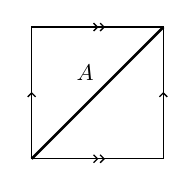
Consider the simple closed curve \(A\) contained in the torus \(T\), as shown below. Sometimes \(A\) is a called a \((1,1)\)-curve. Use the long exact sequence of relative homology groups to compute \(H_n(T,A)\) for all \(n\). (You may state the homology groups \(\widetilde H_n(T)\) and \(\widetilde H_n(S^1)\) without proof.)
Solution
Write \(T=S^1\times S^1\) with \(H_1(T)\cong\ZZ^2\) generated by the two circle factors, and let \(i\colon A\hookrightarrow T\) be the inclusion; \(A\cong S^1\).
1. \(i_*\colon H_1(A)\cong\ZZ\to H_1(T)\cong\ZZ^2\) sends a generator to \((1,1)\); it is injective with cokernel \(\ZZ\).
A \((1,1)\)-curve winds once around each circle factor, so its class is \((1,1)\). This vector is primitive, so \(i_*\) is injective and \(\ZZ^2/\langle(1,1)\rangle\cong\ZZ\), for example via \((a,b)\mapsto a-b\).
2. \(i_*\colon H_0(A)\to H_0(T)\) is an isomorphism.
\(A\) and \(T\) are connected and \(A\) is nonempty, so both groups are \(\ZZ\), generated by the class of a point of \(A\).
3. The long exact sequence of the pair \((T,A)\) gives the exact sequence\[0\to H_2(T)\to H_2(T,A)\to H_1(A)\xrightarrow{i_*}H_1(T)\to H_1(T,A)\to0,\]and \(H_0(T,A)=0\).
\(H_2(A)=0\) because \(A\cong S^1\). By step 2, \(H_0(A)\to H_0(T)\) is injective, so \(H_1(T,A)\to H_0(A)\) is zero; and it is surjective, so \(H_0(T,A)=0\).
4. Q.E.D.
By step 1, \(i_*\) is injective, so exactness in step 3 makes \(H_2(T)\cong\ZZ\to H_2(T,A)\) an isomorphism and identifies \(H_1(T,A)\) with \(\operatorname{coker}i_*\cong\ZZ\). For \(n\ge3\), \(H_n(T)\) and \(H_{n-1}(A)\) vanish, so \(H_n(T,A)=0\). Hence \[\boxed{H_n(T,A;\ZZ)\cong\begin{cases}\ZZ,&n=1,2,\\0,&\text{otherwise.}\end{cases}}\]