Show that \[ \int_{0}^{\infty} \sin \left(x^{2}\right) d x=\int_{0}^{\infty} \cos \left(x^{2}\right) d x=\frac{\sqrt{2 \pi}}{4} .\]
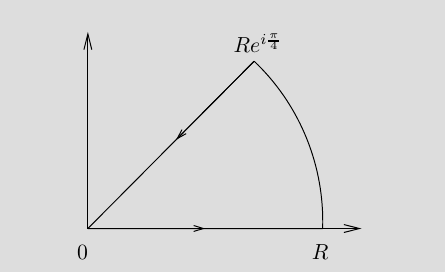
Hint: integrate \(e^{-x^2}\) over the following contour, using the fact that \(\int_{-\infty}^{\infty} e^{-x^{2}} d x=\sqrt{\pi}\):
Solution
For \(R>0\), let \(\Gamma_R\) be the boundary of the sector with vertices \(0\), \(R\), and \(Re^{i\pi/4}\), traversed along \([0,R]\), then along the arc \(\abs{z} = R\) from \(R\) to \(Re^{i\pi/4}\), then along the ray \(\arg z = \pi/4\) back to \(0\).
1. \(\displaystyle\int_{\Gamma_R} e^{-z^2}\, dz = 0\) for every \(R>0\).
The function \(e^{-z^2}\) is entire, so Cauchy’s theorem applies.
2. \(\displaystyle\int_0^R e^{-x^2}\, dx \to \frac{\sqrt{\pi}}{2}\) as \(R \to \infty\).
The integrand is even, so \(\int_0^\infty e^{-x^2}\, dx = \frac{1}{2}\int_{-\infty}^\infty e^{-x^2}\, dx = \frac{\sqrt\pi}{2}\).
3. The arc contribution \(\int_{\text{arc}} e^{-z^2}\, dz\) tends to \(0\) as \(R \to \infty\).
On the arc \(z = Re^{i\theta}\), \(0 \leq \theta \leq \pi/4\), one has \(\abs{e^{-z^2}} = e^{-R^2 \cos 2\theta}\). Since \(\theta\mapsto\cos 2\theta\) is concave on \([0,\pi/4]\), it lies above its chord: \(\cos 2\theta \geq 1 - 4\theta/\pi\). Hence \[\abs{\int_{\text{arc}} e^{-z^2}\,dz} \leq R\int_0^{\pi/4} e^{-R^2(1-4\theta/\pi)}\, d\theta = \frac{\pi}{4R}\bigl(1-e^{-R^2}\bigr) \leq \frac{\pi}{4R}.\]
4. \(\displaystyle\int_{\text{ray}} e^{-z^2}\, dz = -e^{i\pi/4}\int_0^R e^{-ir^2}\, dr\).
On the ray \(z = re^{i\pi/4}\) one has \(z^2 = ir^2\) and \(dz = e^{i\pi/4}\, dr\). The ray is traversed from \(R\) to \(0\), so the integral is \(\int_R^0 e^{-ir^2} e^{i\pi/4}\, dr\).
5. \(\displaystyle\int_0^\infty e^{-ir^2}\, dr = e^{-i\pi/4}\frac{\sqrt\pi}{2}\).
By step 1, \(\int_0^R e^{-x^2}\, dx + \int_{\text{arc}} e^{-z^2}\,dz + \int_{\text{ray}} e^{-z^2}\,dz = 0\). Letting \(R\to\infty\) and using steps <1>2–<1>4 gives \(\frac{\sqrt\pi}{2} - e^{i\pi/4}\int_0^\infty e^{-ir^2}\, dr = 0\).
6. \(\displaystyle\int_0^\infty \cos(r^2)\, dr = \int_0^\infty \sin(r^2)\, dr = \boxed{\frac{\sqrt{2\pi}}{4}}\).
Since \(e^{-ir^2}=\cos(r^2)-i\sin(r^2)\) and \(e^{-i\pi/4} = \frac{\sqrt2}{2}(1 - i)\), step 5 gives \[\int_0^\infty \cos(r^2)\, dr = \Re\int_0^\infty e^{-ir^2}\, dr = \frac{\sqrt2}{2}\cdot\frac{\sqrt\pi}{2}, \qquad \int_0^\infty \sin(r^2)\, dr = -\Im\int_0^\infty e^{-ir^2}\, dr = \frac{\sqrt2}{2}\cdot\frac{\sqrt\pi}{2}.\]
7. Q.E.D.
Step 6 proves both identities.