Let \(f\) be a holomorphic map of the open unit disc \(\DD\) to itself. Show that for any \(z, w\in \DD\), \[ \left|\frac{f(w)-f(z)}{1-\overline{f(w)} f(z)}\right| \leq\left|\frac{w-z}{1-\bar{w} z}\right| .\] Show that this inequality is strict for \(z\neq w\) except when \(f\) is a linear fractional transformation from \(\DD\) to itself.
The Schwarz conjugation trick:
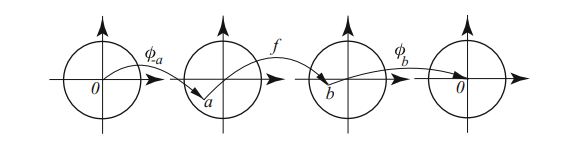
Write the RHS as \(a\), we then want something in the form \(\abs{F(a)}\leq \abs{a}\). The choice \(a=\psi_w(z)\) is forced, so \(z= \inverseof{\psi_w}(a)\). This forces the choice for the LHS \[ { f(w) - (f\circ \inverseof{\psi_w})(a) \over 1 - \bar{f(w)} (f\circ \inverseof{\psi_w})(a) } = (\psi_{f(w)} \circ f \circ \inverseof{\psi_w})(a) \da F(a) .\]
Solution
This is the Schwarz–Pick lemma.
Fix \(z_1\) and let \(w_1 = f(z_1)\). Define \[ \psi_{a}(z) \da {a-z \over 1-\bar{a}z} \in \Aut(\DD) .\]
- Note that inequality now reads \[ \abs{\psi_{f(w)}(f(z)) } \leq \abs{\psi_w(z)} .\] Moreover \(\psi_a\) is an involution that swaps \(a\) and \(0\).
Now set up a situation where Schwarz’s lemma will apply: \[ 0 \mapsvia{\psi_{z_1}} z_1 \mapsvia{f} f(z) \mapsvia{\psi_{f(z_1)}} 0 ,\] so \(F\da \psi_{f(z_1)} \circ f \circ \psi_{z_1} \in \Aut(\DD)\) and \(F(0) = 0\).
Apply Schwarz we get \(\abs{F(z)} \leq \abs{z}\) for all \(z\), so \[ \abs{F(z)} &\leq \abs{z} \\ \implies \abs{ f(z_1) - (f\circ \psi_{z_1})(z) \over 1 - \bar{f(z_1)} \cdot (f\circ \psi_{z_1}) (z) } &\leq \abs{ z} \\ \implies \abs{f(z_1) - f(w) \over 1 - \bar{f(z_1)}\cdot f(w) } &\leq \abs{\psi_{z_1}(z)} && w\da \psi_{z_1}(z) \\ \implies \abs{f(z_1) - f(w) \over 1 - \bar{f(z_1)}\cdot f(w) } &\leq \abs{z_1 - z \over 1 - \bar{z_1} z } .\]
Since \(z_1\) was arbitrary and fixed and \(w\) was a free variable, this holds for all \(z,w\in \DD\).
Strictness: suppose equality holds, we’ll show that \(f(z) = {az+b\over cz+d}\)
By Schwarz, \(F(z) = \lambda z\) for \(\lambda \in S^1\). Thus \[ (\psi_{f(z_1)} \circ f \circ \psi_{z_1}) (z) &= \lambda z \\ \implies (f \circ \psi_{z_1}) (z) &= \inverseof{\psi_{f(z_1)}}(\lambda z ) \\ \implies f(w) &= \inverseof{\psi_{f(z_1)}}(\lambda \inverseof{\psi_{z_1}}(w) ) && w\da \psi_{z_1}(z) \\ &= \psi_{f(z_1)} \qty{\lambda \psi_{z_1}(w)} \\ &= \lambda \psi_{\bar \lambda f(z_1)} \qty{\psi_{z_1}(w)} \\ &\da \lambda \psi_a(\psi_b(w)) \\ &=\lambda\qty{ a- \psi_b(w) \over 1 - \bar a \psi_b(w) } \\ &= \quad \vdots \\ &= -\lambda \qty{ \frac{{\left(a \overline{b} - 1\right)} z - a + b}{{\left(\overline{a} - \overline{b}\right)}z - b \overline{a} + 1} } \\ &= \qty{ \frac{-\lambda {\left(a \overline{b} - 1\right)} z + \lambda( a - b)}{{\left(\overline{a} - \overline{b}\right)}z + (- b \overline{a} + 1)} } ,\] which is evidently a linear fractional transformation.