Residue theorem: if \(f\) is holomorphic on an open set \(\Omega\) except at isolated singularities \(a_1,\ldots,a_k\), and \(\gamma\) is a closed curve in \(\Omega\setminus\{a_1,\ldots,a_k\}\) that is homologous to zero in \(\Omega\), then \(\oint_\gamma f\,dz=2\pi i\sum_jn(\gamma,a_j)\Res_{a_j}f\). At a pole of order \(n\), \(\Res_af=\frac{1}{(n-1)!}\lim_{z\to a}\frac{d^{n-1}}{dz^{n-1}}\big((z-a)^nf(z)\big)\); if \(g(a)\ne0\) and \(h\) has a simple zero at \(a\), then \(\Res_a(g/h)=g(a)/h'(a)\). A real integral is evaluated by closing the contour with an arc whose integral tends to \(0\). The ML inequality \(\abs{\int_\gamma f\,dz}\le\sup_\gamma\abs{f}\cdot\operatorname{length}(\gamma)\) applies when \(\abs{f(z)}\) decays faster than \(1/\abs{z}\). Jordan’s lemma: for \(a>0\) and the upper semicircle \(C_R\) of radius \(R\) centred at \(0\), \(\abs{\int_{C_R}e^{iaz}g(z)\,dz}\le\frac{\pi}{a}\max_{C_R}\abs{g}\), which tends to \(0\) when \(\max_{C_R}\abs{g}\to0\). If \(a\) is a simple pole of \(f\), the integral of \(f\) over a positively oriented circular arc of angle \(\theta\) centred at \(a\) tends to \(i\theta\Res_af\) as the radius tends to \(0\). The residue at infinity is \(\Res_\infty f=-\Res_0\big(z^{-2}f(1/z)\big)\), and if \(f\) has finitely many singularities in \(\CC\), the sum of all its residues, including the residue at infinity, is \(0\).
Residue theorem (Tag T-HRPNO)
Let \(\Omega\subseteq\CC\) be open and let \(f\) be meromorphic on \(\Omega\) with finitely many poles \(z_1,\ldots,z_N\). Let \(\gamma\) be a piecewise smooth closed curve in \(\Omega\setminus\{z_1,\ldots,z_N\}\) whose winding number \(n_\gamma(a)\) is \(0\) for every \(a\in\CC\setminus\Omega\). Then \[ \frac{1}{2\pi i}\int_\gamma f(z)\dz=\sum_{j=1}^Nn_\gamma(z_j)\Res_{z=z_j}f. \] In particular, if \(n_\gamma(z_j)=1\) for every \(j\), then \[ \frac{1}{2\pi i}\int_\gamma f(z)\dz=\sum_{j=1}^N\Res_{z=z_j}f. \]
See [@SS03].
Residue at a pole of order $n$ (Tag T-ESKLY)
Let \(f\) be holomorphic on a punctured disc about \(z_0\in\CC\) with a pole of order \(n\geq1\) at \(z_0\). Then the residue of \(f\) at \(z_0\) is \[ \Res_{z=z_0}f=\lim_{z\to z_0}\frac{1}{(n-1)!}\frac{d^{n-1}}{dz^{n-1}}\bigl((z-z_0)^nf(z)\bigr). \] In particular, if \(z_0\) is a simple pole of \(f\), then \[ \Res_{z=z_0}f=\lim_{z\to z_0}(z-z_0)f(z). \]
Residue of $1/h$ at a simple zero of $h$ (Tag C-ZTEH7)
Let \(g\) and \(h\) be holomorphic near \(z_0\), with \(h(z_0)=0\) and \(h'(z_0)\neq0\). Then \[ \Res_{z=z_0}\frac{g(z)}{h(z)}=\frac{g(z_0)}{h'(z_0)}. \] In particular, \(\Res_{z=z_0}\frac{1}{h(z)}=\frac{1}{h'(z_0)}\).
ML estimate for contour integrals (Tag PR-ZCMJQ)
Let \(\gamma\colon[a,b]\to\CC\) be a piecewise \(C^1\) curve with length \(L\coloneqq\int_a^b\abs{\gamma'(t)}\dt\), and let \(f\) be continuous on the image of \(\gamma\). With \(M\coloneqq\max_{z\in\gamma}\abs{f(z)}\), \[ \abs{\int_\gamma f(z)\dz}\le ML. \]
By the definition of the contour integral, \[ \abs{\int_\gamma f(z)\dz}=\abs{\int_a^bf(\gamma(t))\gamma'(t)\dt}\le\int_a^b\abs{f(\gamma(t))}\abs{\gamma'(t)}\dt\le M\int_a^b\abs{\gamma'(t)}\dt=ML. \]
Jordan's lemma (Tag T-ZO5UU)
For \(R>0\) let \(C_R\) be the upper semicircle \(t\mapsto Re^{it}\), \(t\in[0,\pi]\).
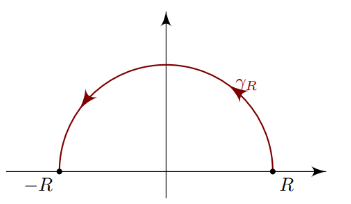
Let \(\alpha>0\), let \(g\) be continuous on \(C_R\), and let \(M_R\coloneqq\sup_{z\in C_R}\abs{g(z)}\). Then \[ \abs{\int_{C_R}e^{i\alpha z}g(z)\dz}\leq\frac{\pi}{\alpha}M_R. \] In particular, if \(g\) is continuous on \(\{z : \operatorname{Im}z\geq0,\ \abs{z}\geq R_0\}\) for some \(R_0\) and \(M_R\to0\) as \(R\to\infty\), then \(\int_{C_R}e^{i\alpha z}g(z)\dz\to0\).
For \(\alpha<0\) the same statements hold with \(C_R\) replaced by the lower semicircle \(t\mapsto Re^{-it}\), \(t\in[0,\pi]\), and \(\pi/\alpha\) replaced by \(\pi/\abs{\alpha}\).
For \(\alpha>0\) and \(z=Re^{it}\), \(\abs{e^{i\alpha z}}=e^{-\alpha R\sin t}\) and \(\abs{\dz}=R\,dt\), so \[ \abs{\int_{C_R}e^{i\alpha z}g(z)\dz}\leq M_R\int_0^\pi e^{-\alpha R\sin t}R\,dt=2M_R\int_0^{\pi/2}e^{-\alpha R\sin t}R\,dt. \] Since \(\sin t\geq 2t/\pi\) for \(t\in[0,\pi/2]\), \[ \int_0^{\pi/2}e^{-\alpha R\sin t}R\,dt\leq\int_0^{\pi/2}e^{-2\alpha Rt/\pi}R\,dt\leq\frac{\pi}{2\alpha}, \] which gives the bound. For \(\alpha<0\) and \(z=Re^{-it}\) with \(t\in[0,\pi]\), \(\abs{e^{i\alpha z}}=e^{\alpha R\sin t}=e^{-\abs{\alpha}R\sin t}\), and the same estimate applies with \(\abs{\alpha}\) in place of \(\alpha\).
Fractional residue theorem for a simple pole (Tag T-SSNLT)
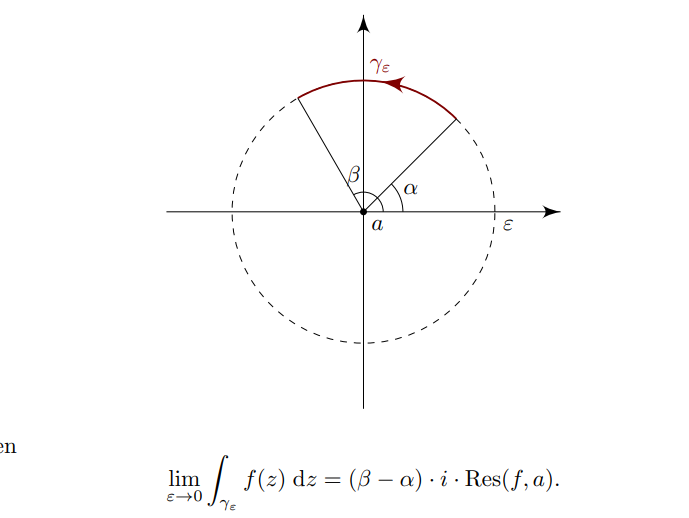
Let \(f\) be holomorphic on a punctured disc about \(z_0\in\CC\) with a simple pole at \(z_0\). For real numbers \(\alpha<\beta\) and \(\varepsilon>0\), let \(\gamma_\varepsilon\) be the arc \(t\mapsto z_0+\varepsilon e^{it}\), \(t\in[\alpha,\beta]\), of the circle \(\{z : \abs{z-z_0}=\varepsilon\}\). Then \[ \lim_{\varepsilon\to0}\int_{\gamma_\varepsilon}f(z)\dz=i(\beta-\alpha)\Res_{z=z_0}f. \]
Residue at infinity (Tag T-WFXQP)
Let \(R>0\) and let \(f\) be holomorphic on \(\{z : \abs{z}>R\}\). Define \(g(z)\coloneqq-\dfrac{1}{z^2}f\Bigl(\dfrac1z\Bigr)\) for \(0<\abs{z}<1/R\). Then the residue of \(f\) at \(\infty\) is \[ \Res_{z=\infty}f=\Res_{z=0}g=-\frac{1}{2\pi i}\int_{\abs{z}=\rho}f(z)\dz \] for every \(\rho>R\), the circle \(\abs{z}=\rho\) being oriented counterclockwise.
Residues belong to the differential form \(f(z)\dz\) rather than to the function \(f\). Under \(w=1/z\) the form \(f(z)\dz\) becomes \(f(1/w)\,d(1/w)=-\frac{1}{w^2}f(1/w)\dw=g(w)\dw\), and the counterclockwise circle \(\abs{z}=\rho\) becomes the clockwise circle \(\abs{w}=1/\rho\), which accounts for the sign.