(Polar dual)
For \(P \subseteq M_\RR\) containing the origin in its interior, \[ P^\circ = \ts{ u \in N_\RR \st \inp{m}{u} \geq -1 \text{ for all } m \in P } . \]
(Polar dual from the facet presentation)
If \(0\) is in the interior of \(P\) and \(P = \ts{ m \in M_\RR \st \inp{m}{u_F} \geq -a_F \text{ for every facet } F }\), then every \(a_F > 0\) and \[ P^\circ = \operatorname{Conv}\qty( a_F^{-1} u_F \st F \text{ a facet of } P ) . \]
(The square)
The square \(P = \ts{ m \st \inp{m}{\pm e_i} \geq -1 }\) has \(a_F = 1\) for all four facets, so \(P^\circ = \operatorname{Conv}(\pm e_1, \pm e_2)\) is the diamond.
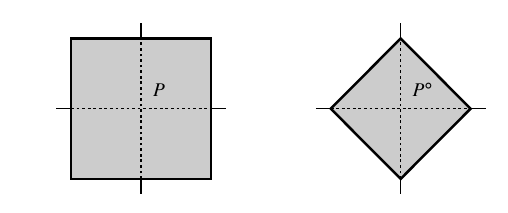
(Reflexive)
\(P\) is reflexive if it is a lattice polytope with facet presentation \[ P = \ts{ m \in M_\RR \st \inp{m}{u_F} \geq -1 \text{ for every facet } F } , \] that is, every facet lies at lattice distance \(1\) from the origin. Then \(P^\circ = \operatorname{Conv}(u_F \st F \text{ a facet of } P)\) is again a lattice polytope, and \((P^\circ)^\circ = P\).
If \(P\) is reflexive, then \(X_P\) is Gorenstein Fano, that is, \(-K_{X_P}\) is Cartier and ample, and \(P_{-K_{X_P}} = P\). Conversely, if a complete toric variety \(X_\Sigma\) is Gorenstein Fano, then \(P_{-K_{X_\Sigma}}\) is reflexive with normal fan \(\Sigma\). A lattice polytope is a smooth polytope if each vertex meets exactly \(n = \dim M\) edges and the primitive vectors along those edges form a lattice basis; for \(P\) reflexive, \(X_P\) is smooth if and only if \(P\) is a smooth polytope.
In dimension two there are \(16\) reflexive polygons up to equivalence, hence \(16\) Gorenstein Fano toric surfaces. Exactly five of them are smooth, giving the toric del Pezzo surfaces: \[ \PP^2, \quad \PP^1 \times \PP^1, \quad \Bl_1 \PP^2, \quad \Bl_2 \PP^2, \quad \Bl_3 \PP^2 , \] the last three obtained by blowing up the torus-fixed points of \(\PP^2\) one at a time. Blowing up a torus-fixed point of \(\Bl_3\PP^2\) produces two \((-2)\)-curves \(C\), with \(-K\cdot C=2+C^2=0\); so \(-K\) is nef and big but not ample, and the surface is not del Pezzo.