A torus-invariant divisor \(D=\sum_\rho a_\rho D_\rho\) on \(X_\Sigma\) has polytope \(P_D=\{m\in M_\RR:\langle m,u_\rho\rangle\ge-a_\rho\text{ for every ray }\rho\}\), and the characters \(\chi^m\) for \(m\in P_D\cap M\) form a basis of \(H^0(X_\Sigma,\OO(D))\).
The toric variety of a polytope and the normal fan (Tag D-TORPOLY)
Let \(P \subseteq M_\RR\) be a lattice polytope. A face is a slice by a supporting affine hyperplane, \[ F = P \intersect \ts{m \in M_\RR \st \inp{m}{u} = r}, \qquad \inp{m}{u} \geq r \text{ on } P , \] for some \(u \in N\) and \(r \in \RR\). The facets are the faces of codimension one, and \(P\) has the facet presentation \[ P = \ts{ m \in M_\RR \st \inp{m}{u_F} \geq -a_F \text{ for every facet } F } , \] where \(u_F \in N\) is the primitive inward normal to \(F\).
(The normal fan)
For a face \(F \leq P\) set \[ \sigma_F = \Cone\big( u_F' \st F \leq F',\ F' \text{ a facet} \big) \subseteq N_\RR . \] These cones form the normal fan \(\Sigma_P\), and \(X_P \da X_{\Sigma_P}\). Vertices of \(P\) give the maximal cones, facets of \(P\) give the rays, and the whole poset is reversed. The vertex \(m_i\) corresponds to the maximal cone \(\sigma_i = \dualof{\Cone(P \cap M - m_i)}\).
(Combinatorial equivalence)
Polytopes \(P_1\) and \(P_2\) are combinatorially equivalent if there is a bijection between their faces that preserves inclusions, intersections and dimensions of faces.
(A hexagon)
For the hexagon \(P\) with vertices \(v_1, \ldots, v_6\), the cone of directions out of each vertex \(v_i\) is dual to the maximal cone \(\sigma_i\) of the normal fan \(\Sigma_P\), which has six maximal cones.
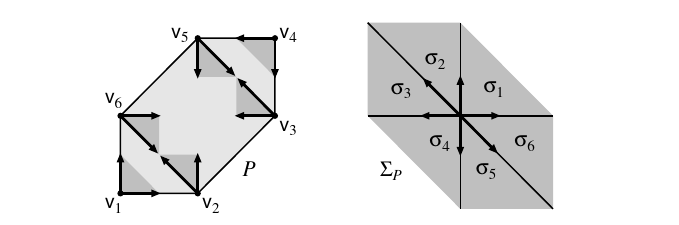
(Descriptions of $X_P$)
Let \(P\) be a full-dimensional lattice polytope.
\(X_P\) is the toric variety of the normal fan \(\Sigma_P\).
If \(0\) lies in the interior of \(P\), then \(\Sigma_P\) is the fan of cones over the proper faces of the polar dual \(P^\circ\).
For a vertex \(m\) of \(P\), the maximal cone \(\sigma_m\) of \(\Sigma_P\) has dual cone \(\dualof{\sigma_m}=\Cone(P \intersect M - m)\), the cone of directions out of \(m\), and \(X_P = \Union_{m \text{ a vertex}} \Spec k[\Cone(P \intersect M - m) \intersect M]\).
\(X_P\) carries the ample divisor \(D_P\) of D-TORQD, so every \(X_P\) is projective. Conversely, a complete fan need not be the normal fan of a polytope, and a complete toric variety need not be projective.
The moment map and the polytope as an orbit space (Tag D-TORMOMENT)
A projective toric variety \(X_P\) carries an action of the compact torus \(T_c \cong (S^1)^n \subseteq T\), and the moment map \[ \mu : X_P \to M_\RR \cong \RR^n \] has image exactly \(P\), with \(\inverseof{\mu}(\text{relative interior of } F)\) the orbit attached to the face \(F\). So \(P\) is the quotient \(X_P / T_c\), and the torus orbits of \(X_P\) correspond to the faces of \(P\), the orbit of a face \(F\) having dimension \(\dim F\).
To construct \(\mu\), realise \(X_\Sigma\) as a quotient of an open subset of \(\CC^{\Sigma(1)}\) by a torus of rank \(\size\Sigma(1) - n\); the moment map of that torus is \[ \mu_\Sigma : \CC^{\size \Sigma(1)} \to \RR^{\size\Sigma(1) - n} , \] and, for \(X_\Sigma\) smooth and projective, \(X_\Sigma\) is the symplectic quotient \(\mu_\Sigma^{-1}(c)/T_c'\) for a regular value \(c\) determined by \(P\), where \(T_c'\) is the compact part of that torus. For \(\PP^n\), \(\mu([z]) = \abs{z}^{-2}(\abs{z_0}^2, \ldots, \abs{z_n}^2)\) has image the standard simplex, whose vertices are the images of the coordinate points.
Simple and simplicial polytopes and simplicial normal fans (Tag D-FULSIMPLE)
Let \(P\) have dimension \(d\).
\(P\) is a simplex if it has exactly \(d+1\) vertices.
\(P\) is simple if every vertex lies on exactly \(d\) facets.
\(P\) is simplicial if every facet is a simplex.
The normal fan \(\Sigma_P\) is simplicial exactly when \(P\) is simple. Hence \(X_P\) is \(\QQ\)-factorial with at worst finite quotient singularities exactly when \(P\) is simple, and \(X_P\) is smooth exactly when in addition each vertex has its \(d\) edge directions forming a \(\ZZ\)-basis of \(M\).
(Each without the other)
The cube in \(\RR^3\) is simple and not simplicial: each vertex meets three facets, but the facets are squares. The octahedron in \(\RR^3\) is simplicial and not simple: each facet is a triangle, but each vertex meets four of them. The two are polar duals, which is the general picture — \(P\) is simple exactly when \(P^\circ\) is simplicial.
Explicitly, the cube \(P \subseteq \RR^3\) with vertices \((\pm 1, \pm 1, \pm 1)\) has facet normals \(\pm e_1, \pm e_2, \pm e_3\) and facet presentation \(\inp{m}{\pm e_i} \geq -1\). The origin is interior, so \(P^\circ\) is the octahedron with vertices \(\pm e_i\), and the maximal cones of the normal fan of \(P\) are the eight octants of \(\RR^3\), the cones over the facets of \(P^\circ\).
For a full-dimensional polytope \(P\), the vertices of \(P\) correspond to the maximal cones of \(\Sigma_P\): the cone at a vertex \(v\) is spanned by the inward facet normals of the facets containing \(v\). So \(v\) lies on exactly \(d\) facets if and only if its cone has exactly \(d\) rays, that is, if and only if the cone is simplicial. The facets of \(P\) correspond to the rays of \(\Sigma_P\), so the shape of a facet, such as whether it is a simplex, does not affect whether \(\Sigma_P\) is simplicial.
Divisors from the rays
Divisors, class group and Picard group from the rays (Tag T-TORDIV)
Let \(\Sigma\) have rays \(\Sigma(1)\) with primitive generators \(u_\rho\). Each ray \(\rho\) gives a prime divisor \(D_\rho\), the closure of the corresponding codimension-one orbit, and \[ \Div_T(X_\Sigma) = \bigoplus_{\rho \in \Sigma(1)} \ZZ D_\rho \cong \ZZ^{\Sigma(1)} . \] There are exact sequences \[ M \to \bigoplus_{\rho} \ZZ D_\rho \to \Cl(X_\Sigma) \to 0 , \qquad M \to \CDiv_T(X_\Sigma) \to \Pic(X_\Sigma) \to 0 , \] compatible with the inclusions \(\CDiv_T \subseteq \Div_T\) and \(\Pic \subseteq \Cl\). The left map is \[ m \mapsto \operatorname{div}(\chi^m) = \sum_{\rho \in \Sigma(1)} \inp{m}{u_\rho} D_\rho , \] whose kernel is \(M \cap \bigcap_\rho u_\rho^\perp\). It is injective, so both sequences are short exact, exactly when the \(u_\rho\) span \(N_\RR\), that is, when \(X_\Sigma\) has no torus factor. [@Ful93]
(Cartier divisors as a limit over the fan)
Order \(\Sigma\) by inclusion of faces and let \(M(\sigma) = \sigma^\perp \cap M\). Restriction to the affine opens \(U_\sigma\) identifies \[ \CDiv_T(X_\Sigma) \cong \varprojlim_{\sigma \in \Sigma} M/M(\sigma) , \] the inverse limit over the face poset of the groups \(\CDiv_T(U_\sigma) \cong M/M(\sigma)\) of local data \(m_\sigma\).
(Quotient construction)
Suppose the \(u_\rho\) span \(N_\RR\). Let \(S = \CC[x_\rho : \rho \in \Sigma(1)]\), for \(\sigma \in \Sigma\) let \(x^{\hat\sigma} = \prod_{\rho \notin \sigma(1)} x_\rho\), and let \(B(\Sigma) = \gens{x^{\hat\sigma} : \sigma \in \Sigma}\) be the irrelevant ideal, generated by the \(x^{\hat\sigma}\) for maximal \(\sigma\). Then \(Z(\Sigma) = V(B(\Sigma)) \subseteq \CC^{\Sigma(1)}\) is a union of coordinate subspaces of codimension at least \(2\). Applying \(\Hom_\ZZ(-, \CC^\times)\) to \(0 \to M \to \ZZ^{\Sigma(1)} \to \Cl(X_\Sigma) \to 0\) gives \[ 1 \to G \to (\CC^\times)^{\Sigma(1)} \to T_N \to 1 , \qquad G = \Hom_\ZZ(\Cl(X_\Sigma), \CC^\times) , \] and \(X_\Sigma\) is the good categorical quotient \(\qty(\CC^{\Sigma(1)} \sm Z(\Sigma)) /\!\!/ G\). It is a geometric quotient if and only if \(\Sigma\) is simplicial.
A primitive collection is a subset \(C \subseteq \Sigma(1)\) not contained in \(\sigma(1)\) for any \(\sigma \in \Sigma\), every proper subset of which is contained in some \(\sigma(1)\); then \(Z(\Sigma) = \bigcup_C V(x_\rho : \rho \in C)\) over the primitive collections.
(The cone over the quadric surface)
Let \(\sigma = \Cone(e_1, e_2, e_1 + e_3, e_2 + e_3) \subseteq \RR^3\), a cone with four edges, so not simplicial, and \(X_\sigma = V(xz - yw) \subseteq \CC^4\), the affine cone over \(\PP^1 \times \PP^1\).
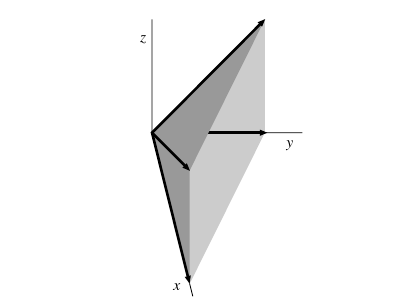
Here \[ \Cl(X_\sigma) = \operatorname{coker}\qty( \ZZ^3 \xrightarrow{A} \ZZ^4 ) = \ZZ , \qquad A = \begin{bmatrix} 1 & 0 & 0 \\ 0 & 1 & 0 \\ 1 & 0 & 1 \\ 0 & 1 & 1 \end{bmatrix} , \] generated by \(D_\rho\) for any ray \(\rho\), while \(\Pic(X_\sigma) = 0\) because \(X_\sigma\) is affine.
For \(\PP^n\), with rays \(e_1, \ldots, e_n\) and \(e_0 = -\sum_i e_i\), the only primitive collection is \(\ts{e_0, \ldots, e_n}\), so \(Z = \ts{0}\), and \(G = \CC^\times\) acts on \(\CC^{n+1}\) by \(\lambda \cdot (x_0, \ldots, x_n) = (\lambda x_0, \ldots, \lambda x_n)\), recovering \(\PP^n = (\CC^{n+1} \sm \ts{0})/\CC^\times\).
(Canonical divisor)
\(\omega_{X_\Sigma} \cong \OO\big( -\sum_\rho D_\rho \big)\), so \(K_X \sim -\sum_{\rho \in \Sigma(1)} D_\rho\).
So the class group is the cokernel of an explicit integer matrix whose rows are the ray generators. Two consequences are immediate. It has rank \(\size \Sigma(1) - \dim N_\RR\), and it has torsion exactly when the rays fail to generate \(N\) as a lattice. When \(\Sigma\) is simplicial, \(\Pic\) has finite index in \(\Cl\) and \(\rank \Pic(X_\Sigma) = \size \Sigma(1) - \dim N_\RR\) as well — for \(\FF_a\) this is \(4 - 2 = 2\), a fibre and a section.
Cartier divisors are cut out locally: \(D = \sum a_\rho D_\rho\) is Cartier iff for every maximal cone \(\sigma\) there is \(m_\sigma \in M\) with \(\inp{m_\sigma}{u_\rho} = -a_\rho\) for all \(\rho \leq \sigma\), and then \(D|_{U_\sigma} = \operatorname{div}(\chi^{-m_\sigma})\). Equivalently \(\CDiv_T(U_\sigma) \cong M/M(\sigma)\) where \(M(\sigma) = \sigma^\perp \intersect M\).
For \(\PP^n\) the \(n+1\) rays give \(D_0, \ldots, D_n\), all linearly equivalent, so \(K_{\PP^n} \sim -(n+1)H\) and \(\omega_{\PP^n} = \OO(-n-1)\) falls out of counting rays.
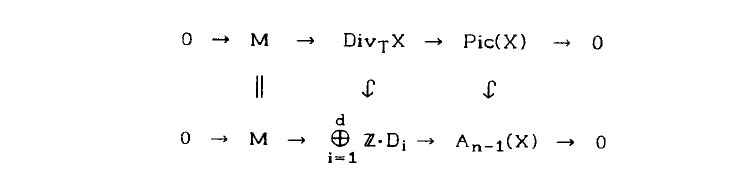
In the two sequences, \(\Pic\) and \(\Cl\) are the quotients of \(\CDiv_T\), the torus-invariant Cartier divisors, and of \(\Div_T\), all torus-invariant Weil divisors, by the principal divisors \(\operatorname{div}(\chi^m)\). On a smooth fan \(\Pic=\Cl\). On a simplicial fan \(\Pic\) has finite index in \(\Cl\): the cone over the rational normal curve of degree \(d\) has \(\Cl\cong\ZZ/d\) and \(\Pic=0\). On a non-simplicial fan the index can be infinite: the cone over a square, whose toric variety is \(V(xy-zw)\subset\AA^4\), has \(\Cl\cong\ZZ\) and \(\Pic=0\).
The polytope of a divisor
The polytope of a divisor, and its lattice points as sections (Tag D-TORQD)
For \(D = \sum_{\rho} a_\rho D_\rho\) on \(X_\Sigma\) put \[ P_D = \ts{ m \in M_\RR \st \inp{m}{u_\rho} \geq -a_\rho \text{ for all } \rho \in \Sigma(1) } . \]
(Sections)
\[ H^0\big( X_\Sigma, \OO(D) \big) = \bigoplus_{m \in P_D \intersect M} k \cdot \chi^m , \] so \(h^0(\OO(D))\) is a count of lattice points.
Starting from a full-dimensional lattice polytope \(P\) with facet presentation \(\inp{m}{u_F} \geq -a_F\), the divisor \(D_P = \sum_F a_F D_F\) on \(X_P\) is ample and satisfies \(P_{D_P} = P\). Starting from a basepoint-free Cartier divisor \(D\) on a complete toric variety \(X_\Sigma\), the fan \(\Sigma\) refines the normal fan of \(P_D\).
Since \(K_X = -\sum_\rho D_\rho\), the anticanonical divisor has \(a_\rho = 1\) for every \(\rho\) and \[ P_{-K_X} = \ts{ m \in M_\RR \st \inp{m}{u_\rho} \geq -1 } , \] which, for \(\Sigma\) complete, is the polar dual of the convex hull of the ray generators. For \(X = X_P\) with \(P\) reflexive this recovers \(P_{-K_{X_P}} = P\).
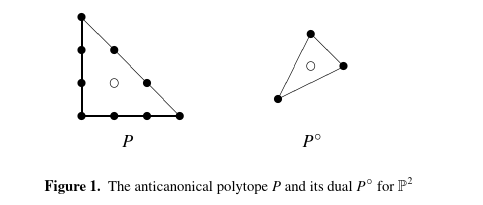
The projective plane, computed entirely from its fan (Tag FE-TORP2)
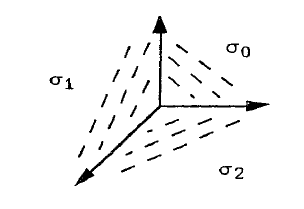
\(N = \ZZ^2\) with rays \(u_1 = e_1\), \(u_2 = e_2\), \(u_0 = -e_1 - e_2\), and the three two-dimensional cones spanned by consecutive pairs. Each is smooth, the support is all of \(N_\RR\), so \(\PP^2\) is smooth and complete, with \(\chi = \size\Sigma(2) = 3\).
(The charts)
Let \(\sigma_0 = \Cone(e_1, e_2)\), \(\sigma_1 = \Cone(e_2, -e_1-e_2)\), \(\sigma_2 = \Cone(-e_1-e_2, e_1)\). Their duals are
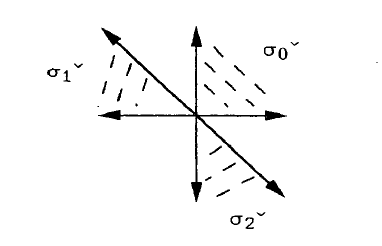
and each \(U_{\sigma_i} \cong \CC^2\), with coordinates \[ U_{\sigma_0} : (x, y), \qquad U_{\sigma_1} : (x^{-1}, x^{-1}y), \qquad U_{\sigma_2} : (y^{-1}, xy^{-1}) . \] Setting \(x = t_1/t_0\) and \(y = t_2/t_0\) identifies \(U_{\sigma_i}\) with the standard chart \(\ts{t_i \neq 0}\) of \(\PP^2\), and the gluings agree.
(Class group)
The map \(M \to \ZZ^3\) is \(m \mapsto (\inp{m}{u_1}, \inp{m}{u_2}, \inp{m}{u_0})\), with matrix rows \((1,0), (0,1), (-1,-1)\). The cokernel is \(\ZZ\) via \((a_1, a_2, a_0) \mapsto a_1 + a_2 + a_0\), since \(e_1 \mapsto (1,0,-1)\) and \(e_2 \mapsto (0,1,-1)\) both have coordinate sum \(0\). So \(\Cl(\PP^2) = \ZZ\), all three \(D_i\) map to \(1\), and \(D_1 \sim D_2 \sim D_0 = H\) — the three coordinate lines.
(Anticanonical polytope)
\(K_X = -(D_0 + D_1 + D_2) = -3H\), so \(-K_X = 3H\) and \[ P_{-K} = \ts{ m \st m_1 \geq -1,\ m_2 \geq -1,\ -m_1 - m_2 \geq -1 } = \operatorname{Conv}\big( (-1,-1),\ (2,-1),\ (-1,2) \big) , \] the triangle \(3\Delta\) translated to have the origin in its interior. Counting its lattice points gives \(1 + 2 + 3 + 4 = 10 = h^0(\OO(3))\), which is the dimension of the space of plane cubics. Its polar dual is \(\operatorname{Conv}\big( (1,0), (0,1), (-1,-1) \big)\), the convex hull of the ray generators, so \(P_{-K}\) is reflexive.
\(-K_X = 3H\) is Cartier and ample, so \(\PP^2\) is Fano, and the whole verification was three rays and a lattice-point count. Replacing \(-K\) by \(D = dH\) gives \(P_D = d\Delta\) with \(\binom{d+2}{2}\) lattice points, reproducing \(h^0(\PP^2, \OO(d))\) without a single cohomology computation.
Positivity
Base-point freeness, ampleness and very ampleness through support functions (Tag PR-TORPOS)
For a Cartier divisor \(D = \sum a_\rho D_\rho\) the support function \(\varphi_D : \abs{\Sigma} \to \RR\) is the unique function that is linear on each cone with \(\varphi_D(u_\rho) = -a_\rho\). On a maximal cone \(\sigma\) it is \(\varphi_D = \inp{m_\sigma}{\wait}\) for the Cartier datum \(m_\sigma \in M\). It is integral if \(\varphi_D(\abs{\Sigma} \intersect N) \subseteq \ZZ\), convex if \[ \varphi_D(t u + (1-t) v) \geq t \varphi_D(u) + (1-t)\varphi_D(v) , \] and strictly convex if in addition \(m_\sigma \neq m_{\sigma'}\) for distinct maximal cones.
(Positivity)
Let \(X_\Sigma\) be complete.
\(D\) is base point free, equivalently \(\OO(D)\) is globally generated, iff \(\varphi_D\) is convex, iff \(m_\sigma \in P_D\) for every \(\sigma \in \Sigma(n)\), iff \(P_D = \operatorname{Conv}\ts{m_\sigma \st \sigma \in \Sigma(n)}\).
\(D\) is ample iff \(\varphi_D\) is strictly convex, iff \(P_D\) is \(n\)-dimensional with the \(m_\sigma\) as its distinct vertices.
\(D\) is very ample iff it is ample and, for every vertex \(m_\sigma\), the semigroup \(S_\sigma\) is generated by \(\ts{m - m_\sigma \st m \in P_D \intersect M}\).
The last clause is a saturation condition on the vertex cone, and it is the only place the three notions can come apart. On a smooth complete toric variety ample implies very ample, so the distinction is invisible until a singular example is produced; the cone over the rational normal curve is where to look for one.
A convex piecewise-linear function bends upwards across every wall. That is the picture to draw: the graph of \(\varphi_D\) over the fan is a tent, and \(D\) is ample when every wall is a genuine crease.
For \(D=\sum a_\rho D_\rho\) Cartier on a complete \(X_\Sigma\), \(P_D\) is cut out by the inequalities \(\inp{m}{u_\rho}\geq-a_\rho\). If the Cartier data \(m_\sigma\) are distinct vertices of \(P_D\), one for each maximal cone, then \(D\) is ample; if every \(m_\sigma\) lies in \(P_D\) but two maximal cones have the same \(m_\sigma\), then \(D\) is base-point free and not ample.
Normal polytopes and very ample dilations (Tag D-FULNORMPOLY)
A lattice polytope \(P \subseteq M_\RR\) is normal if \[ (kP \intersect M) + (\ell P \intersect M) = (k+\ell)P \intersect M \quad \text{for all } k, \ell \geq 1 , \] equivalently \(k \cdot (P \intersect M) = (kP) \intersect M\) for all \(k \geq 1\), equivalently \((P \intersect M) \times \ts{1}\) generates the semigroup \(C(P) \intersect (M \times \ZZ)\), where \(C(P) \da \Cone(P \times \ts{1})\).
(Normality and dilation)
Normal implies very ample.
If \(P\) is full-dimensional with \(\dim P \geq 2\), then \(kP\) is normal for every \(k \geq \dim P - 1\).
(Consequences for very ampleness)
For a full-dimensional lattice polytope \(P\) of dimension \(d\ge2\), the proposition gives that \(kP\) is normal, hence very ample, for every \(k\ge d-1\). For \(d=2\) this holds for \(k=1\): every lattice polygon is normal, so every ample divisor on a complete toric surface is very ample. For \(d=3\), \(kP\) is normal for every \(k\ge2\), so a lattice polytope of dimension three that is not very ample can occur only at \(k=1\).
The toric variety \(X_P\) is \(\Proj\) of the semigroup ring \(\CC[C(P)\intersect(M\times\ZZ)]\), graded by the last coordinate. So \(P\) is normal if and only if this ring is generated in degree \(1\), that is, if and only if the embedding of \(X_P\) by the characters in \(P\intersect M\) is projectively normal.
An ample divisor that is not very ample (Tag FE-FULAVA)
In \(M_\RR = \RR^3\) take \[ P = \operatorname{Conv}\big( (0,0,0),\ (0,1,1),\ (1,0,1),\ (1,1,0) \big) , \] a lattice \(3\)-simplex, and let \(D = D_P\) be the corresponding divisor on \(X_P\). Since \(P\) is a full-dimensional simplex, its normal fan has four maximal cones matched with the four vertices, so \(\varphi_D\) is strictly convex and \(D\) is ample.
(Why it is not very ample)
The only lattice points of \(P\) are its four vertices. At the vertex \(v = (0,0,0)\) the edge vectors are \[ (0,1,1), \quad (1,0,1), \quad (1,1,0) , \] and \[ \det \begin{bmatrix} 0 & 1 & 1 \\ 1 & 0 & 1 \\ 1 & 1 & 0 \end{bmatrix} = 2 , \] so they generate a sublattice of index \(2\) in \(M = \ZZ^3\). The semigroup \(\ts{m - v \st m \in P \intersect M}\) is therefore not saturated, which is exactly the clause very ampleness requires, and \(D\) fails it.
(What the map does)
The four lattice points give a morphism \(X_P \to \PP^3\), and \[ \deg X_P = 3! \cdot \vol(P) = 3! \cdot \tfrac{1}{3} = 2 , \] so the map is finite of degree \(2\) rather than an embedding: \(X_P\) is a double cover of \(\PP^3\) branched over the four coordinate hyperplanes. Doubling repairs it: \(2P\) is normal and hence very ample, so \(2D\) is very ample while \(D\) is ample but not.
Three structural features make the example minimal. It must be three-dimensional, because ample and very ample agree on complete toric surfaces. It must be singular, because they also agree on smooth complete toric varieties. And the obstruction is a single determinant, which is the same index computation that detects a quotient singularity at the corresponding fixed point.
Very ampleness depends on the lattice points of \(P_D\) as well as on \(\Sigma\): for the lattice simplex \(P\) with vertices \((0,0,0)\), \((0,1,1)\), \((1,0,1)\), \((1,1,0)\), the divisor \(D_P\) is ample, and its four lattice points give a finite morphism \(X_P\to\PP^3\) of degree \(2\).
Fano and Calabi-Yau
Reflexive polytopes, Gorenstein Fano toric varieties and the five toric del Pezzos (Tag D-TORREFL)
For \(P \subseteq M_\RR\) containing the origin in its interior, \[ P^\circ = \ts{ u \in N_\RR \st \inp{m}{u} \geq -1 \text{ for all } m \in P } . \]
(Polar dual from the facet presentation)
If \(0\) is in the interior of \(P\) and \(P = \ts{ m \in M_\RR \st \inp{m}{u_F} \geq -a_F \text{ for every facet } F }\), then every \(a_F > 0\) and \[ P^\circ = \operatorname{Conv}\qty( a_F^{-1} u_F \st F \text{ a facet of } P ) . \]
(The square)
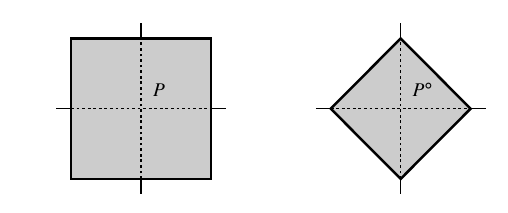
The square \(P = \ts{ m \st \inp{m}{\pm e_i} \geq -1 }\) has \(a_F = 1\) for all four facets, so \(P^\circ = \operatorname{Conv}(\pm e_1, \pm e_2)\) is the diamond.
(Reflexive)
\(P\) is reflexive if it is a lattice polytope with facet presentation \[ P = \ts{ m \in M_\RR \st \inp{m}{u_F} \geq -1 \text{ for every facet } F } , \] that is, every facet lies at lattice distance \(1\) from the origin. Then \(P^\circ = \operatorname{Conv}(u_F \st F \text{ a facet of } P)\) is again a lattice polytope, and \((P^\circ)^\circ = P\).
If \(P\) is reflexive, then \(X_P\) is Gorenstein Fano, that is, \(-K_{X_P}\) is Cartier and ample, and \(P_{-K_{X_P}} = P\). Conversely, if a complete toric variety \(X_\Sigma\) is Gorenstein Fano, then \(P_{-K_{X_\Sigma}}\) is reflexive with normal fan \(\Sigma\). A lattice polytope is a smooth polytope if each vertex meets exactly \(n = \dim M\) edges and the primitive vectors along those edges form a lattice basis; for \(P\) reflexive, \(X_P\) is smooth if and only if \(P\) is a smooth polytope.
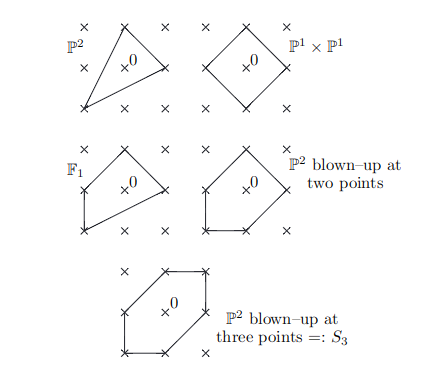
In dimension two there are \(16\) reflexive polygons up to equivalence, hence \(16\) Gorenstein Fano toric surfaces. Exactly five of them are smooth, giving the toric del Pezzo surfaces: \[ \PP^2, \quad \PP^1 \times \PP^1, \quad \Bl_1 \PP^2, \quad \Bl_2 \PP^2, \quad \Bl_3 \PP^2 , \] the last three obtained by blowing up the torus-fixed points of \(\PP^2\) one at a time. Blowing up a torus-fixed point of \(\Bl_3\PP^2\) produces two \((-2)\)-curves \(C\), with \(-K\cdot C=2+C^2=0\); so \(-K\) is nef and big but not ample, and the surface is not del Pezzo.
Reflexivity is also where toric geometry meets mirror symmetry: a reflexive polytope \(P\) gives a Calabi-Yau anticanonical hypersurface in \(X_P\), and \(P^\circ\) gives its mirror. There are \(16\) reflexive polygons and \(4319\) reflexive polytopes in dimension three, up to lattice isomorphism.