The real and imaginary parts of a holomorphic function are harmonic, and a harmonic function equals its average over every circle and disc in its domain.
Laplacian and harmonic functions (Tag D-CFBSA)
Let \(\Omega\subseteq\RR^2\) be open and let \(u\colon\Omega\to\RR\) be a \(C^2\) function of \((x,y)\). The Laplacian of \(u\) is \[ \Delta u\coloneqq\frac{\partial^2u}{\partial x^2}+\frac{\partial^2u}{\partial y^2}, \] and \(u\) is harmonic on \(\Omega\) if \(\Delta u=0\) on \(\Omega\).
Cauchy--Riemann implies holomorphic (Tag PR-JKE6C)
Let \(\Omega\subseteq\CC\) be open and let \(f = u+iv\colon\Omega\to\CC\), where \(u,v\colon\Omega\to\RR\) are continuously differentiable as functions of \((x,y)\), \(z=x+iy\). If \(u_x=v_y\) and \(u_y=-v_x\) on \(\Omega\), then \(f\) is holomorphic on \(\Omega\) and \[ f'(z) = \del f(z) = u_x(z) + iv_x(z). \]
Fix \(z\in\Omega\) and write \(h=h_1+ih_2\). Since \(u\) and \(v\) are continuously differentiable, they are real differentiable at \(z\), so \[ f(z+h)-f(z)=u_xh_1+u_yh_2+i\qty{v_xh_1+v_yh_2}+o(\abs{h}), \] with the partial derivatives evaluated at \(z\). Substituting \(u_y=-v_x\) and \(v_y=u_x\) gives \(u_xh_1-v_xh_2+i\qty{v_xh_1+u_xh_2}=(u_x+iv_x)(h_1+ih_2)\), so \(\frac{f(z+h)-f(z)}{h}\to u_x+iv_x\) as \(h\to0\). Finally, \(\del f=\frac12\qty{f_x-if_y}=\frac12\qty{u_x+v_y+i(v_x-u_y)}=u_x+iv_x\) by the same equations.
Holomorphic functions have harmonic components (Tag PR-K57J6)
Let \(\Omega\subseteq\CC\) be open and let \(f(z) = u(x, y) + iv(x, y)\) be holomorphic on \(\Omega\), with \(u,v\) real-valued and \(z=x+iy\). Then \(u\) and \(v\) are harmonic on \(\Omega\).
The derivative of a holomorphic function is holomorphic, so \(f\) is infinitely differentiable and \(u,v\) have continuous partial derivatives of all orders. By the Cauchy–Riemann equations \(u_x=v_y\) and \(u_y=-v_x\), so \(u_{xx}=v_{yx}=v_{xy}=-u_{yy}\) and \(v_{xx}=-u_{yx}=-u_{xy}=-v_{yy}\), using equality of mixed partials. Hence \(\Delta u=\Delta v=0\).
By the Cauchy–Riemann equations, \[ \begin{aligned} u_x = v_y && u_y = -v_x \end{aligned}.\]
Differentiate in \(x\): \[ \begin{aligned} u_{xx} = v_{yx} && u_{yx} = -v_{xx} \end{aligned}.\]
Differentiate in \(y\): \[ \begin{aligned} u_{xy} = v_{yy} && u_{yy} = -v_{xy} \end{aligned}.\]
A holomorphic function is analytic, so \(u\) and \(v\) are \(C^\infty\), and by Clairaut’s theorem the mixed partials agree. Hence \[ u_{xx} + u_{yy} = 0, \qquad v_{xx} + v_{yy} = 0 .\]
The mean value property
Mean value property for harmonic functions (Tag PR-UWGI6)
Let \(\Omega\subseteq\CC\) be open, let \(u\) be harmonic on \(\Omega\), and let \(z_0=x_0+iy_0\in\Omega\) and \(r>0\) satisfy \(\overline{D_r(z_0)}\subseteq\Omega\). Then \[ u(z_0)=\frac{1}{2\pi r}\oint_{\bd D_r(z_0)}u\,ds=\frac{1}{\pi r^2}\iint_{D_r(z_0)}u(x,y)\dx\dy, \] where \(ds\) is arc length on the circle \(\bd D_r(z_0)\).
Define \[ F(r) \coloneqq {1\over 2\pi r} \oint_{\bd \DD_r(z_0)} u\,ds = {1\over 2\pi} \int_{[-\pi, \pi]} u(z_0 + re^{it} ) \dt ,\] and differentiate: \[ \begin{aligned} F'(r) &= {1\over 2 \pi} \int_{[-\pi, \pi]} \cos(t) u_x(z_0 +re^{it} ) + \sin(t) u_y(z_0 + re^{it}) \dt \\ &= {1\over 2\pi r} \oint_{\bd \DD_r(z_0)}\qty{x-x_0\over r} u_x(x, y) + \qty{y-y_0\over r}u_y(x, y) \,ds \\ &= {1\over 2\pi r} \oint_{\bd \DD_r(z_0)} \dd{u}{n} \,ds \qquad n = \tv{{x-x_0\over r}, {y-y_0\over r}} \\ &= {1\over 2\pi r} \iint_{\DD_r(z_0)} \laplacian u \dx \dy \\ &= 0 \end{aligned},\] where \(n\) is the outward unit normal, using Green’s theorem and \(\laplacian u = 0\). So \(F\) is constant, and letting \(r\to 0\), \[ F(r) = {1\over 2\pi} \int_{[-\pi, \pi]} u(z_0 + re^{it}) \dt \too u(z_0) .\] Multiplying \(u(z_0) = F(s)\) by \(s\) and integrating over \(0\leq s\leq r\) gives \(\frac{r^2}{2}u(z_0) = \frac{1}{2\pi}\iint_{\DD_r(z_0)} u \dx\dy\) in polar coordinates, which is the area mean.
(Converse)
A continuous \(u\) satisfying the mean value property on every disc in its domain is harmonic, so the mean value property characterizes harmonic functions among continuous functions. The mean value property gives the strict maximum principle: a real harmonic function on a connected open set that attains its maximum is constant, by the argument on Maximum modulus and open mapping.
Exercises
Holomorphic iff delbar vanishes (Tag E-P2PEF)
Show that \(f\) is holomorphic iff \(\delbar f = 0\).
Solution
\[ 2\delbar f &\da (\del_x + i \del_y) (u+iv) \\ &= u_x + iv_x + iu_y - v_y \\ &= (u_x - v_y) + i(u_y + v_x) \\ &= 0 && \text{by Cauchy-Riemann} .\]
Holomorphic functions have harmonic components (Tag E-TZJKN)
Show that if \(f = u+iv\) is holomorphic then \(u, v\) are harmonic.
Solution
Idea: use Cauchy-Riemann, take further derivatives, and use equality of partials.
By CR, \[ u_x = v_y && u_y = -v_x .\]
Differentiate with respect to \(x\): \[ u_{xx} = v_{yx} && u_{yx} = -v_{xx} .\]
Differentiate with respect to \(y\): \[ u_{xy} = v_{yy} && u_{yy} = -v_{xy} .\]
Clairaut’s theorem: partials are equal, so \[ u_{xx} - v_{yx} = 0 \implies u_{xx} + u_{yy} = 0 \\ \\ v_{xx} + u_{yx} = 0 \implies v_{xx} + v_{yy} = 0 \\ \\ .\]
A bounded harmonic function on $\RR^2$ is constant (Tag E-I6W47)
Show that if \(u\) is harmonic on \(\RR^2\) and bounded, then \(u\) is constant.
Solution: Using Liouville
Write \(f=u+iv\) for \(v\) a harmonic conjugate of \(u\), then \(f\) is holomorphic on \(\CC\). Now \(e^f = e^{u+iv} = e^u e^{iv}\) and thus \[ \abs{e^f}= \abs{e^u} \abs{e^{iv}} = e^u \] is bounded, so \(e^f\) is a bounded entire function and thus constant by Liouville. Then \(0=(e^f)'=f'e^f\), and \(e^f\) has no zeros, so \(f'\equiv0\) and \(f\) is constant. Hence \(u=\Re f\) is constant.
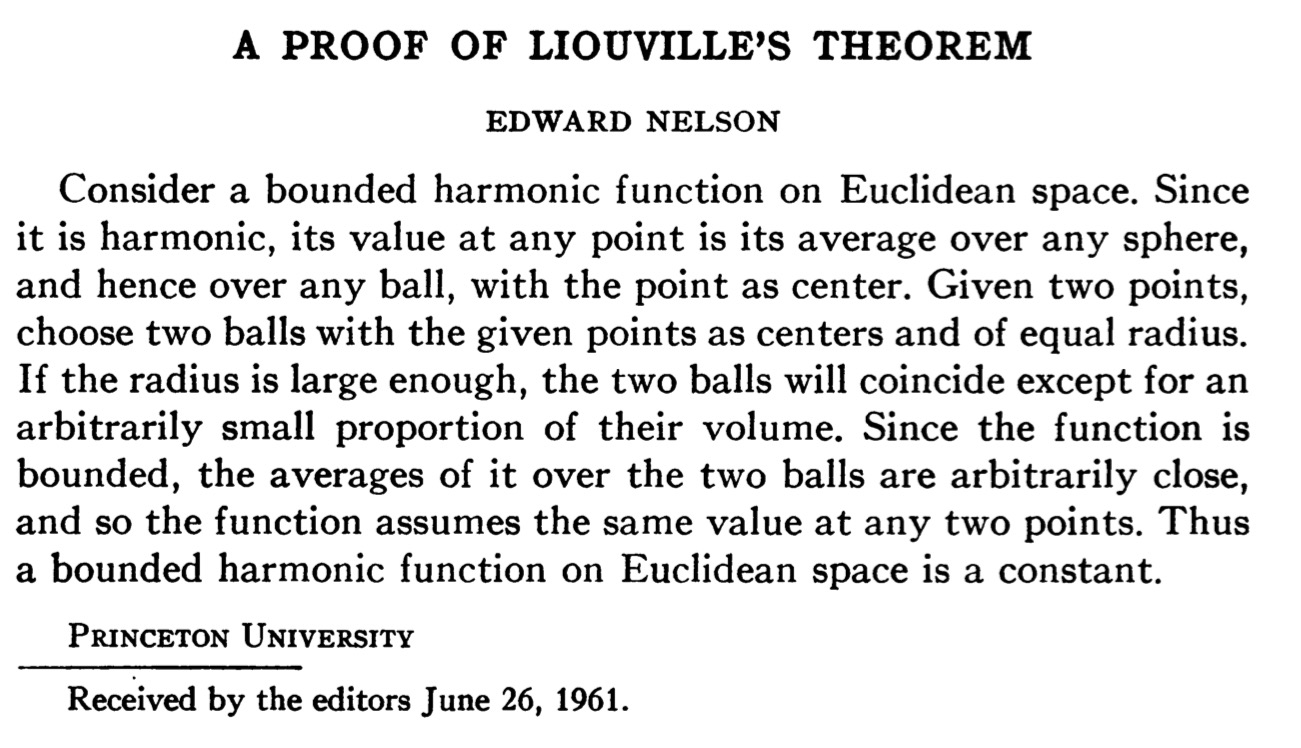
Solution: Using the mean value property
$u^2-v^2$, $uv$ and $u_x$ are harmonic for harmonic conjugates $u,v$ (Tag E-BEYZ5)
Show that if \(u,v\) are harmonic conjugates, then
- \(u^2-v^2\) is harmonic
- \(uv\) is harmonic.
- \(u_x\) is harmonic.
Solution
Write \(f=u+iv\), which is analytic.
\(f^2\) is analytic, and \(f^2 = (u+iv)^2 = u^2 - v^2 + i (2uv)\), which necessarily has harmonic components.
The imaginary part of \(f^2\) is \(2uv\), so \(uv\) is harmonic.
\(f'\) is analytic and \(f' = u_x + iv_x\), which has harmonic components.
Alternatively, \(uv\) is in the kernel of the Laplacian: \[ \laplacian(uv) &= (uv)_{xx} + (uv)_{yy} \\ &= (u_{xx}v + uv_{xx} + 2u_x v_x) + (u_{yy}v + uv_{yy} + 2u_y v_y) \\ &= (u_{xx} + u_{yy}) v + (v_{xx} + v_{yy}) u + 2(u_xv_x + u_yv_y) \\ &= (u_{xx} + u_{yy}) v + (v_{xx} + v_{yy}) u + 2(-u_x u_y + u_y u_x) && v_x = -u_y,\, v_y = u_x \\ &= (u_{xx} + u_{yy}) v + (v_{xx} + v_{yy})u \\ &= \laplacian(u)v + \laplacian(v)u \\ &= 0 .\]
A harmonic conjugate of $x^3-3xy^2-x-y$ (Tag E-B4ZSQ)
Find a harmonic conjugate for \[ u(x, y) = x^3 - 3xy^2 -x -y .\]
A harmonic conjugate \(v\) of \(u\) on a simply connected domain is computed as follows:
- Start with \(u\)
- Take \(\dd{}{x}\) to get \(u_x\)
- Apply CR to get \(u_x = v_y\)
- Take \(\int \dy\) to get \(v\) up to an unknown function \(f(x)\).
- Take \(\dd{}{x}\) to get \(v_x\) which involves \(f_x\)
- Apply CR to set \(v_x = -u_y\) and solve for \(f_x\)
- Compute \(\int f_x \dx\) to obtain \(f(x)\).
The same steps as a diagram:
Solution
First, check that \(u\) is actually harmonic: \[ \laplacian u = \dd{}{x}(3x^2-3y^2-1) + \dd{}{y}(-6xy - 1) = 6x + (-6x) = 0 .\]
Integrate \(v_y=u_x\) with respect to \(y\), \[ v_y = u_x = 3x^2 - 3y^2 - 1 \implies v = \int u_x \dy = 3x^2y - y^3 - y + f_1(x) .\] Now differentiate \(v\) with respect to \(x\) and set \(v_x = -u_y\): \[ v_x = 6xy + (f_1)_x = -u_y = 6xy + 1\implies f_1 = x + c_1 .\] Thus \[ v(x, y) = 3x^2y - y^3 - y + x + c_1 .\]