Throughout, \(f \in \QQ[x]\) is separable of degree \(n\) with roots \(r_1,\ldots,r_n\), and \(G = \Gal(\SF(f)/\QQ)\), which acts faithfully on the roots and so embeds in \(S_n\). The group \(G\) is determined by combining upper bounds (the transitive subgroups of \(S_n\), the discriminant) with elements exhibited in \(G\) (cycle types from reduction modulo primes, complex conjugation).
Galois theory exercises with solutions: chapter 4.
Degree bounds
\(\size{G} = [\SF(f):\QQ]\).
If \(f\) is irreducible, \(G\) acts transitively on the roots, so by orbit-stabilizer \(n = \size{\Orb(r_1)} = [G:\Stab_G(r_1)]\) divides \(\size G\), and \[ n\divides \size G \divides n!. \]
For each root \(r_i\), \([\QQ(r_i):\QQ]\) divides \([\SF(f):\QQ]\).
The Galois group of an irreducible polynomial is a transitive subgroup (Tag PR-LXSGE)
Let \(k\) be a field, \(f \in k[x]\) irreducible, \(\SF(f)\) a splitting field of \(f\) over \(k\), and \(\alpha_1, \ldots, \alpha_m\) the distinct roots of \(f\) in \(\SF(f)\). Then \(\Gal(\SF(f)/k)\) acts faithfully and transitively on \(\theset{\alpha_1, \ldots, \alpha_m}\), so it is isomorphic to a transitive subgroup of \(S_m\). If \(f\) is separable of degree \(n\), then \(m = n\).
Transitive subgroups of \(S_n\)
(Transitive subgroups of $S_n$ for $n\leq 5$)
Write \(C_n\) for the cyclic group of order \(n\).
| \(n\) | Transitive subgroups of \(S_n\) up to conjugacy | Orders | Nonabelian |
|---|---|---|---|
| \(1\) | \(1\) | \(1\) | none |
| \(2\) | \(S_2 \cong C_2\) | \(2\) | none |
| \(3\) | \(S_3\cong D_3\), \(A_3 \cong C_3\) | \(6\), \(3\) | \(S_3\) |
| \(4\) | \(S_4\), \(A_4\), \(D_4\), \(C_4\), \(C_2^2\) | \(24\), \(12\), \(8\), \(4\), \(4\) | \(S_4\), \(A_4\), \(D_4\) |
| \(5\) | \(S_5\), \(A_5\), \(F_5\cong C_5\semidirect C_4\), \(D_5\), \(C_5\) | \(120\), \(60\), \(20\), \(10\), \(5\) | \(S_5\), \(A_5\), \(F_5\), \(D_5\) |
Here \(\size{D_n} = 2n\), \(\size{S_n} = n!\), \(\size{A_n} = n!/2\), and \(F_5\) has presentation \(\gens{a,b \st a^5, b^4, ba\inverseof{b} = a^2}\).
The quaternion group \[ Q_{8}=\left\langle\alpha, \beta \mid \alpha^{4}=\beta^{4}=1, \alpha \beta \alpha=\beta, \beta^{2}=\alpha^{2}\right\rangle \] is a transitive subgroup of \(S_8\) via its regular action, and it is not isomorphic to a subgroup of \(S_m\) for any \(m<8\).
The discriminant
Discriminant of a polynomial (Tag D-W3DSO)
Let \(k\) be a field and \(f\in k[x]\) a monic polynomial of degree \(n\geq 1\), and write \(f=\prod_{i=1}^n (x-r_i)\) with roots \(r_1,\ldots,r_n\), listed with multiplicity, in a splitting field of \(f\) over \(k\). The discriminant of \(f\) is \[ \Delta_f \coloneqq \prod_{1\leq i<j\leq n} (r_i - r_j)^2 . \]
\(\Delta_f = 0\) if and only if \(f\) has a repeated root.
A product in a field vanishes if and only if one of its factors does, and \((r_i-r_j)^2=0\) if and only if \(r_i=r_j\) for some \(i<j\).
Let \(f\in \RR[x]\) be a monic cubic with \(\Delta_f\neq 0\). Then \(\Delta_f>0\) if and only if \(f\) has three distinct real roots, and \(\Delta_f<0\) if and only if \(f\) has one real root and a pair of complex conjugate non-real roots.
Since \(\Delta_f\neq 0\), the roots \(r_1,r_2,r_3\in\CC\) are distinct, and since \(f\) has real coefficients, its non-real roots occur in conjugate pairs. So either all three roots are real, or \(r_1\in\RR\) and \(r_{2,3}=a\pm bi\) with \(a,b\in\RR\) and \(b\neq 0\). In the first case each factor \(r_i-r_j\) is a nonzero real number, so \(\Delta_f>0\). In the second case \((r_1-r_2)(r_1-r_3)=\abs{r_1-r_2}^2>0\) and \((r_2-r_3)^2=(2bi)^2=-4b^2<0\), so \[ \Delta_f=\bigl((r_1-r_2)(r_1-r_3)\bigr)^2(r_2-r_3)^2<0 . \] The two cases are exhaustive and give opposite signs, which proves both equivalences.
For monic \(f\), the discriminant is \(\Delta_f = \prod_{i<j}(r_i - r_j)^2\), a product of \(n(n-1)/2\) factors, and \(\Delta_f\neq 0\) because \(f\) is separable. Then \[ G \subseteq A_n \iff \sqrt{\Delta_f} \in \QQ. \]
(Formulas)
For \(f = ax^2+bx+c\), \(\Delta = b^2-4ac\).
For \(f = ax^3+bx^2+cx+d\), \(\Delta = b^2c^2 - 4ac^3 - 4b^3d - 27a^2d^2 + 18abcd\). For \(a=1\), the substitution \(x = t - b/3\) gives \(t^3+pt+q\), with the same discriminant \(\Delta = -4p^3-27q^2\).
\(\Delta_f = 0\) if and only if \(f\) has a repeated root.
Cycle types from reduction modulo \(p\)
Dedekind's theorem: cycle types in the Galois group from factorization modulo $p$ (Tag PR-XDWOP)
Let \(f\in\ZZ[x]\) be monic of degree \(n\) with nonzero discriminant \(\Delta\), and let \(G\) be the Galois group of \(f\) over \(\QQ\), regarded as a subgroup of \(S_n\) through its action on the roots of \(f\). Let \(p\) be a prime with \(p\notdivides\Delta\), and let \(f\equiv f_1f_2\cdots f_m\pmod p\) be the factorization into monic irreducibles in \(\FF_p[x]\). Then \(G\) contains a permutation of cycle type \((\deg f_1, \deg f_2, \ldots, \deg f_m)\). Equivalently, the Galois group of \(f\bmod p\) over \(\FF_p\), which is cyclic and generated by the Frobenius automorphism, is isomorphic to a subgroup of \(G\) through a bijection between the roots of \(f\bmod p\) and the roots of \(f\).
The Chebotarev density theorem strengthens this: for each cycle type occurring in \(G\), the set of primes \(p\notdivides\Delta\) for which \(f\bmod p\) factors with that cycle type has natural density equal to the proportion of elements of \(G\) of that cycle type.
Dedekind’s theorem applies only to primes \(p\) not dividing the leading coefficient for which \(f \bmod p\) is squarefree.
For such a prime \(p\), if \(f \bmod p\) factors into irreducibles of degrees \(d_1,\ldots,d_k\), then \(G\) contains an element of cycle type \((d_1,\ldots,d_k)\).
(A transposition and a $5$-cycle)
Let \(f\) be irreducible of degree \(5\) with exactly two nonreal roots. Complex conjugation restricts to a transposition \(\tau\in G\), and \(5\divides\size G\), so \(G\) contains a \(5\)-cycle \(\sigma\). Some power of \(\sigma\) sends the first point of \(\tau\) to the second, so after replacing \(\sigma\) by that power and relabeling the roots, \(\tau = (1,2)\) and \(\sigma = (1,2,3,4,5)\). Then \(\sigma\tau\inverseof{\sigma} = (2,3)\) and \((1,2)(2,3) = (1,2,3)\), so \(3\divides\size G\). Hence \(\size G\) is divisible by \(30\), which excludes \(F_5\), \(D_5\), and \(C_5\); since \(\tau\) is odd, \(G\neq A_5\), and \(G=S_5\).
(Cycle types for $x^5+2x+1$)
\(f(x) = x^5+2x+1\) is irreducible modulo \(3\), so \(f\) is irreducible over \(\QQ\) and \(G\) contains a \(5\)-cycle. Modulo \(17\), \(f\) factors into irreducibles of degrees \(2\) and \(3\), so \(G\) contains an element \(\rho\) of cycle type \((2,3)\), and \(\rho^3\) is a transposition. A subgroup of \(S_5\) containing a \(5\)-cycle and a transposition is \(S_5\), so \(G = S_5\).
($x^4+x+1$)
\(f(x) \da x^4+x+1\) is irreducible modulo \(2\), so \(f\) is irreducible over \(\QQ\) and \(G\) contains a \(4\)-cycle. Modulo \(3\), \(f\) factors into irreducibles of degrees \(1\) and \(3\), so \(G\) contains a \(3\)-cycle. Hence \(12\divides\size G\), and \(G\) contains the odd permutation given by the \(4\)-cycle, so \(G = S_4\).
(A transposition from a power)
\(f(x) = x^6+x^4+x+3\) factors modulo \(11\) into irreducibles of degrees \(1\) and \(5\), and modulo \(7\) into irreducibles of degrees \(2\) and \(4\). The only factorization type over \(\QQ\) compatible with both is a single factor of degree \(6\), so \(f\) is irreducible and \(G\) is transitive. \(G\) contains a \(5\)-cycle fixing one root, so the stabilizer of that root is transitive on the other five roots, and \(G\) is \(2\)-transitive, hence primitive. Modulo \(2\), \(f\) factors into irreducibles of degrees \(1\), \(2\), and \(3\), and \(\qty{(a,b)(c,d,e)}^3 = (a,b)\) is a transposition in \(G\). A primitive subgroup of \(S_n\) containing a transposition is \(S_n\), so \(G = S_6\).
Similarly, \(x^7-x-1\) is irreducible modulo \(2\) and factors modulo \(3\) into irreducibles of degrees \(2\) and \(5\); the fifth power of an element of type \((2,5)\) is a transposition, and a subgroup of \(S_7\) containing a \(7\)-cycle and a transposition is \(S_7\).
Distinguishing the remaining candidates
(Criteria for $n = 4$ and $n=5$)
\(n=4\):
\(C_4\) contains a \(4\)-cycle and \(C_2^2\) does not; both contain elements of type \((2,2)\).
\(A_4\) contains no transposition and no \(4\)-cycle, so either one in \(G\) excludes \(A_4\); the discriminant separates \(S_4\) from \(A_4\).
\(n=5\) and general \(n\):
A subgroup of \(S_5\) containing a transposition and a \(5\)-cycle is \(S_5\).
\(S_n = \gens{(a,b), (1,2,\ldots,n)}\) if and only if \(\gcd(b-a, n) = 1\).
Subgroups of $S_n$ for $n$ prime containing an $n$-cycle (Tag PR-5PI25)
Let \(n\) be a prime and let \(G \leq S_n\) contain an \(n\)-cycle.
If \(G\) contains a transposition, then \(G = S_n\).
If \(n \geq 3\) and \(G\) contains a \(3\)-cycle, then \(G = A_n\) or \(G = S_n\).
For composite \(n\), a transposition and an \(n\)-cycle need not generate \(S_n\). In \(S_4\), the elements \((1\,3)\) and \((1\,2\,3\,4)\) preserve the partition \(\theset{\theset{1,3},\theset{2,4}}\), and they generate the dihedral group of order \(8\). The specific transposition \((1\,2)\) and the specific \(n\)-cycle \((1\,2\,\cdots\,n)\) do generate \(S_n\) for every \(n \geq 2\).
For composite \(n\), a \(3\)-cycle and an \(n\)-cycle need not generate a group containing \(A_n\). In \(S_6\), both \((1\,2\,3)\) and \((1\,4\,2\,5\,3\,6)\) preserve the partition \(\theset{\theset{1,2,3},\theset{4,5,6}}\), so the group they generate lies in the stabilizer of that partition, which has order \(72 < \abs{A_6} = 360\).
For the Galois group \(G \leq S_n\) of an irreducible separable polynomial \(f\) of degree \(n\), the action on the roots is transitive, so \(n \divides \abs{G}\) by the orbit-stabilizer theorem. If \(n\) is prime, Cauchy’s theorem gives an element of order \(n\) in \(G\), and every element of order \(n\) in \(S_n\) is an \(n\)-cycle.
(Parity)
- A permutation lies in \(A_n\) if and only if it has an even number of cycles of even length.
(Subgroups of $S_4$)
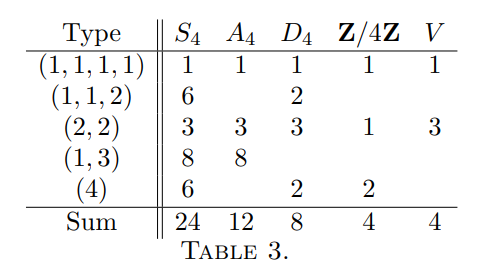
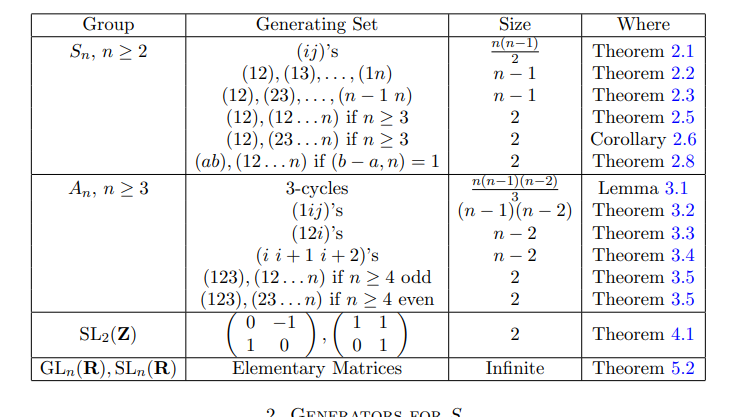
Structural facts
(Structural facts)
If \(f = f_1\cdots f_k\) with the \(f_i\) irreducible, then \(G\) permutes the roots of each \(f_i\) among themselves, so \(G\) embeds in \(\prod_i\Gal(\SF(f_i)/\QQ)\).
If \(\SF(f)\) contains a subfield that is not normal over \(\QQ\), then \(G\) is nonabelian. For \(f = x^3-2\), \(\SF(f) = \QQ(\zeta_3, 2^{1/3})\) contains the non-normal subfield \(\QQ(2^{1/3})\), so \(G = S_3\).
If \(f\) has exactly \(k\) pairs of nonreal roots, complex conjugation restricts to an element of \(G\) that is a product of \(k\) disjoint transpositions.
If every exponent in \(f\) is even, the roots come in pairs \(\pm r\), and \(G\) permutes these pairs; for example, \(x^4-5x^2+5\) has Galois group \(C_4\).
For positive integers \(a\neq b\), \(\QQ(\zeta_a) = \QQ(\zeta_b)\) if and only if one of \(a,b\) is odd and the other is twice it.
If \(f = a_nx^n + \cdots + a_0\in\ZZ[x]\) and \(p/q\) is a rational root in lowest terms, then \(p \divides a_0\) and \(q\divides a_n\).
Subgroup lattices of small groups: Groups of small order.
(Degrees and indices)
For a finite Galois extension \(L/F\) with \(G = \Gal(L/F)\) and an intermediate field \(K\) corresponding to \(H = \Gal(L/K)\), \[ [L:K] = \size H, \qquad [K:F] = [G:H], \qquad [L:F] = \size G. \]