Let \((X,\mu)\) be a measure space and \(1\leq p\leq\infty\). If \(\mu(X)<\infty\) and \(1\le p<q\le\infty\), then \(L^q(\mu)\subseteq L^p(\mu)\). For Lebesgue measure on \(\RR\) neither of \(L^p\) and \(L^q\) contains the other, and for counting measure on \(\NN\), \(\ell^p\subseteq\ell^q\).
For \(1<p<\infty\) and \(q=p/(p-1)\), the map \(g\mapsto\qty{f\mapsto\int fg\,d\mu}\) is an isometric isomorphism \(L^q\cong(L^p)^*\); for \(p=1\) this holds when \(\mu\) is \(\sigma\)-finite. For Lebesgue measure on \([0,1]\), the corresponding map \(L^1\to(L^\infty)^*\) is not surjective. By the Riesz–Fischer theorem, \(L^p\) is complete for \(1\leq p\leq\infty\).
Dense subspaces of $L^p$ for $1\leq p<\infty$ (Tag PR-NFB7Q)
Let \(1\leq p<\infty\) and \(n\geq1\). Each of the following subspaces is dense in \(L^p(\RR^n)\) [@Fol13]:
simple functions \(\sum_{j=1}^k a_j\chi_{E_j}\) with \(a_j\in\CC\) and \(E_j\) Lebesgue measurable of finite measure;
step functions \(\sum_{j=1}^k a_j\chi_{R_j}\) with \(a_j\in\CC\) and \(R_j\) closed rectangles;
bounded measurable functions with bounded support;
\(C_c(\RR^n)\), the continuous functions with compact support;
\(C_c^\infty(\RR^n)\), the smooth functions with compact support.
For a bounded interval \([a,b]\), \(C([a,b])\) and the functions in \(C_c^\infty((a,b))\) extended by \(0\) are dense in \(L^p([a,b])\).
$L^p$ norms approach $\norm{f}_\infty$ on finite measure spaces (Tag T-4KKSH)
Let \((X,\mcm,\mu)\) be a measure space with \(\mu(X)<\infty\), and let \(f\colon X\to\CC\) be measurable. Then, in \([0,\infty]\), \[ \lim_{p\to\infty} \norm{f}_p = \norm{f}_\infty , \] where \(\norm{f}_\infty\) is the essential supremum of \(\abs{f}\).
Inclusions among $L^p$ spaces (Tag FT-GQRV2)
Let \(1\le p< q\le\infty\).
If \((X,\mcm,\mu)\) is a measure space with \(\mu(X)<\infty\), then \(L^q(X)\subseteq L^p(X)\), and \(\norm{f}_p\le\mu(X)^{\frac1p-\frac1q}\norm{f}_q\) for \(f\in L^q(X)\), with \(\frac1\infty\coloneqq0\). In particular \(L^\infty(X) \subseteq L^2(X) \subseteq L^1(X)\).
For counting measure on \(\ZZ\), \(\ell^p(\ZZ)\subseteq\ell^q(\ZZ)\), and \(\norm{a}_q\le\norm{a}_p\) for \(a\in\ell^p(\ZZ)\). In particular \(\ell^1(\ZZ) \subseteq \ell^2(\ZZ) \subseteq \ell^\infty(\ZZ)\).
For Lebesgue measure on \(\RR^n\), neither \(L^p(\RR^n)\subseteq L^q(\RR^n)\) nor \(L^q(\RR^n)\subseteq L^p(\RR^n)\) holds.
For \(q=\infty\), \(\int_X\abs{f}^p\le\mu(X)\norm{f}_\infty^p\). For \(q<\infty\), apply Hölder’s inequality with exponents \(r=q/p\) and \(r'=q/(q-p)\) to \(\abs{f}^p\cdot1\): \[ \int_X\abs{f}^p\dmu\le\qty{\int_X\abs{f}^q\dmu}^{p/q}\mu(X)^{1-p/q}, \] and take \(p\)-th roots.
If \(\norm{a}_p=1\), then \(\abs{a_k}\le1\) for all \(k\), so \(\norm{a}_\infty\le1\) and, for \(q<\infty\), \(\sum_k\abs{a_k}^q\le\sum_k\abs{a_k}^p=1\). The general case follows by scaling \(a\) by \(1/\norm{a}_p\).
Let \(f_a(x)\coloneqq\abs{x}^{-a}\one_{\abs{x}\le1}\) and \(g_a(x)\coloneqq\abs{x}^{-a}\one_{\abs{x}>1}\). In polar coordinates, \(f_a\in L^r(\RR^n)\) if and only if \(ar<n\) (for \(r<\infty\)), and \(g_a\in L^r(\RR^n)\) if and only if \(ar>n\). If \(q<\infty\), choose \(a\) with \(n/q\le a<n/p\): then \(f_a\in L^p\setminus L^q\), and choosing \(a\) with \(n/q<a\le n/p\) gives \(g_a\in L^q\setminus L^p\). If \(q=\infty\), then \(f_a\in L^p\setminus L^\infty\) for \(0<a<n/p\), and the constant function \(1\) lies in \(L^\infty\setminus L^p\).
Duals of $L^p$ spaces (Tag T-5BFVS)
Let \((X,\mcm,\mu)\) be a measure space, let \(1\leq p<\infty\), and let \(q\in(1,\infty]\) satisfy \(\frac1p+\frac1q=1\). If \(p=1\), assume that \(\mu\) is $\sigma$-finite. Then the map \[ L^q(X,\mu)\to \dualof{L^p(X,\mu)},\qquad g\mapsto\qty{f\mapsto\int_X fg\dmu}, \] is an isometric isomorphism onto the space \(\dualof{L^p(X,\mu)}\) of continuous linear functionals on \(L^p(X,\mu)\) with the dual norm [@Fol13].
$L^1$ embeds isometrically in $(L^\infty)^*$ but not surjectively (Tag PR-N7YFV)
Let \((X,\mcm,\mu)\) be a measure space. For \(g\in L^1(\mu)\), the map \(\phi_g\colon L^\infty(\mu)\to\CC\), \(\phi_g(f)\coloneqq\int_X fg\dmu\), is a bounded linear functional with \(\norm{\phi_g}=\norm{g}_1\), so \(g\mapsto\phi_g\) is an isometric linear embedding \(L^1(\mu)\to(L^\infty(\mu))^*\) [@Fol13]. For Lebesgue measure on \([0,1]\) this embedding is not surjective.
The functional \(f\mapsto f(0)\) on the subspace \(C([0,1])\subseteq L^\infty([0,1])\) has norm \(1\), and by the Hahn–Banach theorem it extends to some \(\Lambda\in(L^\infty([0,1]))^*\). No \(g\in L^1([0,1])\) satisfies \(\Lambda=\phi_g\).
An almost everywhere limit of functions bounded in $L^p$ is bounded in $L^p$ (Tag PR-TWF4F)
Let \((X,\mcm,\mu)\) be a measure space, \(1\leq p\leq\infty\), \(M\geq0\), and let \(f_k\colon X\to\CC\) be measurable with \(\norm{f_k}_p\leq M\) for all \(k\geq1\). If \(f_k\to f\) \(\mu\)-almost everywhere for a measurable \(f\colon X\to\CC\), then \(f\in L^p(\mu)\) and \(\norm{f}_p\leq M\).
Continuity of translation in $L^p$ for $1\leq p<\infty$ (Tag PR-JX4YU)
For \(h\in\RR^n\) and \(f\colon\RR^n\to\CC\), let \((\tau_h f)(x)\coloneqq f(x-h)\).
If \(1\leq p<\infty\) and \(f\in L^p(\RR^n)\), then \(\norm{\tau_h f-f}_{L^p}\to0\) as \(h\to0\) [@Fol13].
A function \(f\colon\RR^n\to\CC\) is uniformly continuous if and only if \(\sup_{x\in\RR^n}\abs{f(x-h)-f(x)}\to0\) as \(h\to0\).
Part (a) fails for \(p=\infty\): for \(f\coloneqq\chi_{[0,\infty)}\in L^\infty(\RR)\) and \(h\neq0\), \(\tau_h f-f=\pm\chi_I\) for the half-open interval \(I\) between \(0\) and \(h\), so \(\norm{\tau_h f-f}_{L^\infty}=1\).
Convolution of Hölder-conjugate $L^p$ functions is bounded and uniformly continuous (Tag PR-3W4FO)
Let \(1\le p,q\le\infty\) satisfy \[ \frac1p+\frac1q=1. \] If \(f\in L^p(\RR^d)\) and \(g\in L^q(\RR^d)\), then the convolution \[ (f*g)(x)\coloneqq\int_{\RR^d}f(x-y)g(y)\,dy \] converges absolutely for every \(x\in\RR^d\), satisfies \[ \sup_{x\in\RR^d}\abs{(f*g)(x)}\le \norm{f}_p\norm{g}_q, \] and is uniformly continuous on \(\RR^d\).
For every \(x\in\RR^d\), the function \(y\mapsto f(x-y)\) is measurable with \(\norm{f(x-\cdot)}_p=\norm{f}_p\) by invariance of Lebesgue measure under \(y\mapsto x-y\). Hölder’s inequality gives \[ \int_{\RR^d}\abs{f(x-y)g(y)}\,dy \le \norm{f(x-\cdot)}_p\norm{g}_q=\norm{f}_p\norm{g}_q, \] so the integral converges absolutely and \(\abs{(f*g)(x)}\le\norm{f}_p\norm{g}_q\).
Suppose first that \(p<\infty\). For \(h\in\RR^d\) and every \(x\), Hölder’s inequality and the same invariance give \[ \abs{(f*g)(x+h)-(f*g)(x)} \le \norm{f(\,\cdot+h)-f}_p\,\norm{g}_q . \] Translation is continuous in \(L^p(\RR^d)\) for \(1\le p<\infty\), so the right-hand side, which does not depend on \(x\), tends to \(0\) as \(h\to0\). Hence \(f*g\) is uniformly continuous.
If \(p=\infty\), then \(q=1\). The substitution \(y\mapsto x-y\) gives \[ (f*g)(x)=\int_{\RR^d}f(y)g(x-y)\,dy, \] so \[ \abs{(f*g)(x+h)-(f*g)(x)} \le \norm{f}_\infty\,\norm{g(\,\cdot+h)-g}_1 \] for every \(x\), and \(\norm{g(\,\cdot+h)-g}_1\to0\) as \(h\to0\) by continuity of translation in $L^1$. Hence \(f*g\) is uniformly continuous in this case as well.
Approximation and translation
For Lebesgue measure on \(\RR^d\) and \(1\leq p<\infty\), continuous functions with compact support are dense in \(L^p\), and \(\norm{f(\wait+h)-f}_p\to0\) as \(h\to0\) for every \(f\in L^p\).
Translation invariance of the Lebesgue integral (Tag PR-XAVMU)
Let \(f\in L^1(\RR^n)\) and \(h\in\RR^n\). Then \(x\mapsto f(x+h)\) lies in \(L^1(\RR^n)\) and \[ \int_{\RR^n} f(x+h)\dx = \int_{\RR^n} f(x)\dx . \]
Integrals of nonnegative functions are subadditive over covers and additive over disjoint unions (Tag PR-HLPMX)
Let \((Y,\mcm,\mu)\) be a measure space, \(f\in\) $L^+$, and \(X,A,B\in\mcm\). If \(X\subseteq A\cup B\), then \[ \int_X f\dmu \leq \int_A f\dmu + \int_B f\dmu, \] with equality when \(X=A\cup B\) and \(A\cap B=\emptyset\).
Uniformly continuous $L^1$ functions vanish at infinity (Tag PR-BDHAT)
Let \(f\colon\RR^n\to\CC\) be uniformly continuous with \(f\in L^1(\RR^n)\). Then \(f(x) \to 0\) as \(\abs{x}\to \infty\).
Suppose not. Then there exist \(\varepsilon>0\) and points \(x_k\in\RR^n\) with \(\abs{x_k}\to\infty\) and \(\abs{f(x_k)}\geq\varepsilon\) for all \(k\). By uniform continuity, choose \(\delta>0\) such that \(\abs{x-y}<\delta\) implies \(\abs{f(x)-f(y)}<\varepsilon/2\); then \(\abs{f}\geq\varepsilon/2\) on each ball \(B(x_k,\delta)\). Passing to a subsequence, we may assume \(\abs{x_{k+1}}\geq\abs{x_k}+2\delta\), so the balls \(B(x_k,\delta)\) are pairwise disjoint. Hence \[ \int_{\RR^n}\abs{f}\geq\sum_{k}\int_{B(x_k,\delta)}\abs{f}\geq\sum_k\frac{\varepsilon}{2}\vol\qty{B(0,\delta)}=\infty, \] contradicting \(f\in L^1(\RR^n)\).
Small tails of $L^1(\RR^d)$ functions (Tag T-RIY2P)
Let \(d\geq1\), let \(m\) be Lebesgue measure on \(\RR^d\), and let \(f\colon\RR^d\to\CC\) be integrable with respect to \(m\). For \(r>0\), let \(B_r(0)\coloneqq\theset{x\in\RR^d\suchthat\abs{x}<r}\). Then \[ \lim_{r\to\infty}\int_{\RR^d\setminus B_r(0)}\abs{f}\,dm=0. \] Equivalently, for every \(\varepsilon>0\) there exists \(r>0\) such that \[ \int_{\RR^d\setminus B_r(0)}\abs{f}\,dm<\varepsilon. \]
Absolute continuity of the integral of an $L^1$ function (Tag PR-4OXGZ)
Let \(m\) be Lebesgue measure on \(\RR^n\) and let \(f\in L^1(\RR^n)\). For every \(\varepsilon>0\) there exists \(\delta>0\) such that every Lebesgue measurable set \(E\subseteq\RR^n\) with \(m(E)<\delta\) satisfies \[ \abs{\int_E f}\le\int_E \abs{f} < \varepsilon . \]
$L^1$ functions are finite almost everywhere (Tag PR-2KEIE)
Let \(m\) be Lebesgue measure on \(\RR^n\) and let \(f\colon\RR^n\to[-\infty,\infty]\) be measurable with \(\int_{\RR^n}\abs{f}\,dm<\infty\). Then \(m\qty{\theset{x\in\RR^n\suchthat \abs{f(x)} = \infty}} = 0\).
Continuity of translation in $L^1$ (Tag T-BFOJT)
For \(h\in\RR^n\) and \(f\in L^1(\RR^n)\) let \((\tau_hf)(x)\coloneqq f(x-h)\). For every \(f\in L^1(\RR^n)\), \[ \lim_{h\to 0}\norm{\tau_h f - f}_1 = 0 . \]
Each \(\tau_h\) is a linear isometry of \(L^1(\RR^n)\), so the family \(\theset{\tau_h\suchthat h\in\RR^n}\) is equicontinuous as a family of maps \(L^1(\RR^n)\to L^1(\RR^n)\). Together with the pointwise convergence \(\tau_hf\to f\) of the theorem, this makes the convergence uniform on compact subsets \(K\subseteq L^1(\RR^n)\): \[ \lim_{h\to0}\sup_{f\in K}\norm{\tau_hf-f}_1=0 . \]
Integration by parts for indefinite integrals of $L^1$ functions (Tag PR-TNFL4)
Let \(f,g\in L^1([0,1])\) and put \[ F(x)\coloneqq\int_{0}^{x} f(y) \,dy, \qquad G(x)\coloneqq\int_{0}^{x} g(y) \,dy \qquad (0\leq x\leq1). \] Then \[ \int_{0}^{1} F(x) g(x) \,dx=F(1) G(1)-\int_{0}^{1} f(x) G(x) \,dx . \]
Lebesgue differentiation theorem (Tag T-S3C3S)
Let \(d\geq1\) and let \(f\colon\RR^d\to\CC\) be Lebesgue integrable. Then for almost every \(x\in\RR^d\), \[ \lim_{\substack{m(B)\to0\\ x\in B}}\frac{1}{m(B)}\int_B f(y)\,dy=f(x), \] where the limit is taken over open balls \(B\subseteq\RR^d\) containing \(x\) as their Lebesgue measure \(m(B)\) tends to \(0\) [@SS05].
Let \(f\colon\RR\to\CC\) be Lebesgue integrable, and for \(h>0\) define \(A_h f\colon\RR\to\CC\) by \[ A_h f(x)\coloneqq\frac{1}{2h}\int_{x-h}^{x+h}f(y)\,dy. \] Then \(A_h f(x)\to f(x)\) as \(h\to0^+\) for almost every \(x\in\RR\), and \(\norm{A_h f-f}_{L^1(\RR)}\to0\) as \(h\to0^+\) [@SS05].
Density and duality arguments
If \(\Phi,\Psi\colon L^p\to Y\) are continuous maps into a metric space \(Y\) and \(\Phi=\Psi\) on a dense subset of \(L^p\), such as \(C_c(\RR^d)\) for \(1\leq p<\infty\), then \(\Phi=\Psi\) on \(L^p\). For \(1\leq p<\infty\) and \(f\in L^p\), if \(\int fg=0\) for every \(g\) in a dense subset of \(L^q\), then \(f=0\) almost everywhere.
Continuous functions on $[0,1]$ with vanishing moments are identically zero (Tag E-IAQ6D)
Suppose \(f\colon[0,1]\to\mathbb{R}\) is continuous and \(\int_0^1 f(t)t^n\,dt=0\) for all \(n=0,1,2,\ldots\). Show that \(f(t)=0\) for all \(t\in[0,1]\).
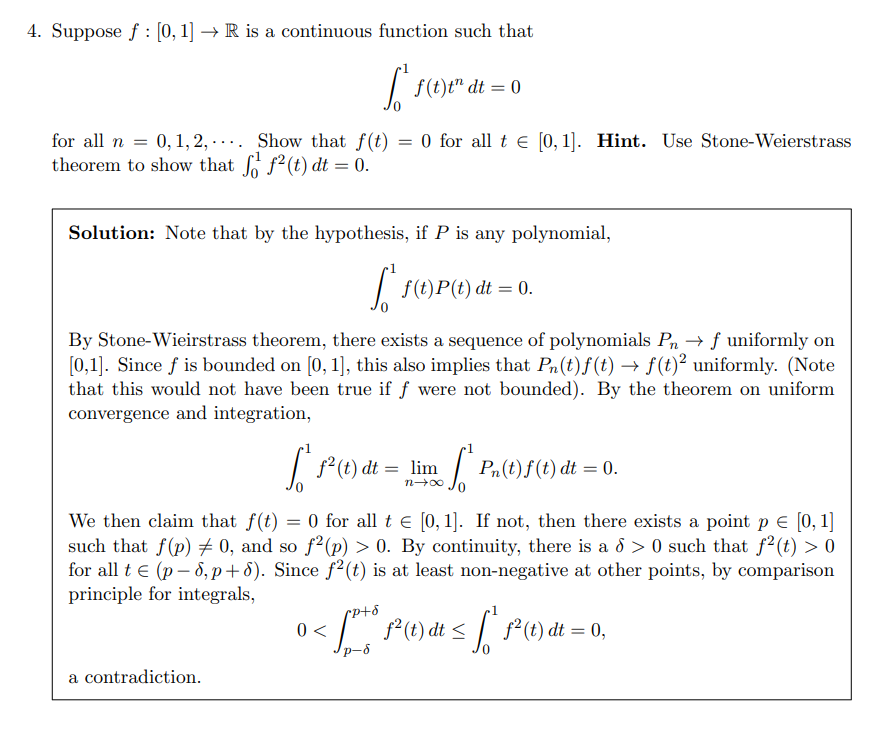
Solution
<1>1. \(\int_0^1 f(t)p(t)\,dt = 0\) for every polynomial \(p\).
If \[ p(t)=\sum_{k=0}^N a_k t^k, \] then linearity of the integral and the hypotheses give \[ \int_0^1 f(t)p(t)\,dt = \sum_{k=0}^N a_k\int_0^1 f(t)t^k\,dt =0. \]
<1>2. \(\int_0^1 f(t)^2\,dt = 0\).
By the Weierstrass approximation theorem, there are polynomials \(p_n\) such that \[ \|p_n-f\|_\infty\longrightarrow0. \] Since \(f\) is continuous on \([0,1]\), it is integrable, and therefore \[ \begin{aligned} \left|\int_0^1 f(t)^2\,dt-\int_0^1 f(t)p_n(t)\,dt\right| &= \left|\int_0^1 f(t)(f(t)-p_n(t))\,dt\right|\\ &\le \|f-p_n\|_\infty\int_0^1|f(t)|\,dt \longrightarrow0. \end{aligned} \] By step <1>1, \(\int_0^1 f(t)p_n(t)\,dt=0\) for every \(n\), so \(\int_0^1 f(t)^2\,dt=0\).
<1>3. Q.E.D.
Since \(f^2\) is continuous and nonnegative, step <1>2 implies \(f(t)^2=0\) for every \(t\in[0,1]\), that is, \(\boxed{f\equiv0}\).
Continuity of translation in $L^1$ (Tag FT-4ED3Q)
For every \(f \in L^{1}(\RR^n)\), \[ \lim_{h \to 0} \int_{\RR^n}\abs{f(x+h)-f(x)}\,dx=0 . \]
Let \(\varepsilon>0\). Since compactly supported continuous functions are dense in \(L^1(\RR^n)\), choose \(g\in C_c(\RR^n)\) with \(\norm{f-g}_{L^1}<\varepsilon/3\). By translation invariance of Lebesgue measure, \(\int\abs{f(x+h)-g(x+h)}\,dx=\norm{f-g}_{L^1}<\varepsilon/3\) for every \(h\). The function \(g\) is uniformly continuous and, for \(\abs{h}\le1\), \(x\mapsto g(x+h)-g(x)\) vanishes outside the compact set \(K=\supp g+\overline{B(0,1)}\), so \(\int\abs{g(x+h)-g(x)}\,dx\le \vol(K)\sup_x\abs{g(x+h)-g(x)}<\varepsilon/3\) for \(\abs{h}\) small enough. The triangle inequality then gives \(\int\abs{f(x+h)-f(x)}\,dx<\varepsilon\) for \(\abs{h}\) small enough.
Orthogonality to $C_c^0$ implies $f=0$ almost everywhere (Tag PR-C626A)
Let \(f\colon\RR^n\to\CC\) be locally integrable, that is, \(\int_K\abs{f}<\infty\) for every compact \(K\subseteq\RR^n\), and let \(C_c^0(\RR^n)\) be the space of continuous functions \(\RR^n\to\CC\) with compact support. If \[ \int_{\RR^n} f \phi = 0 \quad \text{for all } \phi\in C_c^0(\RR^n), \] then \(f = 0\) almost everywhere.
(Consequences of the Riesz--Fischer proof)
The proof of the Riesz–Fischer theorem shows that every sequence converging in \(L^p\), \(1\leq p<\infty\), has a subsequence converging almost everywhere to the same limit.