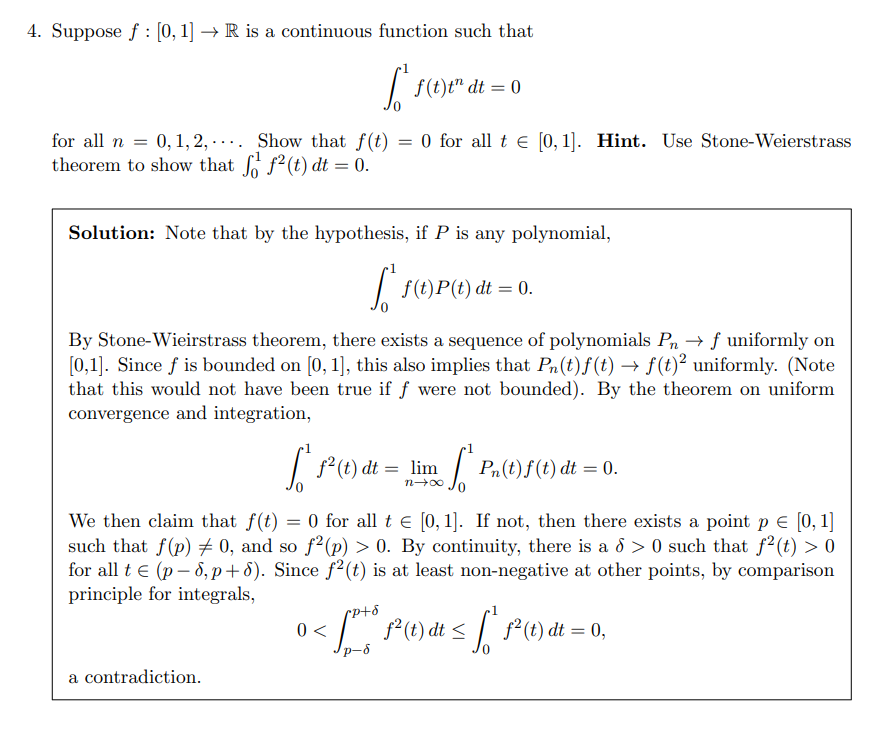
Suppose \(f\colon[0,1]\to\mathbb{R}\) is continuous and \(\int_0^1 f(t)t^n\,dt=0\) for all \(n=0,1,2,\ldots\). Show that \(f(t)=0\) for all \(t\in[0,1]\).
Solution
1. \(\int_0^1 f(t)p(t)\,dt = 0\) for every polynomial \(p\).
If \[ p(t)=\sum_{k=0}^N a_k t^k, \] then linearity of the integral and the hypotheses give \[ \int_0^1 f(t)p(t)\,dt = \sum_{k=0}^N a_k\int_0^1 f(t)t^k\,dt =0. \]
2. \(\int_0^1 f(t)^2\,dt = 0\).
By the Weierstrass approximation theorem, there are polynomials \(p_n\) such that \[ \|p_n-f\|_\infty\longrightarrow0. \] Since \(f\) is continuous on \([0,1]\), it is integrable, and therefore \[ \begin{aligned} \left|\int_0^1 f(t)^2\,dt-\int_0^1 f(t)p_n(t)\,dt\right| &= \left|\int_0^1 f(t)(f(t)-p_n(t))\,dt\right|\\ &\le \|f-p_n\|_\infty\int_0^1|f(t)|\,dt \longrightarrow0. \end{aligned} \] By step 1, \(\int_0^1 f(t)p_n(t)\,dt=0\) for every \(n\), so \(\int_0^1 f(t)^2\,dt=0\).
3. Q.E.D.
Since \(f^2\) is continuous and nonnegative, step 2 implies \(f(t)^2=0\) for every \(t\in[0,1]\), that is, \(\boxed{f\equiv0}\).