Much of the notation and many of the results on this page follow [Eur15].
Notation
- \(\DD_r(a) \coloneqq \ts{z\in \CC \st \abs{z-a}< r}\), the open disc of radius \(r\) about \(a\).
- \(\bar{\DD}_r(a) \coloneqq \ts{z\in \CC \st \abs{z-a} \leq r}\), the closed disc of radius \(r\) about \(a\).
- \(\DD_r^*(a) \coloneqq \ts{z\in \CC \st 0 < \abs{z-a} < r}\), the punctured disc of radius \(r\) about \(a\).
- \(\Delta \coloneqq \DD_1(0)\), the open unit disc; \(\bar\Delta \coloneqq \bar{\DD}_1(0)\), the closed unit disc; \(\Delta^* \coloneqq \DD_1^*(0)\), the punctured unit disc.
- \(\Omega\) denotes an open simply connected subset of \(\CC\).
- \(\OO(\Omega) = \Hol(\Omega) = \Hol(\Omega, \CC)\) denotes the \(\CC\)-algebra of holomorphic functions \(f\colon\Omega \to \CC\).
Principal results
- Estimates for derivatives: Cauchy's inequality
- Cauchy's theorem
- Cauchy's integral formula and the mean value property
- Morera's theorem
- Liouville's theorem
- The maximum modulus principle and the open mapping theorem
- Rouché's theorem
- The Schwarz reflection principle
- The Schwarz lemma
- The Casorati--Weierstrass theorem and the Picard theorems
- Conformal maps
- Automorphisms of the disc and the plane
- The identity principle
- Computing residues
Jordan's lemma (Tag T-ZO5UU)
Choose the semicircle where $e^{i\alpha z}$ decays; the arc integral is bounded by $\pi M_R/\abs{\alpha}$.Suggest a sloganFor \(R>0\) let \(C_R\) be the upper semicircle \(t\mapsto Re^{it}\), \(t\in[0,\pi]\).
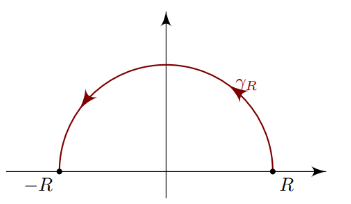
Let \(\alpha>0\), let \(g\) be continuous on \(C_R\), and let \(M_R\coloneqq\sup_{z\in C_R}\abs{g(z)}\). Then \[ \abs{\int_{C_R}e^{i\alpha z}g(z)\dz}\leq\frac{\pi}{\alpha}M_R. \] In particular, if \(g\) is continuous on \(\{z : \operatorname{Im}z\geq0,\ \abs{z}\geq R_0\}\) for some \(R_0\) and \(M_R\to0\) as \(R\to\infty\), then \(\int_{C_R}e^{i\alpha z}g(z)\dz\to0\).
For \(\alpha<0\) the same statements hold with \(C_R\) replaced by the lower semicircle \(t\mapsto Re^{-it}\), \(t\in[0,\pi]\), and \(\pi/\alpha\) replaced by \(\pi/\abs{\alpha}\).
For \(\alpha>0\) and \(z=Re^{it}\), \(\abs{e^{i\alpha z}}=e^{-\alpha R\sin t}\) and \(\abs{\dz}=R\,dt\), so \[ \abs{\int_{C_R}e^{i\alpha z}g(z)\dz}\leq M_R\int_0^\pi e^{-\alpha R\sin t}R\,dt=2M_R\int_0^{\pi/2}e^{-\alpha R\sin t}R\,dt. \] Since \(\sin t\geq 2t/\pi\) for \(t\in[0,\pi/2]\), \[ \int_0^{\pi/2}e^{-\alpha R\sin t}R\,dt\leq\int_0^{\pi/2}e^{-2\alpha Rt/\pi}R\,dt\leq\frac{\pi}{2\alpha}, \] which gives the bound. For \(\alpha<0\) and \(z=Re^{-it}\) with \(t\in[0,\pi]\), \(\abs{e^{i\alpha z}}=e^{\alpha R\sin t}=e^{-\abs{\alpha}R\sin t}\), and the same estimate applies with \(\abs{\alpha}\) in place of \(\alpha\).
- The Cauchy--Riemann equations
- The argument principle
- The Riemann mapping theorem
- Riemann's removable singularity theorem
- Harmonic functions and the mean value property
Complex analysis theorem summary is a compact statement sheet.
Identities
The algebraic identities for \(z\bar z\), \(\Re z\), \(\Im z\), the exponential forms of \(\cos\), \(\sin\), \(\cosh\), \(\sinh\), and the zeros and periods of the hyperbolic functions are on Complex arithmetic.
\[ \begin{aligned} dz &= dx + i\,dy, \\ d\bar z &= dx - i\,dy, \\ f_z &= f_x = f_y / i \quad \text{for } f \text{ holomorphic}, \end{aligned} \] and for \(\ell\in\ZZ\), \[ \int_{0}^{2 \pi} e^{i \ell x} \dx = \begin{cases} 2 \pi & \ell=0, \\ 0 & \ell\neq 0. \end{cases} \]
- \(\abs{f}^2 = f\bar{f}\).
- \(z\) is purely imaginary if and only if \(\bar{z} = -z\), and \(z\in \RR\) if and only if \(\bar z = z\).
- \(\log\abs{z} = {1\over 2}\log\qty{\abs{z}^2} = {1\over 2}\log\qty{x^2 + y^2}\) for \(z = x+iy\neq 0\).
- For \(w, z, a\in\CC\) with \(\abs{w-a}<\abs{z-a}\), \[ \frac{1}{z-w} =\frac{1}{(z-a)\qty{1-\frac{w-a}{z-a}}} =\sum_{n=0}^{\infty}\frac{(w-a)^n}{(z-a)^{n+1}}. \] The standard expansions, generalized binomial coefficients, Cauchy products, and inverses of power series are on Series reference.
Holomorphy
(Sufficient conditions for holomorphy)
A function \(f\) on an open set \(U\) is holomorphic if any of the following holds:
- \(f\) is continuous and \(\int_{\bd T} f = 0\) for every closed triangle \(T\subseteq U\) (Morera's theorem);
- \(f\) has a holomorphic primitive on \(U\);
- \(f\) is locally the sum of a convergent power series.
- If \(f\) is holomorphic with no zeros, then \(1/f\) is holomorphic; applying the maximum modulus principle or Liouville’s theorem to \(1/f\) gives the minimum modulus principle and constancy of entire functions bounded below by a positive constant.
- If \(f\) is holomorphic and nonvanishing on a simply connected domain \(\Omega\), then \(f = e^g\) for some holomorphic \(g\) on \(\Omega\), and \(f^{1/n} \coloneqq \exp\qty{{1\over n}g}\) is a holomorphic \(n\)th root.
- If \(f\) is holomorphic on a neighborhood of \(\bar\DD\) and \(\abs{f} = 1\) on \(\bd \DD\), then \(f\) is a unimodular constant times a finite Blaschke product.
- The substitutions \(z\mapsto 1/z\), \(f\mapsto 1/f\), and \(w = e^z\) transfer statements between \(0\) and \(\infty\), between zeros and poles, and between strips and annuli.
Constancy
(Criteria for a holomorphic function to be constant)
Let \(f\) be holomorphic on a domain \(U\). Then \(f\) is constant if any of the following holds:
- \(f' = 0\) on \(U\); by the Cauchy–Riemann equations it suffices that \(u_x = u_y = 0\) for \(u = \Re f\).
- One of \(\Re f\), \(\Im f\), \(\abs{f}\), or \(\arg f\) (for a continuous branch) is constant.
- \(\abs f\) attains a maximum in \(U\), or \(f\) is nonvanishing and \(\abs f\) attains a minimum in \(U\).
- \(f(U)\) is not open, for instance \(f(U)\subseteq\RR\) or \(f(U)\subseteq \bd\DD_r(0)\) (open mapping theorem).
- \(U\) is bounded, \(f\) extends continuously to \(\bar U\), \(f\) has no zeros in \(U\), and \(\abs f\) is constant on \(\bd U\): the maximum modulus principle applied to \(f\) and to \(1/f\) shows \(\abs f\) is constant.
If moreover \(U = \CC\), then \(f\) is constant if any of the following holds:
- \(f\) is bounded (Liouville's theorem); if also \(f(z)\to 0\) as \(z\to\infty\), then \(f\equiv 0\).
- \(\abs f\geq M\) for some \(M>0\), by Liouville’s theorem applied to \(1/f\).
- \(e^f\) or \(e^{-f}\) is bounded, since \(\abs{e^{f}} = e^{\Re f}\).
- \(f\) is periodic with two \(\RR\)-linearly independent periods, since then \(f\) is bounded by its bound on a closed fundamental parallelogram.
- \(f\) omits two values of \(\CC\), for instance when \(f(\CC)\) misses an open set (little Picard theorem).
If \(f\) and \(g\) are holomorphic on a domain \(U\) and \(f-g\) has a zero set with a limit point in \(U\), then \(f = g\) (identity principle).
Singularities
(Classifying an isolated singularity)
Let \(f\) be holomorphic on a punctured disc about \(z_0\).
- \(z_0\) is removable if and only if \(f\) is bounded near \(z_0\).
- \(z_0\) is a pole if and only if \(\abs{f(z)}\to\infty\) as \(z\to z_0\).
- \(z_0\) is a pole of order \(m\) if and only if \(f(z) = (z-z_0)^{-m}g(z)\) with \(g\) holomorphic near \(z_0\) and \(g(z_0)\neq 0\), equivalently if \(1/f\) has a zero of order \(m\) at \(z_0\), equivalently if the Laurent expansion at \(z_0\) has lowest term of degree \(-m\).
- \(z_0\) is essential if and only if \(\lim_{z\to z_0} f(z)\) exists neither in \(\CC\) nor as \(\infty\), equivalently if the Laurent expansion at \(z_0\) has infinitely many terms of negative degree. Two sequences \(z_k\to z_0\) along which \(f\) has different limits show this.
A meromorphic function \(f\) and its derivative \(f'\) have the same poles.
If \(h\) has an essential singularity at \(z_0\), then by the great Picard theorem, in every punctured neighborhood of \(z_0\), \(h\) takes every value of \(\CC\) infinitely often with at most one exception. With \(h \coloneqq f/g\), this shows \(f(z) = cg(z)\) for infinitely many \(z\) near \(z_0\), for all but at most one \(c\in\CC\).
Zeros
Let \(f\) be holomorphic near \(z_0\).
- \(f\) has a zero of order \(n\) at \(z_0\) if and only if \(f^{(k)}(z_0) = 0\) for \(0\leq k<n\) and \(f^{(n)}(z_0) \neq 0\).
- If \(f(z_0)\neq 0\), then \(f\) is nonzero on a neighborhood of \(z_0\) by continuity.
- If \(f(z_0) = 0\) and \(f\) is not identically zero near \(z_0\), then \(f\) is nonzero on a punctured neighborhood of \(z_0\).
- Dividing by a finite Blaschke product with the same zeros in \(\DD\) gives a function without zeros in \(\DD\) with the same modulus on \(\bd\DD\).
- Zeros in a region are counted by Rouché's theorem and the argument principle.
Estimates
- For \(\abs a\neq \abs b\), the reverse triangle inequality gives \[ {1\over \abs{a\pm b}} \leq {1\over \abs{\abs{a} - \abs{b} } }. \]
- The Cauchy integral formula bounds derivatives of \(f\) by the maximum of \(\abs f\) on a circle, and bounds \(\abs{f}\) at interior points by an integral of \(\abs f\) over a curve.
- If \(u_n\) are harmonic on a bounded domain \(U\), continuous on \(\bar U\), and \(u_n\) converges uniformly on \(\bd U\), then \(u_n\) converges uniformly on \(\bar U\), by the maximum principle applied to \(u_n - u_m\).
- For \(f\colon[a,b]\to\RR\) differentiable with \(\abs{f'} \leq M\), the mean value theorem gives \(\abs{f(x) - f(y)} \leq M\abs{x-y}\).
- If \(h\) is holomorphic on \(\DD\) with \(\abs h\leq 1\) and \(h(0) = 0\), then \(\abs{h(z)}\leq\abs z\) by the Schwarz lemma; applied to \(h \coloneqq f/g\) this gives \(\abs{f(z)}\leq\abs{z}\abs{g(z)}\).
In the criterion that a zero-free \(f\) with \(\abs f\) constant on \(\bd U\) is constant, the hypothesis that \(f\) has no zeros is necessary: \(f(z) = z\) has \(\abs f = 1\) on \(\bd\DD\) and is not constant.
Polynomials
An entire function \(f\) is a polynomial if and only if \(f^{(n)} = 0\) for all sufficiently large \(n\), if and only if \(f\) has a pole or a removable singularity at \(\infty\). Cauchy’s inequality shows \(f^{(n)} = 0\) for \(n>d\) when \(\abs{f(z)}\leq C\abs z^d\) for large \(\abs z\).