A holomorphic map \(f\colon\DD\to\DD\) with \(f(0)=0\) satisfies \(\abs{f(z)}\leq\abs z\) and \(\abs{f'(0)}\leq 1\), and equality in either bound, at a single \(z\neq 0\) in the first, holds only for a rotation.
Schwarz lemma (Tag T-DAETF)
Let \(f\colon\DD\to\DD\) be holomorphic with \(f(0)=0\). Then
\(\abs{f(z)}\leq\abs{z}\) for all \(z\in\DD\), and
\(\abs{f'(0)}\leq1\).
If \(\abs{f(z_0)}=\abs{z_0}\) for some \(z_0\in\DD\setminus\{0\}\), or if \(\abs{f'(0)}=1\), then \(f\) is a rotation: there is \(\lambda\in\CC\) with \(\abs{\lambda}=1\) such that \(f(z)=\lambda z\) for all \(z\in\DD\).
Schwarz lemma as a dichotomy (Tag T-VM6MJ)
Let \(f\colon\DD\to\DD\) be holomorphic with \(f(0)=0\). Then exactly one of the following holds.
There is \(\theta\in\RR\) with \(f(z)=e^{i\theta}z\) for all \(z\in\DD\).
\(\abs{f'(0)}<1\), and \(\abs{f(z)}<\abs{z}\) for all \(z\in\DD\setminus\{0\}\).
Proof of the Schwarz lemma (Tag FF-5H4UZ)
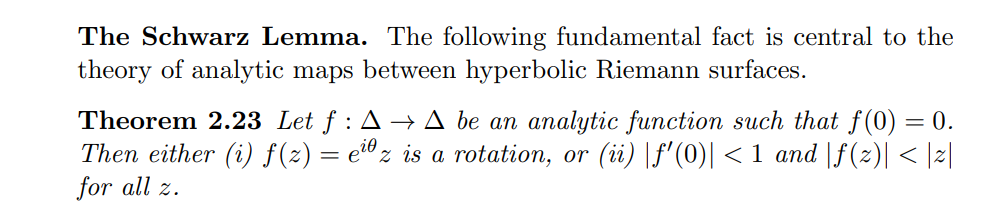
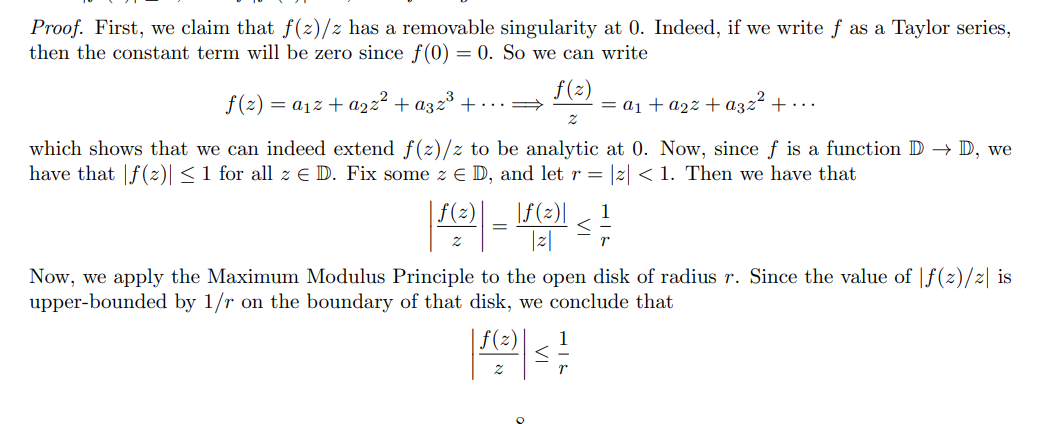
Let \(f\colon\DD\to\DD\) be holomorphic with \(f(0)=0\), as in the Schwarz lemma. Write \(f(z)=\sum_{k\ge0}c_kz^k\) on \(\DD\). Since \(f(0)=0\), \(c_0=0\). Define \(g(z)\coloneqq f(z)/z\) for \(z\in\DD\setminus\{0\}\) and \(g(0)\coloneqq c_1=f'(0)\). Then \(g(z)=\sum_{k\ge1}c_kz^{k-1}\) on \(\DD\), a power series converging on \(\DD\), so \(g\) is holomorphic on \(\DD\).
Fix \(0<r<1\). For \(\abs{z}=r\), \(\abs{g(z)}=\abs{f(z)}/r<1/r\) because \(f\) maps into \(\DD\). By the maximum modulus principle applied to \(g\) on the disc \(\abs{z}<r\), \(\abs{g(z)}\le1/r\) for \(\abs{z}\le r\). For fixed \(z\in\DD\), letting \(r\to1\) through values \(r>\abs{z}\) gives \(\abs{g(z)}\le1\). Hence \(\abs{f(z)}\le\abs{z}\) for \(z\in\DD\), and \(\abs{f'(0)}=\abs{g(0)}\le1\).
If \(\abs{f(z_0)}=\abs{z_0}\) for some \(z_0\neq0\), then \(\abs{g(z_0)}=1\); if \(\abs{f'(0)}=1\), then \(\abs{g(0)}=1\). In either case \(\abs{g}\le1\) on \(\DD\) attains the value \(1\) at a point of \(\DD\), so \(\abs{g}\) has a local maximum there and \(g\) is constant on a neighborhood of that point by the maximum modulus principle. By the identity theorem, \(g\equiv\lambda\) on \(\DD\) for a constant \(\lambda\) with \(\abs{\lambda}=1\), so \(f(z)=\lambda z\).
(Schwarz lemma)
The proof applies the maximum modulus principle to \(g(z) \coloneqq f(z)/z\).
\(\abs{g(z)} \leq 1\):
Expand \(f\) at \(z=0\) as \(\sum_{k\geq 0} c_k z^k\). Since \(f(0) = 0 = c_0\), the constant term vanishes.
So \(g(z) \coloneqq f(z)/z\) is holomorphic on \(\DD\), the singularity at \(z=0\) being removable.
For \(\abs z = r < 1\), \(\abs{g(z)} = \abs{f(z)}/r \leq 1/r\) since \(\abs{f(z)} < 1\).
By the maximum modulus principle \(\abs{g(z)} \leq 1/r\) on the whole disc \(\abs z \leq r\); let \(r\to 1\) to get \(\abs{g} \leq 1\).
\(\abs{f'(0)} \leq 1\), with equality only for a rotation:
Since \(f(0)=0\), \(g(0) = \lim_{z\to 0}{f(z)-f(0)\over z-0} = f'(0)\).
If \(\abs{f'(0)} = 1\) then \(\abs g\), which is at most \(1\), has a maximum at the interior point \(0\), so \(g\) is constant and \(f(z) = cz\) with \(\abs c = 1\).
\(\abs{f(z_0)} = \abs{z_0}\) for some \(z_0 \neq 0\) implies a rotation:
- Then \(\abs g\) has a maximum at the interior point \(z_0\), so \(g\) is constant and \(f(z) = cz\) with \(\abs c = 1\).
(Schwarz lemma, alternative)
(Schwarz–Pick inequality)
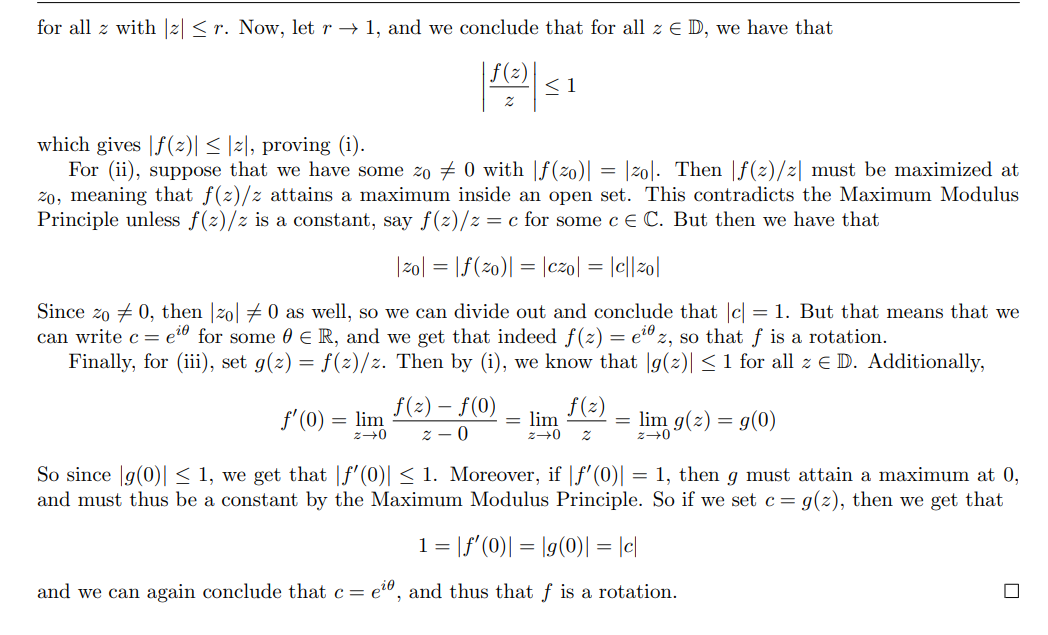
For \(a\in\DD\) the Blaschke factor \(\psi_a(z) = (a-z)/(1-\bar a z)\) is an automorphism of \(\DD\) with \(\psi_a(0)=a\), \(\psi_a(a)=0\), and \(\psi_a\circ\psi_a = \id\). Let \(f\colon\DD\to\DD\) be holomorphic, \(a\in\DD\) and \(b\coloneqq f(a)\). Then \(h\coloneqq\psi_b\circ f\circ\psi_a\) maps \(\DD\) to \(\DD\) with \(h(0)=0\), and the Schwarz lemma applied to \(h\) at \(w=\psi_a(z)\) gives \[ \abs{\psi_{f(a)}(f(z))} \leq \abs{\psi_a(z)}, \qquad z\in\DD .\] The same conjugation computes the automorphism group on Blaschke factors and automorphisms.
(Two fixed points)
A holomorphic \(f\colon\DD\to\DD\) with two distinct fixed points \(a\) and \(c\) is the identity. The map \(h\coloneqq\psi_a\circ f\circ\psi_a\) fixes \(0\) and \(z_0\coloneqq\psi_a(c)\neq 0\), so \(\abs{h(z_0)}=\abs{z_0}\) and \(h(z)=\lambda z\) with \(\abs\lambda=1\) by the Schwarz lemma. Since \(h(z_0)=z_0\neq 0\), \(\lambda = 1\), so \(h=\id\) and \(f=\psi_a\circ h\circ\psi_a=\id\).
The Schwarz lemma also gives a proof of Liouville’s theorem, on Cauchy estimates and Liouville.
Exercises
Holomorphic automorphisms of $\CC$ are the maps $z\mapsto az+b$ with $a\neq 0$ (Tag E-TJ3WM)
Show that \(\Aut_\CC(\CC) = \ts{ z \mapsto az+b\st a\in \unitsof{\CC}, b\in \CC }\).
Solution
Goal: Show that the holomorphic automorphisms of \(\CC\) are exactly the affine maps \(z \mapsto az + b\) with \(a \in \CC^{\times}\), \(b \in \CC\).
<1>1. Every affine map \(z \mapsto az + b\), \(a \neq 0\), is a holomorphic automorphism of \(\CC\).
It is entire, and its inverse \(z \mapsto (z - b)/a\) is also entire; both are bijections of \(\CC\) onto itself.
<1>2. Let \(f \in \Aut_\CC(\CC)\). Consider the singularity of \(f\) at \(\infty\).
\(f\) is entire, so it has a power series expansion \(f(z) = \sum_{n \ge 0} c_n z^n\) converging on all of \(\CC\).
The nature of the singularity at \(\infty\) is determined by the series.
<1>3. The singularity at \(\infty\) is a pole, not an essential singularity.
If \(\infty\) were an essential singularity, then by the Casorati–Weierstrass theorem (or the open mapping theorem on neighborhoods of \(\infty\)), \(f\) would not be injective near \(\infty\) — in fact \(f(\CC)\) would be dense in \(\CC\) and \(f\) could not be injective on all of \(\CC\).
More elementarily: \(f\) is a bijection of \(\CC\), so as \(z \to \infty\) along any sequence, \(f(z) \to \infty\) (otherwise a sequence \(z_n \to \infty\) with \(f(z_n)\) bounded would have a convergent subsequence \(f(z_{n_k}) \to w\), and injectivity + open mapping would be violated — indeed \(f(z_{n_k}) \to w\) with \(z_{n_k} \to \infty\) is impossible for a biholomorphism of \(\CC\)). Hence \(\infty\) is a pole of \(f\).
<1>4. A pole at \(\infty\) means \(f\) is a polynomial.
If \(\infty\) is a pole of order \(m\), then \(f(z) = \sum_{n=0}^m c_n z^n\) is a polynomial of degree \(m\): the power series expansion has only finitely many nonzero terms.
<1>5. The polynomial \(f\) has degree exactly 1.
A polynomial of degree \(d \ge 2\) is not injective on \(\CC\) (the equation \(f(z) = w\) has \(d\) roots counting multiplicity for generic \(w\); by the fundamental theorem of algebra it is not one-to-one).
A polynomial of degree \(0\) is constant, not a bijection. Since \(f\) is a bijection, \(d = 1\).
<1>6. Q.E.D.
<1>1 and <1>5 show \(\Aut_\CC(\CC)\) consists exactly of the maps \(z \mapsto az + b\) with \(a \neq 0\).
Schwarz with domain/codomain scaled (Tag E-MIIW7)
If \(f: \DD_R(a)\to\DD_M(0)\) with \(f(a) = 0\), then \[ \abs{f(z)}\leq {M\over R}\abs{z-a} .\]
Solution
Set \(g(z) \da {f(Rz + a) \over M}\), then \(g: \DD\to \DD\) with \(g(0) = f(a)/M = 0\), so unwinding Schwarz yields \[ \abs{g(z)} \leq \abs{z} \implies \abs{f(Rz+a)\over M} &\leq \abs{z} \\ \implies \abs{f(Rz+a)} &\leq M\abs{z} \\ \implies \abs{f(w)} &\leq M\abs{w-a\over R} \qquad w = Rz+a\implies z={w-a\over R} .\]
Forcing a map to be the identity (Tag E-ZSOC4)
Let \(\psi_a\) be a Blaschke factor and use the Schwarz lemma to prove that \(\psi_a \circ \psi_a = \id_\DD\).
Solution
First, \(\psi_a\) maps \(\DD\to \DD\). Fix \(z\in S^1\), then \[ \abs{\psi_a(z)} \da \abs{a-z\over 1-\bar{a} z} &= \abs{a-z\over 1-\bar{a} z} \cdot \inverseof{\abs{\bar z}} \\ &= \abs{a-z\over \bar{a} - \bar{z}} \\ &= \abs{a-z \over \bar{a-z} } \\ &\da \abs{w \over \bar w } \\ &= \abs{w \over \abs{w}^2/w }\\ &= \abs{w^2 \over \abs{w}^2} \\ &= 1 .\] \(\psi_a\) is holomorphic on \(\DD\) since it has a simple pole at \(z=1/\bar{a}\), but \(\abs{a}<1\) implies \(\abs{1/\bar{a}} > 1\). Let \(g\da \psi_a\circ \psi_a\), then \(g(0) = 0\) so Schwarz applies. Since \(g(a) = a\) with \(a\neq 0\), the 2nd part of Schwarz also applies since \(\abs{g(a)} = \abs{a}\) and \(g(z) = \lambda z\) is a rotation. Since \(a = g(a) = \lambda a\), this forces \(\lambda = 1\), so \(g\) is the identity.
Schwarz--Pick lemma (Tag E-DXQMY)
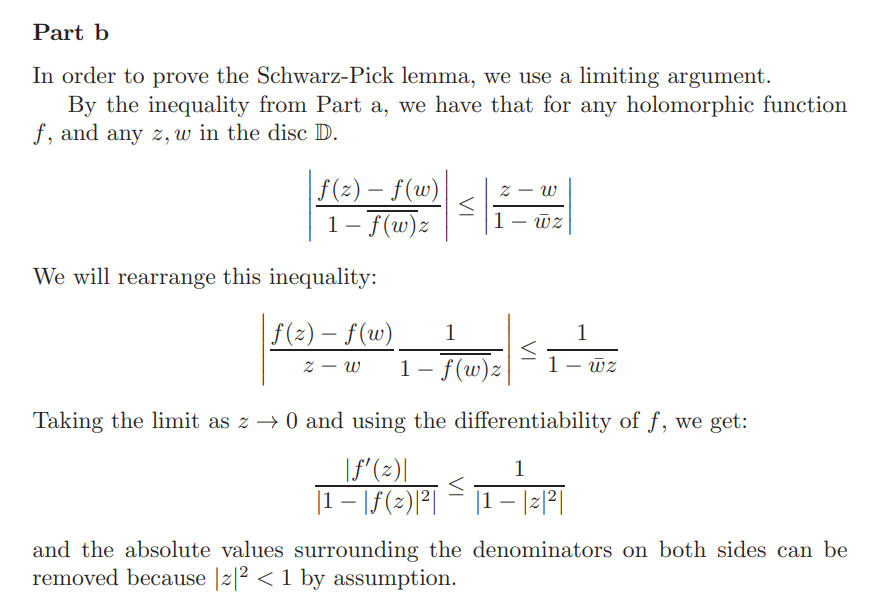
Prove the following: suppose \(\abs{f(z)}\leq 1\), then for all \(z, w\in \DD\), \[ \left|\frac{f(z)-f(w)}{1-\overline{f(w)} f(z)}\right| \leq\left|\frac{z-w}{1-\bar{w} z}\right| \quad\text{ and } \left|f^{\prime}(z)\right| \leq \frac{1-|f(z)|^{2}}{1-|z|^{2}} .\] If equality holds for some \(z\neq w\) in either expression, then \(f= \lambda F\) where \(F\) is a linear fractional transformation and \(\abs{\lambda} = 1\), so \(f\in \Aut(\DD)\).
Note that this does not require \(f(0) = 0\).
Solution
Solution
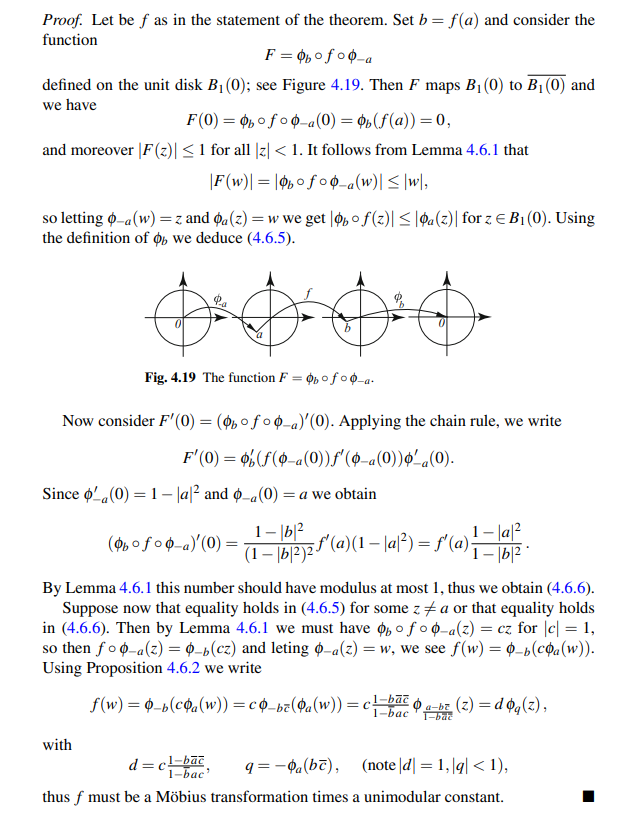
For \(a\in\mathbb D\), write \[ \phi_a(\zeta)=\frac{a-\zeta}{1-\overline a\zeta}. \] This is an automorphism of \(\mathbb D\), interchanging \(0\) and \(a\).
Fix \(w\in\mathbb D\) and define \[ g=\phi_{f(w)}\circ f\circ\phi_w. \] Then \(g:\mathbb D\to\mathbb D\) is holomorphic and \(g(0)=0\). Schwarz’s lemma therefore gives \(|g(\zeta)|\le|\zeta|\). Taking \(\zeta=\phi_w(z)\) and using \(\phi_w^{-1}=\phi_w\) yields \[ \left|\frac{f(z)-f(w)}{1-\overline{f(w)}f(z)}\right| \le \left|\frac{z-w}{1-\overline wz}\right|. \]
Divide by \(|z-w|\) and let \(z\to w\). Since \[ \left|\frac{z-w}{1-\overline wz}\right| =\frac{|z-w|}{|1-\overline wz|}, \] we obtain \[ \frac{|f'(w)|}{1-|f(w)|^2} \le\frac1{1-|w|^2}, \] or equivalently \[ |f'(w)|\le\frac{1-|f(w)|^2}{1-|w|^2}. \]
If equality holds in the two-point inequality for some distinct \(z,w\), then Schwarz’s lemma has equality at a nonzero point for the corresponding \(g\), so \(g(\zeta)=\lambda\zeta\) with \(|\lambda|=1\). Thus \(f\) is a composition of disk automorphisms and is itself in \(\operatorname{Aut}(\mathbb D)\). The same conclusion follows if equality holds in the derivative inequality at one point, by the derivative equality case of Schwarz’s lemma.
Special case of bijections (Tag E-QFOOL)
Show that if \(f: \Delta\to\Delta\) is a biholomorphism with \(f(0) = 0\) then \(f\) is a rotation.
Solution
By Schwarz, \(\abs{f(z)} \leq \abs{z}\), and if we write \(h \da \inverseof{f}\) then \(h(0) = 0\) and \(\abs{h(z)} \leq \abs{z}\) as well. Schwarz says \(f\) will be a rotation if there is any \(z_0\) such that \(\abs{f(z_0)} = \abs{z_0}\). Write \(f(z) = w\), we’ll then show that in fact \(\abs{f(z)} = \abs{z}\) for all \(z\in \DD\). \[ \abs{z} = \abs{(h\circ f)(z)} = \abs{h(w)} \leq \abs{w} = \abs{f(z)}\leq \abs{z} .\]
Solution: Shorter version
By Schwarz, \(\abs{f'(0)} \leq 1\) – the claim is that we have equality, so that by Schwarz \(f(z) = \lambda z\) for some \(\abs{\lambda} = 1\). Use that \(f'(0) \neq 0\) since \(f\) is a bijection near zero and if \(g\da \inverseof{f}\) then \(g'(0) = 1/f'(0)\). Moreover Schwarz applies to \(g\), so \(1 \geq \abs{g'(0)} \geq {1\over \abs{f'(0)} }\), forcing \(\abs{ f'(0) } = 1\). By the equality clause in the Schwarz lemma for \(f\), \(f\) is rotation.
$\abs{f(z)}\le\abs{\frac{z-i}{z+i}}$ for holomorphic $f:\HH\to\DD$ with $f(i)=0$ (Tag E-FJHDQ)
Show that if \(f:\HH\to \DD\) is holomorphic and \(f(i) = 0\) then \(\abs{f(z)} \leq \abs{z-i\over z+i}\).
Solution
Let \(g(z) \da {z-i\over z+i}: \HH\to \DD\) be the Cayley map, a biholomorphism with inverse \(\inverseof{g}(w) = i{1+w\over 1-w}: \DD\to \HH\), and let \(F \da f\circ \inverseof{g}:\DD\to\DD\). Then \(F(0) = f(\inverseof{g}(0)) = f(i) = 0\) by assumption, so the Schwarz lemma gives \(\abs{F(w)} \leq \abs{w}\) for \(w\in\DD\). For \(z\in\HH\), take \(w=g(z)\): \[ \abs{f(z)}=\abs{F(g(z))}\le\abs{g(z)}=\abs{z-i\over z+i} .\]
More juggling (Tag E-ZGFJA)
Suppose \(f:\DD\to \DD\) with \(f(0) = 0\) and that there exists an \(r\in (0, 1)\) with \(f(r) = f(-r) = 0\). Show that \[ \abs{f(z)} \leq \abs{z^2-r^2 \over 1-r^2 z^2} .\]
Solution
The key observation is that this factors: \[ {z^2 - r^2 \over 1-r^2 z^2} = {r-z\over 1+rz}{-r-z\over 1-rz} = \psi_{r}(z) \psi_{-r}(z) ,\] so this inequality will follow from Schwarz on \(g(z) \da f(z)/\psi_a(z)\psi_{-a}(z)\). Schwarz does apply since \(\abs{f}\leq 1\) in \(\DD\) and \(\abs{\psi_a(z)} = 1\) on \(S^1\), so \(\abs{g(z)} \leq 1\) on \(S^1\) and by the MMP this inequality holds in all of \(\DD\). So \(\abs{g(z)}\leq \abs{z}\) and unwinding gives the desired inequality.
Liouville (Tag E-XQX6X)
Use a version of the Schwarz lemma to prove Liouville’s theorem.
Solution
Suppose \(f\) is entire and bounded, we’ll show \(f\) is constant. If \(f\) is bounded by \(M\), then \(f(\CC) \subseteq \DD_M(0)\). Without loss of generality, replace \(f\) with \(g(z) \da f(z) - f(0)\), so \(g(0) = 0\) and is still bounded by \(M' \da M + \abs{f(0)}\) by the triangle inequality. This is still finite since \(0\) is not a singularity since \(f\) is entire.
By the radius \(R\) variant of the Schwarz lemma, for every \(\DD_R(0)\), \[ \abs{g(z)} \leq {M\over R}\abs{z} \qquad \text{for } z\in \DD_R(0) .\] Using that \(g(0) = 0\), \[ \abs{g(z) - g(0) \over z} \leq {M\over R}\convergesto{R\to\infty}0 ,\] where dividing by \(z\) is not an issue since \(z=0\) is a zero of \(g\) of at least order one. This forces \(g(z) = g(0) = 0\) for all \(z\), so \(f(z) = f(z_0)\) is constant.
$\abs{f''(0)}\le2$ for a self-map of $\DD$ with $f(0)=f'(0)=0$ (Tag E-5QAVX)
Let \(f:\DD\to \DD\) with \(f(0) = f'(0) = 0\). Show that \(\abs{f''(0)} \leq 2\) and describe all \(f\) for which this is an equality.
Solution
By Schwarz, \(\abs{f(z)}\leq \abs z\). Write \(g(z) \da f(z)/z\), which is holomorphic on \(\DD\) since \(f\) has a zero of order at least one at \(0\), and \(\abs{g(z)}\leq 1\). Write \(f(z) = \sum_k c_kz^k\); then \(c_0 = 0\) since \(f(0) = 0\) and \(c_1 = 0\) since \(f'(0) = 0\), so \(f(z)=c_2z^2 + \bigo(z^3)\). Thus \(g(z) = c_2z + \bigo(z^2)\) and \(g(0) = 0\). By the maximum modulus principle, the nonconstant function \(g\) with \(\abs g\le1\) satisfies \(\abs g<1\) on \(\DD\) (and \(g\equiv0\) if \(g\) is constant), so \(g:\DD\to\DD\) and Schwarz applies:
- \(\abs{g(z)}\leq \abs{z}\)
- \(\abs{g'(0)} \leq 1\)
We have \(g'(z) = c_2 + \bigo(z)\) so \(g'(0) = c_2 = {f^{(2)}(0) \over 2!}\). \[ 1 \geq \abs{g'(0)} = \abs{c_2} = \abs{f^{(2)}(0) \over 2} \implies \abs{ f^{(2)}(0) } \leq 2! .\]
Suppose this is an equality – then Schwarz on \(g\) shows \(g\) is a rotation, so \[ {f(z)\over z} = g(z) = \lambda z \implies f(z) = \lambda z^2 \qquad \lambda \in S^1 .\] Conversely, \(f(z)=\lambda z^2\) with \(\abs\lambda=1\) satisfies the hypotheses and \(\abs{f''(0)}=2\).
Fixed point convergence (Tag E-TCONN)
Suppose \(f:\DD\to \DD\) with \(f(a) = a\) a fixed point where \(\abs{f'(a)} < 1\). Show that for any initial point \(z_0\), the sequence \(z_k \da f(z_{k-1})\) converges to \(a\).
Solution
First suppose \(a=0\) – then Schwarz applies, and since \(\abs{f'(a)} < 1\) is strict, \(f\) is not a rotation.
For any choice of \(z_0\in \DD\), there is an \(r\) with \(0< \abs{z_0} < r < 1\) and a constant \(C<1\) such that \(\abs{f(z)} \leq C\abs{z}\) for \(\abs{z} < r\).
With such an \(r\) and \(C<1\) in hand,
\[ \abs{z_k} = \abs{f(z_{k-1})} \leq C\abs{z_{k-1}} = C\abs{f(z_{k-2})} \leq C^2 \abs{z_{k-2}} \cdots \implies \abs{z_k} \leq C^k\abs{z_0} \convergesto{k\to\infty}0 ,\] which proves the \(a=0\) case.
(That $f$ is a contraction)
The claim is that for any given \(r\), the constant \(C\da M/r\) works, where \(M\da \max_{\abs{z} = r} \abs{f(z)}>0\). The scaled Schwarz lemma gives \(\abs{f(z)}\leq {M\over r}\abs{z} = C\abs{z}\), and \(\abs{C} \leq 1\) since \(\abs{M} \leq r\), which follows because \(\abs{f(z)}\leq \abs{z}\) on \(\DD\) itself.
For \(a\neq 0\), take a Blaschke factor \(\psi_a(z)\) and consider \(F \da \inverseof{\psi_a} \circ f\circ \psi_a\). The claim is that this reduces to the case \(a=0\).
Note \(F(0) = 0\), so \(0\) is a fixed point of \(F\). Moreover, a clever calculation shows \[ F'(0) &= (\inverseof{\psi_a})'(f(\psi_a(0))) \cdot f'(\psi_a(0)) \cdot \psi_a'(0) \\ \\ &= (\inverseof{\psi_a})'(f( a )) \cdot f'(a ) \cdot \psi_a'(0) \\ \\ &= (\inverseof{\psi_a})'(a) \cdot f'(a ) \cdot \psi_a'(0) \qquad \text{since } f(a) = a \\ \\ &= (\psi_a)'(a) \cdot \psi_a'(0) \cdot f'(a) \qquad \text{since } \inverseof{\psi_a} = \psi_a \\ \\ &= (\psi_a)'( \psi_a(0) ) \cdot \psi_a'(0) \cdot f'(a) \\ \\ &= (\psi_a \circ \psi_a)'(0) \cdot f'(a) \\ &= 1 \cdot f'(a) ,\] so \(\abs{F'(0)} = \abs{f'(a)} < 1\). Now setting \(w_k \da \psi_a(z_n)\) and writing \(f = \psi_a \circ F \circ \inverseof{\psi_a}\), by continuity we have \[ f(z_k) = \psi_a(F(w_k)) \convergesto{k\to\infty} \psi_a(0) = a .\]
Fixed points: multiple (Tag E-VYIZJ)
Show that the only holomorphic map \(f:\DD\to \DD\) two distinct fixed points \(a\neq b\) is the identity.
Solution
Note that without loss of generality we can assume \(a=0\) so \(f(0) = 0\) and \(b\neq 0\). If not, if \(a,b\neq 0\) then let \(F\da \psi_a \circ f \circ \psi_a\), then \(F(0) = 0\) and \(F(b') = b'\) for \(b\da \psi_a(b)\).
Since \(f(0) = 0\), Schwarz applies, so \(\abs{f(z)} = \abs{z}\) with equality attained because \(\abs{f(b)} = \abs{b}\), and \(f(z) = \lambda z\) must be a rotation. Since \(b = f(b) = \lambda b\), we have \(\lambda = 1\).
$\abs{f'(a)}\le1$ at a fixed point and $\abs{f(0)}^2+\abs{f'(0)}^2\le1$ by Schwarz--Pick (Tag E-5I2NN)
Let \(f\in \Hol(\DD)\). Show that if \(f\) has a fixed point \(a\) then \(\abs{f'(a)} \leq 1\), and that \[ \abs{f(0)}^2 + \abs{f'(0)}^2 \leq 1 .\]
Solution
Assume \(f(\DD)\subseteq\DD\), which the Schwarz–Pick lemma requires. Set \(f(a) = a\) in Schwarz-Pick: \[ \left|f^{\prime}(a)\right| \leq \frac{1-|f(a)|^{2}}{1-|a|^{2}} \implies \abs{f'(a)} \leq {1 - \abs{a}^2 \over 1 - \abs{a}^2} = 1 .\] Set \(a=0\): \[ \left|f^{\prime}(0)\right| \leq \frac{1-|f(0)|^{2}}{1-|0|^{2}} = 1-\abs{f(0)}^2 .\] Since the right side is at most \(1\), \(\abs{f'(0)}^2\le\abs{f'(0)}\le1-\abs{f(0)}^2\).
Both bounds fail for holomorphic maps that do not send \(\DD\) into \(\DD\): \(f(z)=2z\) fixes \(0\) and has \(f'(0)=2\).
A self-map of $\DD$ with $f(1/2)=3/4$ and $f'(1/2)=2/3$ (Tag E-FUIDU)
Does there exist a map \(f: \DD\to \DD\) with
\(f\qty{1\over 2} = {3\over 4}\)
\(f'\qty{1\over 2} = {2\over 3}\)
Solution
Apply Schwarz-Pick: \[ \abs{f'\qty{1\over 2}} \leq {1 - \abs{f\qty{1\over 2}}^2 \over 1 - \abs{1\over 2}^2 } = {1-(3/4)^2\over 1-(1/2)^2} = {7/16\over 3/4} = {7\over 12}. \] Since \(7/12<2/3\), the prescribed derivative is impossible.
Bound on $\abs{f(\frac{1+i}{2})}$ for a self-map of $\DD$ with $\abs{f}\le\abs{e^z}$ on $\abs z=1$ (Tag E-JSPEB)
Suppose \(f: \DD\to \DD\) with \(f(0) = 0\) and \(\abs{f(z)} \leq \abs{e^z}\) when \(\abs{z} = 1\). Find an upper bound for \(f\qty{1+i\over 2}\).
Solution
Assume \(f\) extends continuously to \(\overline\DD\), so that the boundary condition makes sense. Consider \(g(z) \da f(z)e^{-z}\), holomorphic on \(\DD\) and continuous on \(\overline\DD\) with \(g(0) = 0\). On \(\abs z=1\), \(\abs{g(z)}\le1\), so by the maximum modulus principle \(\abs g\le1\) on \(\DD\); as \(g(0)=0\), \(g\) is not a unimodular constant, so \(g(\DD)\subseteq\DD\). Schwarz applies and \[ \abs{g(z)}\leq \abs{z} \implies \abs{f(z)} \leq \abs{z}\abs{e^z} = \abs z e^{\Re z} .\] So \[ \abs{f\qty{1+i\over 2}} \leq \abs{1+i\over 2}e^{1/2}= {\sqrt{2e} \over 2} .\]
Bound on $\abs{f(2i)}$ for $f:\HH\to\DD$ with $f(i)=0$ (Tag E-GPFKM)
Suppose \(f:\HH\to \CC\) with \(\abs{f(z)}< 1\) and \(f(i) = 0\). Find an upper bound for \(\abs{f(2i)}\).
Solution
Compose with the inverse Cayley map \(g(z) \da i{1+z\over 1-z}\) so \(g: \DD\to \HH\) to get \(F\da f\circ g:\DD\to \DD\), where \(F(0) =f(g(0))=f(i) = 0\). So Schwarz applies and \(\abs{F(z)}\leq \abs{z}\). The inverse of \(g\) is \[ g^{-1}(w)={w-i\over w+i}, \qquad g^{-1}(2i)={1\over3}. \] Therefore \[ \abs{f(2i)} =\abs{F(g^{-1}(2i))} =\abs{F(1/3)} \le {1\over3}. \]
Combining with Rouche (Tag E-XKMVX)
Use Rouché’s theorem and the Schwarz lemma to prove the following: if \(f:\DD\to \bar{ \DD}\) is holomorphic with \(f(0) = 0\), then there are exactly \(m\) solutions (counted with multiplicity) to \(f(z) = (2z)^m\) in the disc \(\abs{z} < 1/2\).
Solution
First note that the image of \(f\) is in fact \(\DD\) rather than \(\bar{\DD}\), using the open mapping theorem and that the domain \(\DD\) is open. So Schwarz applies to \(f\). Write \(g(z) \da f(z) - (2z)^m\), the claim is that \(g\) has \(m\) zeros. Toward applying Rouché, identify
- The big part of \(g\): \(M(z) \da -(2z)^m\)
- The small part of \(g\): \(m(z) \da g(z) - M(z) = f(z)\).
Now \[ \abs{m(z)} \da \abs{f(z)} \leq \abs{z} = {1\over 2} < \abs{m(z)} = \abs{2z}^m = 1 \qquad \text{on } \abs{z} = {1\over 2} ,\] so Rouché applies: \(\size Z_m = \size Z_M\) on \(\abs{z} < {1\over 2}\), where \(m(z) = f(z)\) and \(M(z) = -(2z)^m\) which has exactly \(m\) zeros.
Note that this works with \(g(z) \da (cz)^m\) and \(R = {1\over c}\).
Estimating and conformal maps (Tag E-MCTII)
Suppose \(f\) is holomorphic and \(\abs{f(z)}\leq 1\) for \(\Re(z) > 0\) with \(f(1) = 0\). Find an upper bound for \(\abs{f(2)}\).
Solution
Use \[ \phi(z)={z-1\over z+1}, \] which maps the right half-plane biholomorphically onto \(\DD\) and satisfies \(\phi(1)=0\). Set \[ F=f\circ\phi^{-1}:\DD\to\DD. \] Then \(F(0)=f(1)=0\), so Schwarz’s lemma gives \(|F(w)|\le|w|\). Since \[ \phi(2)={1\over3}, \] we obtain \[ |f(2)|=|F(\phi(2))|=|F(1/3)|\le {1\over3}. \]
$\abs{f(z)+f(-z)}\le2\abs z^2$ for a holomorphic self-map of $\DD$ fixing $0$ (Tag E-3OJLH)
Suppose \(f:\DD\to \DD\) is holomorphic and \(f(0)=0\). Show that \[ \abs{f(z)+f(-z)}\le 2\abs z^2 \qquad(z\in\DD). \] If equality holds at some \(z_0\neq0\), show that \[ f(z)=\lambda z^2 \] for some \(\abs\lambda=1\).
Solution
By Schwarz’s lemma, \(|f(z)|\le |z|\). Hence \[ g(z)= \begin{cases} f(z)/z,&z\neq0,\\ f'(0),&z=0 \end{cases} \] is holomorphic on \(\DD\) and satisfies \(|g|\le1\). Set \[ h(z)=\frac{g(z)-g(-z)}2. \] Then \(h\) is holomorphic, \(h(0)=0\), and \(|h(z)|\le1\). Schwarz’s lemma gives \(|h(z)|\le|z|\). Since \[ f(z)+f(-z)=z\bigl(g(z)-g(-z)\bigr)=2zh(z), \] we obtain \[ |f(z)+f(-z)|\le2|z|^2. \]
Suppose equality holds at some \(z_0\neq0\). Then \(|h(z_0)|=|z_0|\), so the equality case of Schwarz’s lemma gives \[ h(z)=\lambda z, \qquad |\lambda|=1. \] Let \[ e(z)=\frac{g(z)+g(-z)}2. \] Then \[ g(z)=e(z)+\lambda z, \qquad g(-z)=e(z)-\lambda z. \] Because \(|g(z)|,|g(-z)|\le1\), the parallelogram identity yields \[ 2|e(z)|^2+2|z|^2 =|g(z)|^2+|g(-z)|^2 \le2, \] so \(|e(z)|\le\sqrt{1-|z|^2}\). On \(|z|=r<1\) this gives \(|e(z)|\le\sqrt{1-r^2}\); by the maximum modulus principle the same bound holds on \(|z|\le r\). Letting \(r\uparrow1\) shows \(e\equiv0\). Therefore \[ g(z)=\lambda z, \qquad f(z)=zg(z)=\lambda z^2. \] Conversely, these maps attain equality for every \(z\).