General homotopies
(Contractible factors of products)
For any space \(X\) and \(n\geq 0\), the projection is a homotopy equivalence \[ X\cross \RR^n \homotopic X \cross \pt \cong X. \]
($\pi_0$ and $H_0$ detect path components)
\(\pi_0(X)\) is the set of path components of \(X\), and \(H_0(X;\ZZ)\) is the free abelian group on \(\pi_0(X)\). If \(X\) has finitely many path components, then \(\operatorname{rank}H_0(X;\ZZ)=\abs{\pi_0(X)}\).
Maps into a convex set are homotopic (Tag T-2YTCZ)
Let \(X\) be a topological space and \(C\subseteq\RR^n\) a convex subset. Any two continuous maps \(f, g\colon X\to C\) are homotopic, via the linear homotopy \(F(x,t) = (1-t)f(x) + t\,g(x)\), which lies in \(C\) by convexity. For \(X = [0,1]\) and paths with common endpoints, the linear homotopy is a homotopy rel endpoints [@Hat02].
Let \(X\subseteq\RR^n\) be convex and \(f, g\colon Z \to X\) continuous. Define \(H\colon Z \cross I \to X\) by \(H(z,t) \coloneqq tf(z) + (1-t)g(z)\). By convexity \(H(z,t)\in X\) for all \(z\) and \(t\), and \(H\) is continuous with \(H(\wait,0)=g\) and \(H(\wait,1)=f\).
Fundamental group
Definition
Fundamental group (Tag D-EBNUE)
Let \(X\) be a topological space and \(x_0\in X\), and let \(I = [0,1]\). The fundamental group \(\pi_1(X, x_0)\) is the set of classes of loops \(\gamma\colon I\to X\) based at \(x_0\) under homotopy rel endpoints, with multiplication \[ [\gamma][\eta]\coloneqq[\gamma\cdot\eta], \] where \(\gamma\cdot\eta\) is the concatenation of \(\gamma\) and \(\eta\).
The multiplication on \(\pi_1(X, x_0)\) is well defined and makes \(\pi_1(X, x_0)\) a group. Its identity is the class of the constant loop at \(x_0\), and \(\inverseof{[\gamma]} = [\bar\gamma]\), where \(\bar\gamma(s)\coloneqq\gamma(1-s)\).
Let \(h\colon I\to X\) be a path from \(x_0\) to \(x_1\), with reverse \(\bar h\). Then \(\beta_h\colon\pi_1(X, x_1)\to\pi_1(X, x_0)\), \(\beta_h[\gamma]\coloneqq[h\cdot\gamma\cdot\bar h]\), is a group isomorphism. It depends only on the homotopy class of \(h\) rel endpoints, and for a second path \(h'\) from \(x_0\) to \(x_1\), \(\beta_{h'} = c\circ\beta_h\), where \(c\) is conjugation by \([h'\cdot\bar h]\in\pi_1(X, x_0)\). In particular, if \(X\) is path connected, the groups \(\pi_1(X, x)\) for \(x\in X\) are all isomorphic.
See [@Hat02].
Elements of \(\pi_1(X,x_0)\) are homotopy classes of loops at \(x_0\) rel endpoints, and a continuous map \(f\colon (X,x_0)\to(Y,y_0)\) induces a homomorphism \(f_*\colon\pi_1(X,x_0)\to\pi_1(Y,y_0)\), \([\gamma]\mapsto[f\circ\gamma]\).
Change of basepoint
(Change of basepoint)
Let \(h\) be a path in \(X\) from \(x_0\) to \(x_1\), with reverse path \(\bar h\). Then \(\beta_h\colon \pi_1(X,x_1)\to\pi_1(X,x_0)\), \([f]\mapsto[h\cdot f\cdot\bar h]\), is an isomorphism with inverse \(\beta_{\bar h}\), and it depends only on the homotopy class of \(h\) rel endpoints. If \(h'\) is another such path, then \(\beta_{h'} = c\circ\beta_h\), where \(c\) is conjugation by \([h'\cdot\bar h]\in\pi_1(X,x_0)\). In particular, for \(x_1=x_0\), \(\beta_h\) is conjugation by \([h]\), and the isomorphism \(\pi_1(X,x_1)\cong\pi_1(X,x_0)\) is canonical when \(\pi_1(X,x_0)\) is abelian.
See [Hatc02, Prop. 1.5] for the proof.
Calculating \(\pi_1\)
Fundamental groups from covering space actions (Tag PR-HQE2T)
Let \(G\) act on a simply connected, locally path-connected space \(Y\) such that every \(y\in Y\) has a neighborhood \(U\) with \(gU\cap U = \emptyset\) for all \(g\neq 1\) in \(G\). Then \(Y\to Y/G\) is a universal cover and \(\pi_1(Y/G)\cong G\) [@Hat02].
Skeleta and homotopy groups (Tag PR-FG4DK)
Let \(X\) be a CW complex and \(k\geq 1\). The inclusion \(X^{k+1}\injects X\) of the \((k+1)\)-skeleton induces an isomorphism \(\pi_k(X^{k+1})\cong\pi_k(X)\) [@Hat02]. In particular, \(\pi_1(X)\) depends only on the \(2\)-skeleton [@Hat02], and attaching cells of dimension \(k+2\) or higher does not change \(\pi_k\).
Seifert--van Kampen theorem (Tag T-BTPU4)
Let \(X = U_{1} \union U_{2}\), where \(U_1\), \(U_2\) and \(U_1\intersect U_2\) are open, path-connected and nonempty, and let \(x_0 \in U_1\intersect U_2\). Let \(\iota_k\colon \pi_1(U_1\intersect U_2, x_0)\to\pi_1(U_k, x_0)\), \(k = 1, 2\), be induced by the inclusions. Then the inclusions \(U_1, U_2\injects X\) induce an isomorphism \[ \pi_{1}(U_1, x_0) \ast_{\pi_{1}(U_1 \intersect U_2, x_0)} \pi_{1}(U_2, x_0) \xrightarrow{\ \sim\ } \pi_{1}(X, x_0) \] onto \(\pi_1(X, x_0)\) from the free product with amalgamation, which is the pushout of \(\pi_1(U_1, x_0)\xleftarrow{\iota_1}\pi_1(U_1\intersect U_2, x_0)\xrightarrow{\iota_2}\pi_1(U_2, x_0)\) in the category of groups [@Hat02].
Let \(X = U_1\union U_2\), where \(U_1\), \(U_2\) and \(U_1\intersect U_2\) are open, path-connected and nonempty, let \(x_0\in U_1\intersect U_2\), and let \(\iota_k\colon \pi_1(U_1\intersect U_2, x_0)\to\pi_1(U_k, x_0)\), \(k = 1, 2\), be induced by the inclusions. Suppose \[ \pi_{1}(U_1, x_0) = \left\langle u_{1}, \ldots, u_{k} \suchthat \alpha_{1}, \ldots, \alpha_{l}\right\rangle, \qquad \pi_{1}(U_2, x_0) = \left\langle v_{1}, \ldots, v_{m} \suchthat \beta_{1}, \ldots, \beta_{n}\right\rangle, \] and that \(w_1, \ldots, w_p\) generate \(\pi_1(U_1\intersect U_2, x_0)\). Then \[ \pi_{1}(X, x_0) \cong \left\langle u_{1}, \ldots, u_{k}, v_{1}, \ldots, v_{m} \suchthat \alpha_{1}, \ldots, \alpha_{l},\ \beta_{1}, \ldots, \beta_{n},\ \iota_1(w_{1}) \iota_2(w_{1})^{-1}, \ldots, \iota_1(w_{p}) \iota_2(w_{p})^{-1} \right\rangle \] [@Hat02].
The hypothesis that \(U_1 \intersect U_2\) is path-connected is necessary: for \(S^1\) covered by two open arcs, the intersection has two components, both arcs are simply connected, and \(\pi_1(S^1)\cong\ZZ\).
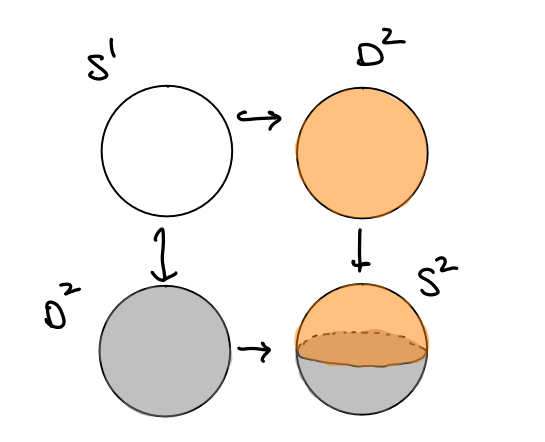
(Sketch)
Let \(\Phi\colon \pi_1(U_1,x_0)*\pi_1(U_2,x_0)\to\pi_1(X,x_0)\) be induced by the inclusions.
\(\Phi\) is surjective: for a loop \(\gamma\) at \(x_0\), a Lebesgue number for the cover \(\ts{\gamma^{-1}(U_1),\gamma^{-1}(U_2)}\) of \(I\) divides \(\gamma\) into paths each lying in \(U_1\) or \(U_2\) with endpoints in \(U_1\intersect U_2\). Joining each endpoint to \(x_0\) by a path in \(U_1\intersect U_2\) and inserting the path and its reverse writes \([\gamma]\) as a product of classes of loops in \(U_1\) or \(U_2\).
The kernel of \(\Phi\) is the normal subgroup generated by \(i_1^*(\omega)\,i_2^*(\omega)^{-1}\) for \(\omega\in\pi_1(U_1\intersect U_2,x_0)\): given a homotopy \(I\times I\to X\) between two products of such loops, subdividing \(I\times I\) into a grid of squares each mapped into \(U_1\) or \(U_2\) shows that the two words differ by these relations.
(An amalgamated product)
Let \(A = \ZZ/4 = \gens{x \suchthat x^4}\), \(B = \ZZ/6 = \gens{y \suchthat y^6}\), and \(Z = \ZZ/2 = \gens{z \suchthat z^2}\), with injections \(\iota_{A}(z) = x^2\) and \(\iota_{B}(z) = y^3\). Then \[ A\ast_{Z} B = \gens{x, y \suchthat x^4, y^6, x^2y^{-3}}. \]
$\pi_1$ of a wedge sum (Tag PR-3APOT)
Let \((X, x_0)\) and \((Y, y_0)\) be path-connected pointed spaces such that \(x_0\) and \(y_0\) are deformation retracts of open neighborhoods in \(X\) and \(Y\) respectively. Then the inclusions induce an isomorphism \[ \pi_1(X)\ast\pi_1(Y)\xrightarrow{\ \sim\ }\pi_1(X \vee Y) \] [@Hat02].
Assume the basepoints \(x_0\in X\) and \(y_0\in Y\) have open neighborhoods \(U\ni x_0\) and \(V\ni y_0\) that deformation retract onto them. Apply van Kampen’s theorem to the open sets \(X\vee V\) and \(U\vee Y\), which deformation retract onto \(X\) and \(Y\) and whose intersection \(U\vee V\) deformation retracts onto the wedge point. Since \(\pi_1(U\vee V)=1\), the amalgamated product is the free product.
Facts
For path-connected \(X\), the Hurewicz map induces an isomorphism \(\pi_1(X)^{\mathrm{ab}}\cong H_1(X)\).
$\pi_1$ of a product (Tag PR-OO3DH)
Let \(X\) and \(Y\) be path-connected spaces. Then the projections induce an isomorphism \[ \pi_1 (X \cross Y) \xrightarrow{\ \sim\ } \pi_1(X) \cross \pi_1(Y) \] [@Hat02].
(Sketch)
A loop in \(X \cross Y\) at \((x_0,y_0)\) is a map \(\gamma\colon I \to X \cross Y\), \(\gamma(t) = (f(t), g(t))\), and \(\gamma\) is continuous in the product topology if and only if the loops \(f\) and \(g\) are continuous.
Likewise a homotopy \(F\colon I^2 \to X \cross Y\) of loops is a pair of homotopies of the component loops.
So \([\gamma] \mapsto ([f], [g])\) is a well-defined bijection \(\pi_1(X\cross Y)\to\pi_1(X)\cross\pi_1(Y)\), and it is a homomorphism because concatenation is computed componentwise.
$\pi_1$ detects simple connectivity (Tag PR-EWJMJ)
Let \(X\) be a path-connected space. Then \(X\) is simply connected if and only if \(\pi_1(X, x_0) = 1\) for some, equivalently every, basepoint \(x_0\in X\) [@Hat02].
For a path-connected space \(X\) with basepoint \(x_0\), \(X\) is simply connected when every loop at \(x_0\) is homotopic rel endpoints to the constant loop, that is, when every element of \(\pi_1(X,x_0)\) equals the identity. By change of basepoint, this does not depend on \(x_0\).
For a finite connected graph \(G\) and a maximal tree \(T\subseteq G\), \[ \pi_1(G)\cong F_n, \qquad n=\abs{E(G)\sm E(T)}=1-\chi(G), \] where \(F_n\) is the free group of rank \(n\) on the edges not in \(T\). Collapsing \(T\) gives a homotopy equivalence \(G\homotopic\bigvee^n S^1\), so \(H_1(G;\ZZ)\cong\ZZ^n\).
General homotopy theory
Whitehead's theorem (Tag T-SDEOY)
Let \(f\colon X\to Y\) be a map of connected CW complexes that induces isomorphisms \(f_*\colon\pi_n(X)\to\pi_n(Y)\) for all \(n\), that is, a weak homotopy equivalence. Then \(f\) is a homotopy equivalence [@Hat02].
(Isomorphic homotopy groups without a weak equivalence)
\(S^2 \cross \RP^3\) and \(S^3 \cross \RP^2\) have universal cover \(S^2\cross S^3\) and fundamental group \(\ZZ/2\), so their homotopy groups are isomorphic in every degree. They are not homotopy equivalent, since by the Künneth theorem \(H_2(S^2 \cross \RP^3)\cong\ZZ\) while \(H_2(S^3 \cross \RP^2)=0\). Whitehead’s theorem concludes that a map \(f\colon X\to Y\) of connected CW complexes is a homotopy equivalence when \(f_*\colon\pi_n(X)\to\pi_n(Y)\) is an isomorphism for every \(n\); no map \(S^2\cross\RP^3\to S^3\cross\RP^2\) induces these isomorphisms.
Hurewicz theorem (Tag T-GL7E6)
Let \(n\geq 2\) and let \(X\) be an \((n-1)\)-connected space. Then \(\tilde H_i(X) = 0\) for \(i < n\), and the Hurewicz map \(\pi_n(X)\to H_n(X)\) is an isomorphism [@Hat02]. For \(n = 1\) and \(X\) path-connected, the Hurewicz map \(\pi_1(X)\to H_1(X)\) induces an isomorphism from the abelianization of \(\pi_1(X)\) onto \(H_1(X)\) [@Hat02].
Cellular approximation theorem (Tag T-I2X3M)
Every map \(f\colon X\to Y\) of CW complexes is homotopic to a cellular map. If \(f\) is already cellular on a subcomplex \(A\subseteq X\), the homotopy may be taken to be stationary on \(A\) [@Hat02].
(Applications of cellular approximation)
\(\pi_k(S^n)=0\) for \(k<n\): with the CW structure \(e^0\union e^n\), a map \(S^k\to S^n\) is homotopic to a cellular map, whose image lies in the \(k\)-skeleton, a point.
For a CW complex \(X\), every element of \(\pi_n(X)\) has a representative with image in the \(n\)-skeleton \(X^{(n)}\), and the inclusion \(X^{(n+1)}\injects X\) induces an isomorphism on \(\pi_n\).
Freudenthal suspension theorem (Tag T-HZUM7)
The suspension map \[ \pi_i(S^n) \to \pi_{i+1}(S^{n+1}) \] is an isomorphism for \(i < 2n-1\) and a surjection for \(i = 2n-1\). More generally, for an \((n-1)\)-connected CW complex \(X\), the suspension map \(\pi_i(X)\to\pi_{i+1}(SX)\) is an isomorphism for \(i < 2n-1\) and a surjection for \(i = 2n-1\) [@Hat02].
In particular, \(\pi_{n+k}(S^n)\) is independent of \(n\) for \(n > k+1\); this common value is the \(k\)th stable homotopy group of spheres.
(Higher homotopy groups)
For \(i\geq 2\), \(\pi_{i}(X)\) is abelian.
If \(X\) is simply connected and \(n\geq 2\) is the least integer with \(H_n(X)\neq 0\), then \(\pi_k(X)=0\) for \(k<n\) and \(\pi_n(X)\cong H_n(X)\).
Homotopy groups of a wedge are not in general the products of the homotopy groups: \(\pi_2(S^1\vee S^2)\cong\ZZ[t,\inverseof{t}]\), the homology \(H_2\) of the universal cover, a line with a sphere attached at each integer, while \(\pi_2(S^1)\times\pi_2(S^2)\cong\ZZ\).
For a covering map \(\hat X \to X\), the induced maps \(\pi_{i}(\hat X) \to \pi_{i}(X)\) are isomorphisms for \(i\geq 2\).
\(\pi_{i}(S^n) = 0\) for \(i < n\), and \(\pi_{n}(S^n) \cong \ZZ\); higher groups need not vanish, for example \(\pi_3(S^2)\cong\ZZ\).
For \(0\leq k<n\), \(S^n / S^k \homotopic S^n \vee \Sigma S^{k}\), and \(\Sigma S^k \cong S^{k+1}\).
For path-connected spaces \(X_\alpha\), the projections induce \(\pi_k\qty{\prod_\alpha X_\alpha}\cong\prod_\alpha\pi_k(X_\alpha)\).
A fibration \(F\to E\to B\) with \(B\) path connected induces a long exact sequence \(\cdots\to\pi_k(F)\to\pi_k(E)\to\pi_k(B)\to\pi_{k-1}(F)\to\cdots\).
For a presentation \(\pi=\gens{S\suchthat R}\), the presentation complex obtained from \(\bigvee_{s\in S}S^1\) by attaching one \(2\)-cell along each relation has fundamental group \(\pi\). It need not be a \(K(\pi,1)\): attaching cells of dimension at least \(3\) to kill its higher homotopy groups produces a \(K(\pi,1)\).