Standard spaces
(Spheres and balls)
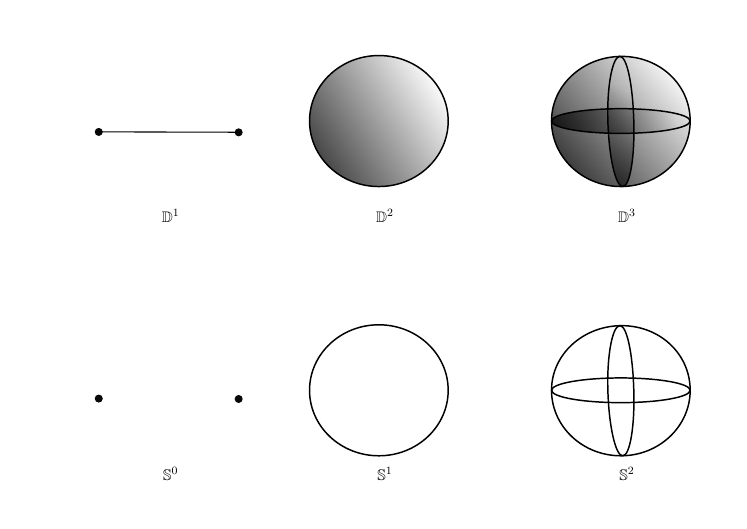
For \(n\geq 0\), \[ \begin{aligned} \DD^n &\coloneqq \ts{ \vector x \in \RR^{n} \st \norm{\vector x} \leq 1}, \\ \SS^n &\coloneqq \ts{ \vector x \in \RR^{n+1} \st \norm{\vector x} = 1} = \bd \DD^{n+1}. \end{aligned} \] Outside this block the blackboard-bold is dropped, and \(D^n\coloneqq\DD^n\), \(S^n\coloneqq\SS^n\).
The sphere \(S^n\) is an \(n\)-manifold, and \[ S^n \cong D^n / \bd D^n \cong D^n \Disjoint_{\bd D^n} D^n, \] the quotient collapsing the boundary to a point and the union of two discs glued by the identity of their boundaries.
(Real projective space)
For \(n\geq 1\), \(\RP^n\) is the quotient of \(S^n\) by the antipodal identification \(\vector x \sim -\vector x\); equivalently, it is the space of lines through \(0\) in \(\RR^{n+1}\). The inclusions \(\RP^n\injects\RP^{n+1}\) define \(\RP^\infty \coloneqq \directlim_{n} \RP^n\). The quotient map \(S^n\to\RP^n\) is a \(2\)-sheeted covering map, a fiber bundle with fiber \(S^0\): \[ S^0 \to S^n \to \RP^n. \]
(Complex projective space)
For \(n\geq 1\), \(\CP^n\) is the quotient of the unit sphere \(S^{2n+1}\subseteq\CC^{n+1}\) by the action of \(S^1\subseteq \CC^\times\) by scalar multiplication, \(\vector z\sim\lambda\vector z\) for \(\abs\lambda=1\); equivalently, it is the space of complex lines through \(0\) in \(\CC^{n+1}\). The inclusions \(\CP^n\injects\CP^{n+1}\) define \(\CP^\infty \coloneqq \directlim_n \CP^n\). The quotient map is a fiber bundle, the Hopf fibration when \(n=1\): \[ S^1 \to S^{2n+1} \to \CP^n. \]
(Tori)
For \(n\geq 1\), the \(n\)-torus is \[ T^n \coloneqq \prod_{j=1}^n S^1. \]
(Grassmannians)
The real Grassmannian \(\Gr(k,\RR^n)\) is the space of \(k\)-dimensional linear subspaces of \(\RR^n\), and \(\Gr(k,\CC^n)\) is the space of complex \(k\)-dimensional subspaces of \(\CC^n\). In particular, \(\RP^{n-1}=\Gr(1,\RR^n)\) and \(\CP^{n-1}=\Gr(1,\CC^n)\).
(Stiefel manifolds)
The real Stiefel manifold \(V_k(\RR^n)\) is the space of ordered orthonormal \(k\)-frames in \(\RR^n\), topologized as a subspace of \((S^{n-1})^k\). \(V_1(\RR^n)=S^{n-1}\) and \(V_n(\RR^n)=O(n)\).
(Matrix groups)
The following are topological groups, with the subspace topology from the space of matrices:
the general linear group \(\GL_n(\RR)\) and the special linear group \(\SL_n(\RR)\);
the orthogonal group \(O(n)\) and the special orthogonal group \(\SO(n)\);
the unitary group \(U(n)\) and the special unitary group \(SU(n)\) of complex unitary matrices of determinant \(1\);
the real symplectic group \(Sp(2n,\RR)\).
(Eilenberg--MacLane spaces)
For a group \(G\) when \(n=1\), or an abelian group \(G\) when \(n\geq2\), an Eilenberg--MacLane space \(K(G,n)\) is a path-connected space with \[ \pi_{k}(K(G, n)) \cong \begin{cases} G & k=n, \\ 0 & k\neq n. \end{cases} \] Such a space exists as a CW complex, and any two CW complexes of type \(K(G,n)\) are homotopy equivalent.
\(S^1\) is a \(K(\ZZ, 1)\).
\(\CP^\infty\) is a \(K(\ZZ, 2)\).
\(\RP^\infty\) is a \(K(\ZZ/2, 1)\).
(Moore spaces)
For an abelian group \(G\) and \(n\geq 1\), a Moore space \(M(G,n)\) is a CW complex with \[ \tilde H_{k}(M(G,n);\ZZ) \cong \begin{cases} G & k=n, \\ 0 & k\neq n, \end{cases} \] simply connected when \(n\geq 2\). For \(n\geq 2\) it is unique up to homotopy equivalence.
\(S^n\) is an \(M(\ZZ, n)\).
\(\RP^2\) is an \(M(\ZZ/2, 1)\).
For \(p\geq 2\), attaching an \((n+1)\)-cell to \(S^n\) by a map of degree \(p\) gives an \(M(\ZZ/p,n)\).
(Low-dimensional identifications)
The Möbius band \(\MM\) deformation retracts onto its core circle, so \(\MM \homotopic S^1\).
As a set, \(\CP^n = \CC^n \Disjoint \CP^{n-1} = \coprod_{i=0}^n \CC^i\), which gives a CW structure with one cell in each even dimension \(0,2,\ldots,2n\).
For \(0\leq k<n\) and the standard inclusion \(S^k\subseteq S^n\), \(S^n / S^k \homotopic S^n \vee S^{k+1}\).
(Exceptional homeomorphisms)
\(\RP^1 \cong S^1\), \(\CP^1 \cong S^2\), and \(\SO(3) \cong \RP^3\).
Deleting points
(Punctured spaces)
For a space \(X\) and \(k\geq 1\) distinct points \(x_1,\ldots,x_k\in X\), write \(D(k, X)\coloneqq X \sm \theset{x_{1}, \ldots, x_{k}}\). For \(n\geq 2\), \[ \begin{aligned} D(k,\RR^n) &\homotopic \bigvee_{i=1}^k S^{n-1}, \\ D(k,S^n) &\homotopic \bigvee_{i=1}^{k-1} S^{n-1}, \\ D(k,T^2) &\homotopic \bigvee_{i=1}^{k+1} S^{1}, \end{aligned} \] where an empty wedge is a point. The second follows from the first because \(D(1,S^n)\cong\RR^n\) by stereographic projection.
Low-dimensional homology
(Integral homology $H_0, H_1, H_2, H_3, H_4$)
| \(X\) | \(H_0\) | \(H_1\) | \(H_2\) | \(H_3\) | \(H_4\) |
|---|---|---|---|---|---|
| \(S^1\), \(\MM\), \(\RP^1\) | \(\ZZ\) | \(\ZZ\) | \(0\) | \(0\) | \(0\) |
| \(\RP^2\) | \(\ZZ\) | \(\ZZ/2\) | \(0\) | \(0\) | \(0\) |
| \(\RP^3\) | \(\ZZ\) | \(\ZZ/2\) | \(0\) | \(\ZZ\) | \(0\) |
| \(\RP^4\) | \(\ZZ\) | \(\ZZ/2\) | \(0\) | \(\ZZ/2\) | \(0\) |
| \(S^2\), \(\CP^1\) | \(\ZZ\) | \(0\) | \(\ZZ\) | \(0\) | \(0\) |
| \(T^2\) | \(\ZZ\) | \(\ZZ^2\) | \(\ZZ\) | \(0\) | \(0\) |
| Klein bottle \(K\) | \(\ZZ\) | \(\ZZ \oplus \ZZ/2\) | \(0\) | \(0\) | \(0\) |
| \(\CP^2\) | \(\ZZ\) | \(0\) | \(\ZZ\) | \(0\) | \(\ZZ\) |
Homotopy, homology, and cell structures
(Invariants of standard spaces)
In the cell column, \(c_0 + c_1 x + c_2 x^2 + \cdots\) records a CW structure with \(c_i\) cells of dimension \(i\); for a space listed up to homotopy equivalence it records a CW complex of that homotopy type. \(F_m\) is the free group of rank \(m\), and in the cohomology column \(\abs{x}\) is the degree of a generator.
| \(X\) | \(\pi_1\) | \(H_*\) | Cells | \(H^*(X;\ZZ)\) |
|---|---|---|---|---|
| \(\RR^n\), \(D^n\) | \(1\) | \(\ZZ\) in degree \(0\) | \(1\) | \(\ZZ\) |
| \(D(k,\RR^n)\), \(n\geq 2\) | \(F_k\) if \(n=2\); \(1\) if \(n\geq 3\) | \(\ZZ\) in degree \(0\), \(\ZZ^k\) in degree \(n-1\) | \(1+kx^{n-1}\) | \(\ZZ\) in degree \(0\), \(\ZZ^k\) in degree \(n-1\), zero products |
| \(S^n\), \(n\geq 1\) | \(\ZZ\) if \(n=1\); \(1\) if \(n\geq 2\) | \(\ZZ\) in degrees \(0,n\) | \(1+x^n\) | \(\ZZ[x]/(x^2)\), \(\abs x=n\) |
| \(D(k,S^n)\), \(n\geq 2\) | \(F_{k-1}\) if \(n=2\); \(1\) if \(n\geq 3\) | \(\ZZ\) in degree \(0\), \(\ZZ^{k-1}\) in degree \(n-1\) | \(1+(k-1)x^{n-1}\) | \(\ZZ\) in degree \(0\), \(\ZZ^{k-1}\) in degree \(n-1\), zero products |
| \(T^n\) | \(\ZZ^n\) | \(\ZZ^{\binom nk}\) in degree \(k\) | \((1+x)^n\) | exterior algebra on \(x_1,\ldots,x_n\), \(\abs{x_i}=1\) |
| \(D(k,T^2)\) | \(F_{k+1}\) | \(\ZZ\), \(\ZZ^{k+1}\) | \(1+(k+1)x\) | \(\ZZ\), \(\ZZ^{k+1}\), zero products |
| \(\bigvee^n S^1\) | \(F_n\) | \(\ZZ\), \(\ZZ^n\) | \(1+nx\) | \(\ZZ\), \(\ZZ^n\), zero products |
| \(\RP^n\), \(n\geq 2\) even | \(\ZZ/2\) | \(\ZZ\) in degree \(0\), \(\ZZ/2\) in odd degrees \(<n\) | \(1+x+\cdots+x^n\) | \(\ZZ\) in degree \(0\), \(\ZZ/2\) in even degrees \(2,\ldots,n\) |
| \(\RP^n\), \(n\geq 3\) odd | \(\ZZ/2\) | \(\ZZ\) in degrees \(0,n\), \(\ZZ/2\) in odd degrees \(<n\) | \(1+x+\cdots+x^n\) | \(\ZZ\) in degrees \(0,n\), \(\ZZ/2\) in even degrees \(2,\ldots,n-1\) |
| \(\CP^n\) | \(1\) | \(\ZZ\) in degrees \(0,2,\ldots,2n\) | \(1+x^2+\cdots+x^{2n}\) | \(\ZZ[x]/(x^{n+1})\), \(\abs x=2\) |
| Möbius band | \(\ZZ\) | \(\ZZ\), \(\ZZ\) | \(1+x\) | \(\ZZ[x]/(x^2)\), \(\abs x=1\) |
| Klein bottle | \(\gens{a,b \st aba\inverseof{b}}\) | \(\ZZ\), \(\ZZ\oplus\ZZ/2\) | \(1+2x+x^2\) | \(\ZZ\), \(\ZZ\), \(\ZZ/2\) |
With \(\ZZ/2\) coefficients, \(H^*(\RP^n;\ZZ/2)\cong\FF_2[a]/(a^{n+1})\) with \(\abs a=1\).
(Higher homotopy groups)
A covering map induces isomorphisms on \(\pi_k\) for \(k\geq 2\), so \(\pi_k(\RP^n)\cong\pi_k(S^n)\) for \(k\geq 2\).
\(T^n\), the Klein bottle, and \(\bigvee^n S^1\) have contractible universal covers (\(\RR^n\), \(\RR^2\), and a tree), so their \(\pi_k\) vanish for \(k\geq 2\).
The long exact sequence of the fibration \(S^1\to S^{2n+1}\to\CP^n\) gives \(\pi_2(\CP^n)\cong\ZZ\) and \(\pi_k(\CP^n)\cong\pi_k(S^{2n+1})\) for \(k\geq 3\).
\(\RR^n\) and \(D^n\) are contractible, so all their homotopy groups vanish.