A real integral is evaluated by residues after it is written as a limit of integrals over closed curves.
The estimates for the added pieces are on Arc estimates, and residue computations are on Computing residues.
Integrals that need no residues
If \(f\) is holomorphic on a neighborhood of the closed region bounded by \(\gamma\), then \(\int_\gamma f = 0\) by Cauchy’s theorem.
If \(f\) has a primitive \(F\) on a neighborhood of \(\gamma\), then \(\int_\gamma f = F(\gamma(1)) - F(\gamma(0))\), which is \(0\) for a closed curve.
If \(f(z) = g(z)/(z-a)^n\) with \(g\) holomorphic inside and on a positively oriented simple closed curve \(\gamma\) around \(a\), the Cauchy integral formula gives \(\int_\gamma {g(z) \over (z-a)^{n}} \dz = {2\pi i \over (n-1)!} g^{(n-1)}(a)\).
For a parameterized curve \(z\colon[a,b]\to\CC\), \(\int_\gamma f \dz = \int_a^b f(z(t)) z'(t) \dt\); a circle about \(z_0\) is \(z = z_0 + re^{i\theta}\).
Rational, decaying at least quadratically
Integrand. \(\displaystyle\int_\RR f\) with \(f = p/q\) rational, \(q\) without real zeros, and \(\deg q \geq \deg p + 2\); more generally \(f = \bigo(1/\abs z^{1+\varepsilon})\) on the upper half plane.
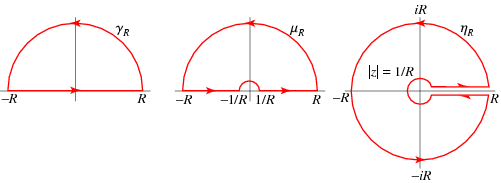
Contour. The segment \([-R, R]\) followed by the upper semicircle \(C_R = \ts{Re^{it} \st t \in [0,\pi]}\).
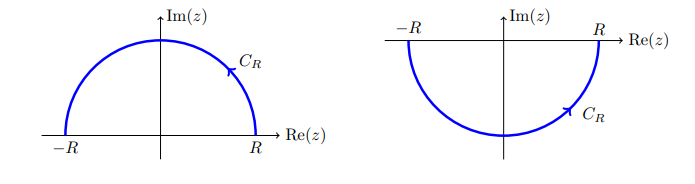
Arc estimate. The ML estimate: \(\abs{f} = \bigo(1/R^{2})\) on \(C_R\) and \(\length(C_R) = \pi R\), so the arc integral is \(\bigo(1/R)\).
Result. \[ \int_\RR f = 2\pi i \sum_{z_0 \in \HH} \Res_{z=z_0} f(z) .\]
The sum is over poles in the open upper half plane. Closing in the lower half plane gives a clockwise contour and \(\int_\RR f = -2\pi i \sum_{\Im z_0<0} \Res_{z=z_0} f(z)\).
Rational against a sine or cosine
Integrand. \(\displaystyle\int_\RR f(x)\cos(ax) \dx\) or \(\displaystyle\int_\RR f(x)\sin(ax)\dx\) with \(a>0\), \(f = p/q\) real rational, \(q\) without real zeros, and \(\deg q \geq \deg p + 1\).
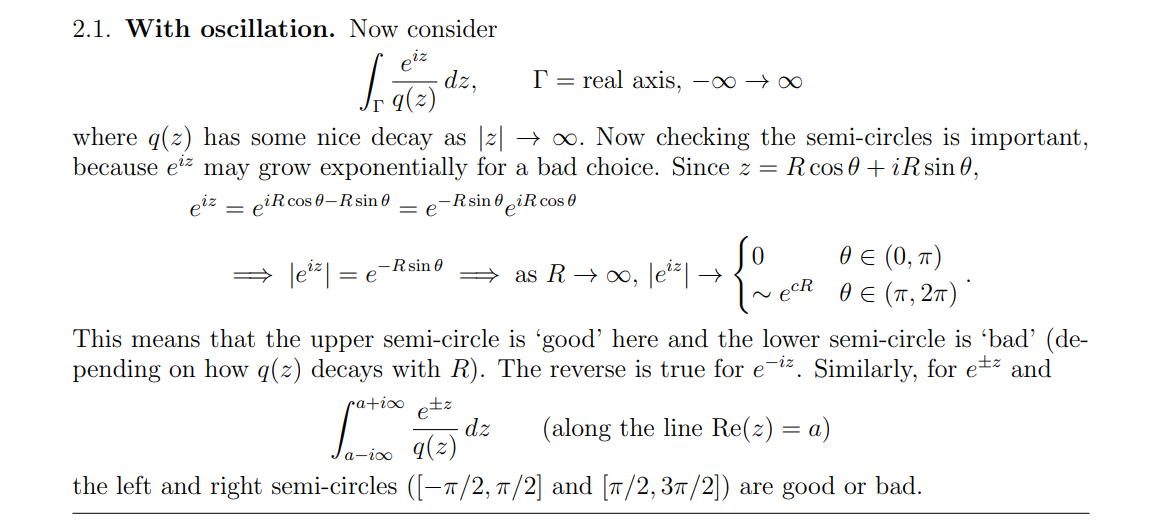
Contour. The same semicircle, applied to \(f(z)e^{iaz}\), with \[ \int_\RR f(x)\cos(ax) \dx = \Re \int_\RR f(x)e^{iax}\dx, \qquad \int_\RR f(x)\sin(ax) \dx = \Im \int_\RR f(x)e^{iax}\dx ,\] the integrals over \(\RR\) taken as limits of integrals over \([-R,R]\).
Arc estimate. Jordan’s lemma: \(\abs{e^{iaz}} = e^{-a\Im z} \leq 1\) on the upper half plane, and \(\abs{\int_{C_R} e^{iaz} f(z)\dz} \leq \pi M_R/a\) with \(M_R = \sup_{C_R}\abs f = \bigo(1/R)\). The functions \(\cos(az)\) and \(\sin(az)\) grow like \(e^{aR}/2\) on \(C_R\), which is why the integrand is rewritten with \(e^{iaz}\).
For \(e^{-iax}\) with \(a>0\), the lower semicircle is used instead.
Rational in \(\cos\) and \(\sin\), over one period
Integrand. \(\displaystyle\int_0^{2\pi} R(\cos\theta, \sin\theta) \dtheta\) with \(R\) a rational function of two variables, finite on the unit circle.
Contour. The unit circle, by the substitution \(z = e^{i\theta}\): \[ \cos\theta = {z + \inverseof{z} \over 2}, \quad \sin\theta = {z - \inverseof{z} \over 2i}, \quad \dtheta = {\dz \over iz} .\] No pieces are added; the substitution writes the integral over \([0,2\pi]\) as an integral over \(S^1\).
Result. \[ \int_0^{2\pi} R(\cos\theta,\sin\theta) \dtheta = 2\pi i \sum_{\abs{z_0} < 1} \Res_{z=z_0} R\qty{ {z+\inverseof{z} \over 2}, {z - \inverseof{z} \over 2i} } {1 \over iz} .\]
The factor \(1/iz\) can contribute a pole at \(z = 0\).
A branch cut: a power \(x^\alpha\)
Integrand. \(\displaystyle\int_0^\infty x^\alpha f(x)\dx\) with \(f\) rational, without poles on \([0,\infty)\), \(\deg f \leq -2\), and \(\alpha\in(-1,1)\) nonintegral.
Contour. The keyhole around the cut along \([0,\infty)\), with the branch \(\arg z \in (0, 2\pi)\) of \(z^\alpha\).
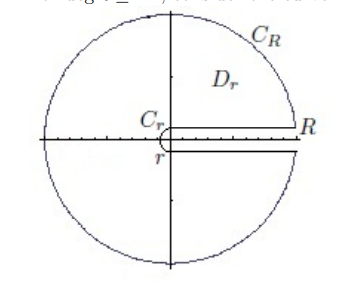
Estimates. The large circle of radius \(R\) contributes \(\bigo(R^{\alpha-1})\to 0\) by the ML estimate, and the small circle of radius \(\varepsilon\) contributes \(\bigo(\varepsilon^{1+\alpha}) \to 0\) because \(\alpha > -1\).
Result. Above the cut the integrand is \(x^\alpha f(x)\); below it \(\arg z = 2\pi\), so the integrand is \(e^{2\pi i \alpha}x^\alpha f(x)\) and the edge is traversed from \(\infty\) to \(0\). Hence \[ \qty{1 - e^{2\pi i \alpha}} \int_0^\infty x^\alpha f(x) \dx = 2\pi i \sum \Res\qty{z^\alpha f(z)} ,\] the sum over all poles of \(f\).
A branch cut: a logarithm
Integrand. \(\displaystyle\int_0^\infty f(x)\log(x)\dx\), or \(\displaystyle\int_0^\infty f(x)\dx\) for \(f\) even computed through \(\int f(z)\log z\dz\).
Contour. An indented semicircle, or the keyhole.
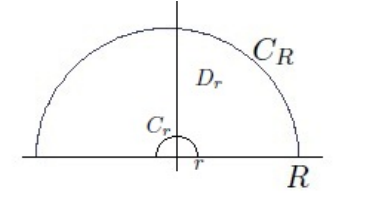
Limits used in the estimates. With the branch \(\arg z\in(0,2\pi)\), for \(x>0\), and for \(n\geq 1\) and \(c\neq 0\), \[ \lim_{\varepsilon \decreasesto 0} \log(x - i\varepsilon) = \ln(x) + 2\pi i, \qquad \lim_{x\to 0} {x\ln(x) \over x^n + c} = 0 .\]
Rotated rays. For \(\zeta = e^{i\theta}\) and \(g\) with \(g(\zeta x) = g(x)\) for \(x>0\), the integral of \(\log(z)g(z)\) along the ray \(z = \zeta x\) is \[ \zeta\int_0^\infty \log(\zeta x)g(\zeta x) \dx = \zeta\int_0^\infty \ln(x)g(x)\dx + i\theta\,\zeta\int_0^\infty g(x)\dx ,\] so a contour made of \([0,\infty)\) and this ray gives a linear relation involving \(\int_0^\infty \ln(x)g(x)\dx\) and \(\int_0^\infty g(x)\dx\).
A pole on the real line
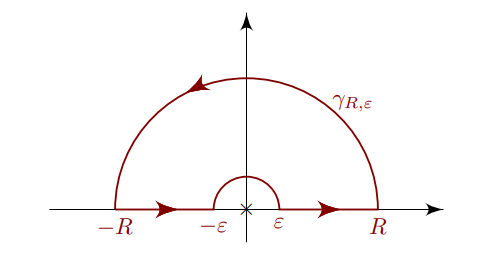
Integrand. \(\displaystyle\int_\RR f\) where \(f\) has simple poles on \(\RR\). The integral diverges, and the principal value is \[ \operatorname{PV} \int_{-\infty}^{\infty} f(x) \dx = \lim_{R\to\infty}\lim_{\varepsilon \decreasesto 0}\qty{\int_{-R}^{x_{0}-\varepsilon} f + \int_{x_{0}+\varepsilon}^{R} f} \] for a single pole \(x_0\), and analogously for several.
Contour. The semicircle, indented by a small half-circle above each real pole.
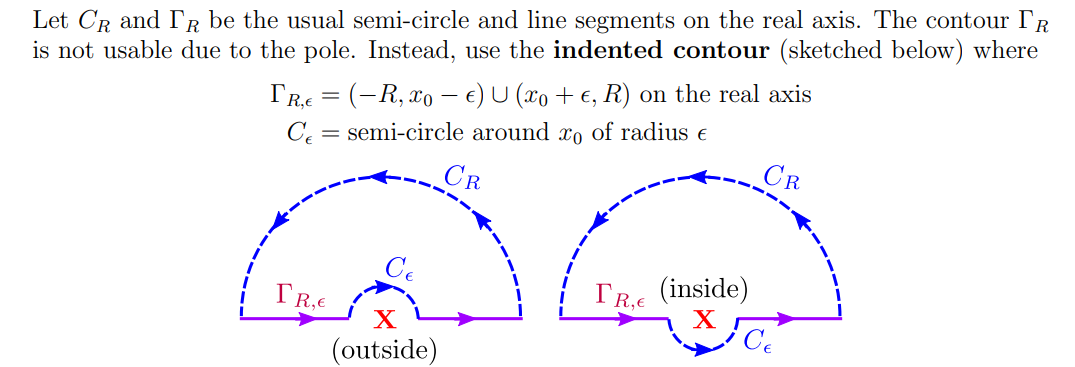
Estimates. The integral over the large arc tends to \(0\) by the ML estimate when \(f = \bigo(1/\abs z^{1+\varepsilon})\) on the upper half plane, and by Jordan’s lemma when \(f(z) = g(z)e^{iaz}\) with \(a>0\) and \(g = \bigo(1/\abs z)\). By Fractional residue theorem for a simple pole, an arc of angle \(\theta\) about a simple pole contributes \(i\theta \Res\) in the limit, so each clockwise half-circle contributes \(-i\pi\Res\).
Result. \[ \operatorname{PV} \int_\RR f = 2\pi i \sum_{z_0 \in \HH} \Res_{z=z_0} f + i\pi \sum_{x_0 \in \RR} \Res_{z=x_0} f .\]
Symmetry under rotation or translation: sectors and rectangles
Integrand. A function whose values on a rotated ray or a translated line are a constant multiple of its values on the real axis.
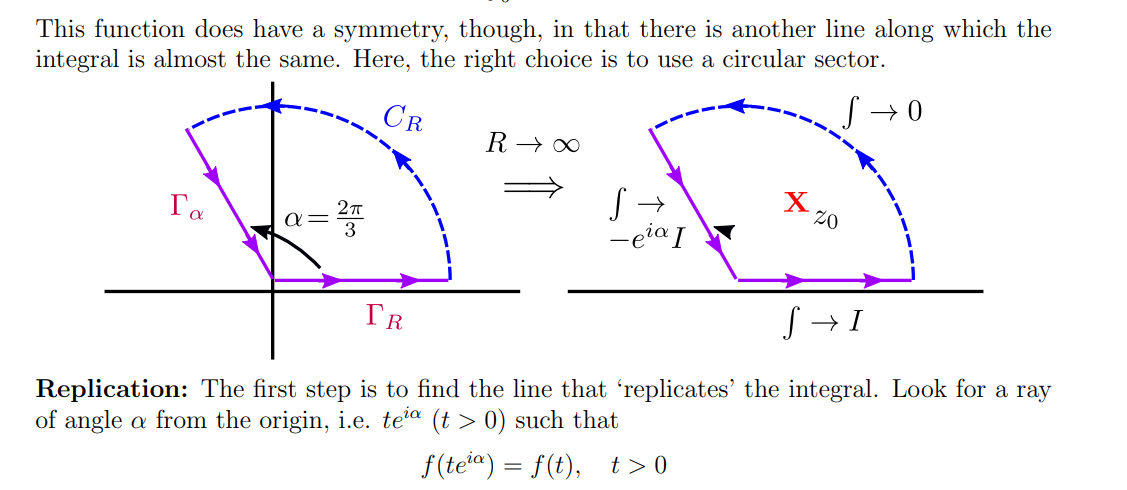
If \(f(\zeta z) = f(z)\) for \(\zeta = e^{2\pi i/m}\), use the sector \(\ts{0\leq\arg z\leq 2\pi/m,\ \abs z\leq R}\). If the arc integral tends to \(0\), the ray \(z = \zeta x\), traversed toward \(0\), contributes \(-\zeta\int_0^\infty f\), so \((1 - \zeta)\int_0^\infty f\) is \(2\pi i\) times the sum of the residues in the sector. For \(f(x) = 1/(1+x^n)\) and \(\zeta = e^{2\pi i/n}\) this gives \(\int_0^\infty {\dx \over 1 + x^n} = {\pi/n \over \sin(\pi/n)}\).
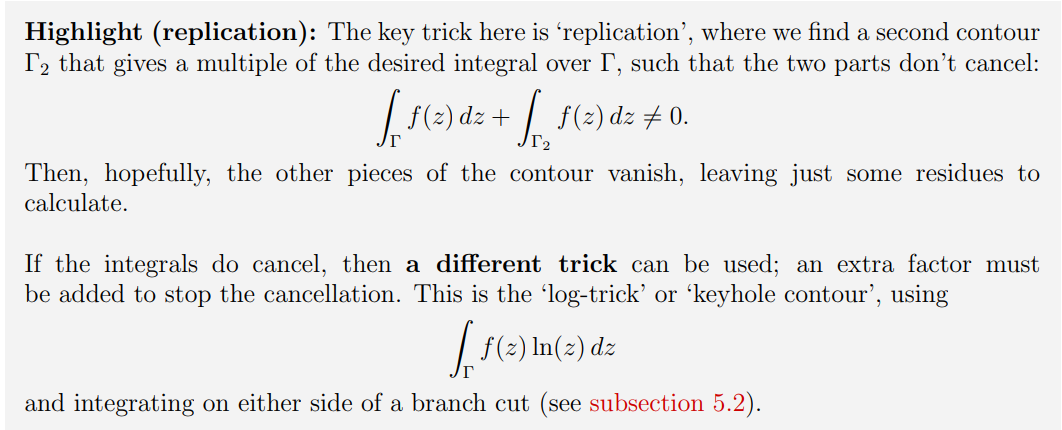
If \(f(z + ib) = cf(z)\) for real \(b\) and constant \(c\), use the rectangle with vertices \(\pm R\) and \(\pm R + ib\). If the vertical edges contribute integrals tending to \(0\), the top edge contributes \(-c\int_\RR f\), so \((1-c)\int_\RR f\) is \(2\pi i\) times the sum of the residues in the strip \(0<\Im z<b\).
A half-line, by symmetry
For \(f\) even, \(\int_0^\infty f = \frac12 \int_\RR f\), and a contour for \(\int_\RR f\) applies. For \(f\) not even with \(f(\zeta z) = f(z)\) for a root of unity \(\zeta\), the sector with edge \(\zeta[0,\infty)\) applies.
The standard contours
Bounding denominators
The reverse triangle inequality bounds a denominator from below: for \(\abs z\neq\abs w\), \[ \abs{z-w} \geq \abs{\abs{z} - \abs{w}} \implies {1\over \abs{z-w}} \leq {1 \over \abs{\abs z - \abs w}} ,\] and the same bound holds for \(\abs{z+w} = \abs{z - (-w)}\).