By Goursat’s theorem, a holomorphic function has vanishing integrals over triangles. Morera’s theorem is the converse for continuous functions, and it shows that locally uniform limits and series of holomorphic functions are holomorphic.
Morera’s theorem
Morera's theorem (Tag T-LHSMY)
Let \(\Omega\subseteq\CC\) be open and let \(f\colon\Omega\to\CC\) be continuous. If \(\int_{\partial T}f(z)\dz=0\) for every closed triangle \(T\subseteq\Omega\), then \(f\) is holomorphic on \(\Omega\).
Morera's theorem (Tag FT-B73T5)
Let \(D\subseteq\CC\) be an open disc and let \(f\colon D\to\CC\) be continuous. If \(\int_{\bd T} f(z)\dz = 0\) for every closed triangle \(T\subset D\), then \(f\) is holomorphic on \(D\).
A continuous function whose integral over every triangle vanishes is holomorphic.
Holomorphy is local, so let \(D\subseteq\Omega\) be an open disc with center \(z_0\). For \(z\in D\) define \(F(z) \coloneqq \int_{[z_0, z]} f(\xi) \dxi\), the integral along the segment from \(z_0\) to \(z\). For \(z, z+h\in D\), the triangle with vertices \(z_0, z, z+h\) lies in \(D\), so the hypothesis gives \[ \frac{F(z+h) - F(z)}{h} - f(z) = \frac1h\int_{[z, z+h]} \qty{f(\xi) - f(z)} \dxi .\] The right side has modulus at most \(\sup_{\xi\in[z,z+h]}\abs{f(\xi)-f(z)}\), which tends to \(0\) as \(h\to 0\) by continuity of \(f\). So \(F\) is holomorphic on \(D\) with \(F' = f\), and \(f\) is holomorphic because derivatives of holomorphic functions are holomorphic.
(Rectangles)
The conclusion also holds for continuous \(f\) whose integrals over the boundaries of all closed rectangles in \(\Omega\) with sides parallel to the axes vanish. The proof is the same, with the segment \([z_0, z]\) replaced by a horizontal segment followed by a vertical one.
Locally uniform limits
Locally uniform limits of holomorphic functions are holomorphic (Tag C-TODSQ)
Let \(\Omega\subseteq\CC\) be open, and let \((f_n)_{n\in\NN}\) be holomorphic functions on \(\Omega\) that converge to \(f\) uniformly on every compact subset of \(\Omega\). Then \(f\) is holomorphic on \(\Omega\), and \(f_n'\to f'\) uniformly on every compact subset of \(\Omega\).
Let \(D\) be an open disc with \(\overline D\subseteq\Omega\). Each \(f_n\) is continuous and \(f_n\to f\) uniformly on \(\overline D\), so \(f\) is continuous on \(D\). For a triangle \(T\subseteq D\), Goursat’s theorem gives \(\int_{\bd T} f_n = 0\), and uniform convergence on \(\bd T\) gives \(\int_{\bd T} f = \lim_n \int_{\bd T} f_n = 0\). By Morera’s theorem \(f\) is holomorphic on \(D\), hence on \(\Omega\).
For the derivatives, let \(K\subseteq\Omega\) be compact and choose \(r>0\) such that \(K_r \coloneqq \ts{z : \operatorname{dist}(z, K)\leq r}\subseteq\Omega\); \(K_r\) is compact. For \(z\in K\), Cauchy’s estimate on the circle \(\abs{\xi - z} = r\) gives \(\abs{f_n'(z) - f'(z)} \leq \sup_{K_r}\abs{f_n - f}/r\), which tends to \(0\) uniformly in \(z\in K\).
Applied to partial sums, the holomorphy of locally uniform limits shows that a series \(\sum_k f_k\) of holomorphic functions converging uniformly on compact subsets of \(\Omega\) is holomorphic and can be differentiated term by term.
Goursat
Goursat’s theorem proves Cauchy’s theorem for triangles and rectangles with no continuity assumption on \(f'\).
Goursat's theorem (Tag T-B3BDO)
Let \(\Omega\subseteq\CC\) be open, let \(f\) be holomorphic on \(\Omega\), and let \(T\subseteq\Omega\) be a closed triangle whose interior is also contained in \(\Omega\). Then the integral of \(f\) over the boundary of \(T\) vanishes: \[ \int_{\bd T}f(z)\dz=0. \]
This is [@SS03]. The hypothesis is complex differentiability of \(f\) at every point of \(\Omega\); continuity of \(f'\) is not assumed, and the proof proceeds by repeated subdivision of \(T\) into four similar triangles. Goursat’s theorem gives primitives of holomorphic functions on discs, and from these follow Cauchy’s theorem for toy contours, the Cauchy integral formula, and the power series expansion of holomorphic functions.
(from Gamelin)
The argument is written for a rectangle; for a triangle, the midpoints of the sides divide it into four triangles, each with half the perimeter, and the same estimates hold.
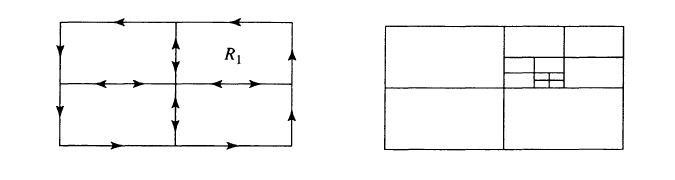
Let \(R\) be a closed rectangle contained, with its interior, in \(\Omega\), subdivided into four equal subrectangles. The integral around \(\partial R\) is the sum of the integrals around the four, so at least one, call it \(R_1\), satisfies \[ \left|\int_{\partial R_{1}} f(z) \dz \right| \geq \frac{1}{4}\left|\int_{\partial R} f(z) \dz \right| .\] Subdividing repeatedly yields nested \(\ts{R_n}\) with \[ \left|\int_{\partial R_{n}} f(z) \dz\right| \geq \frac{1}{4}\left|\int_{\partial R_{n-1}} f(z) \dz \right| \geq \cdots \geq \frac{1}{4^{n}}\left|\int_{\partial R} f(z) \dz\right| .\] The \(R_n\) decrease with diameters tending to zero, so their intersection is a single point \(z_0 \in R\). Differentiability at \(z_0\) gives \[ \left|\frac{f(z)-f\left(z_{0}\right)}{z-z_{0}}-f^{\prime}\left(z_{0}\right)\right| \leq \varepsilon_{n}, \quad z \in R_{n} ,\] with \(\varepsilon_n \to 0\). Writing \(L\) for the length of \(\partial R\), the length of \(\partial R_n\) is \(L/2^n\), and for \(z \in R_n\), \[ \left|f(z)-f\left(z_{0}\right)-f^{\prime}\left(z_{0}\right)\left(z-z_{0}\right)\right| \leq \varepsilon_{n}\left|z-z_{0}\right| \leq 2 \varepsilon_{n} L / 2^{n} .\] Since \(f(z_0)+f'(z_0)(z-z_0)\) has a primitive, its integral over the closed curve \(\partial R_n\) vanishes, and the ML estimate gives \[ \begin{aligned} \left|\int_{\partial R_{n}} f(z) \dz\right| &=\left|\int_{\partial R_{n}}\left[f(z)-f\left(z_{0}\right)-f^{\prime}\left(z_{0}\right)\left(z-z_{0}\right)\right] \dz\right| \\ & \leq\left(2 \varepsilon_{n} L / 2^{n}\right) \cdot\left(L / 2^{n}\right)=2 L^{2} \varepsilon_{n} / 4^{n} \end{aligned},\] hence \[ \left|\int_{\partial R} f(z) \dz\right| \leq 4^{n}\left|\int_{\partial R_{n}} f(z) \dz\right| \leq 2 L^{2} \varepsilon_{n} .\] Since \(\varepsilon_n \to 0\), the integral over \(\partial R\) vanishes.
Exercises
Bounded holomorphic functions form a Banach space (Tag E-WIANB)
For \(\Omega\subseteq\CC\), show that \(A(\CC)\definedas \theset{f: \Omega \to \CC \st f\text{ is holomorphic, bounded}}\) is a Banach space.
Hint: Apply Morera’s Theorem and Cauchy’s Theorem
Solution
Interpreting the displayed space as \[ A(\Omega)=\{f:\Omega\to\mathbb C:f\text{ is holomorphic and bounded}\} \] with the supremum norm \(\|f\|_\infty=\sup_{z\in\Omega}|f(z)|\), let \((f_n)\) be Cauchy in \(\|\cdot\|_\infty\). Then for every \(z\in\Omega\) the sequence \((f_n(z))\) is Cauchy in \(\mathbb C\), so define \[ f(z)=\lim_{n\to\infty}f_n(z). \] The Cauchy property in supremum norm shows that \(f_n\to f\) uniformly on all of \(\Omega\): given \(\varepsilon>0\), choose \(N\) such that \(\|f_n-f_m\|_\infty<\varepsilon\) for \(m,n\ge N\) and let \(m\to\infty\).
The limit \(f\) is bounded, since for fixed \(N\), \[ \|f\|_\infty\le \|f-f_N\|_\infty+\|f_N\|_\infty<\infty. \] It is holomorphic because uniform convergence on \(\Omega\) implies uniform convergence on every compact subset, and locally uniform limits of holomorphic functions are holomorphic (equivalently, apply Morera’s theorem on triangles compactly contained in \(\Omega\)). Hence \(f\in A(\Omega)\) and \(\|f_n-f\|_\infty\to0\). Therefore \(A(\Omega)\) is complete.